
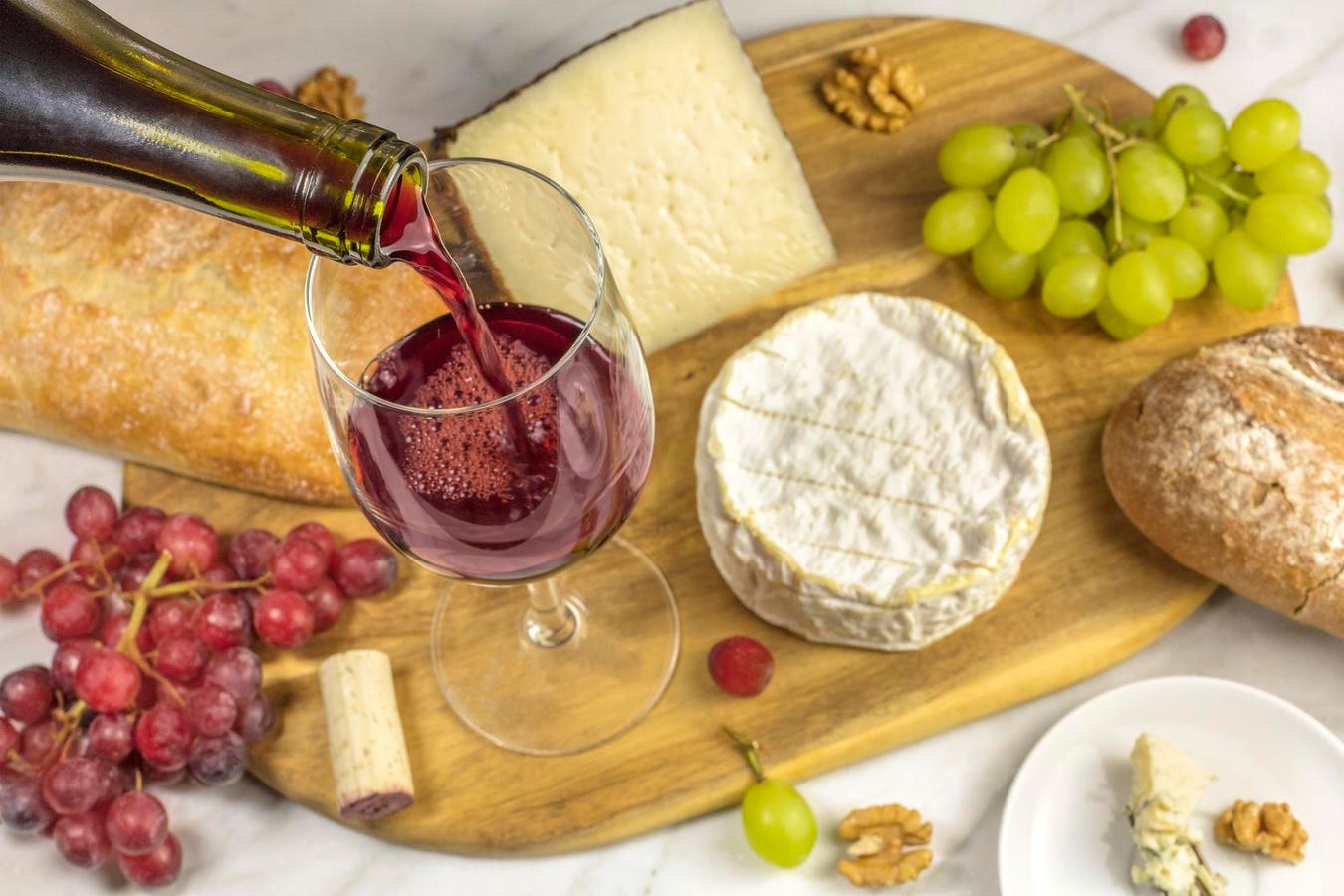
Red wine poured into a glass at a tasting, with various types of cheeses, bread, and grapes. Selective focus
getty
If you want to understand how the French actually pair cheese and drinks, stop thinking like a sommelier and start thinking like a map.
In France, cheese is often not paired by grape variety, tannin charts, or rules about soft versus hard. Instead, it’s paired by proximity. What grows near the cheese is what gets poured with it. The result feels less like a rulebook and more like common sense shaped by centuries of farming.
Here’s how to drink with cheese the French way. Follow the region.
Normandy: apples, cream, and cider
Étretat Coast Normandy, aerial view towards the beach and famous Chalk Cliffs of Etretat – Falaises d’Étretat with Failaise d’Aval and the L’Aiguille (the Needle) and Porte d’Aval Natural Arch at the Normandy Alabaster Coast under sunny sky. Drone Point of View. Porte d’Aval , Étretat, Seine-Maritime, Le Havre, Normandy, France, Europe
getty
In Normandy, cows outnumber grapevines. Apples, not grapes, define the landscape.
The cheeses here are rich and creamy, often washed rind: Camembert de Normandie, Pont-l’Évêque, and Livarot.
ForbesA No-Stress Guide To The World Of French WineBy Emily Price
What cuts through all that cream is not Chardonnay. It’s cider.
A dry Norman cider has the acidity, bubbles, and gentle bitterness to slice through the fat while matching the orchard landscape the cheese comes from.
Loire Valley: goat cheese and crisp whites
Vineyard in Chinon – the Loire Valley, France
getty
The Loire Valley is goat country.
This is where you find Crottin de Chavignol and Valençay, cheeses that are tangy, chalky, herbal, and bright when young, turning nuttier as they age.
Right next door in the vineyards are Sancerre and Pouilly-Fumé.
The wines mirror the cheese. High acid, citrus, green herbs, minerality. It feels like a conversation between two things shaped by the same soil.
Burgundy: washed rinds and structured whites
Burgundy is a historical region in east-central France. It’s famous for its Burgundy wines as well as pinot noirs and Chardonnay, Chablis and Beaujolais.
getty
In Burgundy, the cheeses are bold and the wines are precise.
The well known Époisses is washed in marc de Bourgogne and can be very soft at peak ripeness. Then there’s Comté, nutty, firm, and aged for months or years.
The instinct might be to reach for red Burgundy. Locals often pour Chablis or other white Burgundy instead.
The saline, high acid Chardonnay cuts through funk and fat while the wine’s texture matches the cheese’s depth.
Alsace: pungent cheese and aromatic whites
beautiful landscape in Alsace in east France
getty
On the German border in Alsace, the cheese gets assertive.
Munster is famously pungent and aromatic.
Enter Gewürztraminer and Riesling.
These wines are intensely aromatic, sometimes slightly sweet, and packed with spice and floral notes. That intensity stands up to Munster, while the acidity keeps everything lively.
Alps and Jura: mountain cheese and oxidative whites
Château-Chalon is a French winemaker’s town located in the Jura Department, in the historical region of Franche Comté. High place of Jura tourism, the town is classified among the most beautiful villages in France, labeled city of character of Bourgogne-Franche-Comté, and the site of the village and its surroundings is classified wine landscape. Its vineyard produces the most famous yellow wines of the Jura vineyard under the Château-Chalon (AOC) appellation, a reference product in Franche-Comté gastronomy.
getty
In the Jura and the French Alps, cheese is built for cold weather.
Think Beaufort, Abondance, and long aged Comté. These cheeses are dense, savory, and nutty.
The local wine, Vin Jaune, is oxidative, nutty, and savory as well, aged under a veil of yeast.
The walnut and salt notes in Vin Jaune echo the aged mountain cheeses in a very natural way.
Southwest France: sheep’s milk cheese and rustic reds
Mountain Vignemale in the national park Pyrenees. Occitanie in south of France.
getty
In the Pyrenees and Southwest France, sheep rule.
Ossau-Iraty is firm, buttery, and slightly sweet, often served with black cherry jam.
ForbesThese Lesser-Known Rhône Whites Are Some Of The Best Food Wines In FranceBy Emily Price
The local wines from Madiran, made largely from Tannat, are dark and structured.
Here, red wine makes sense. The fat and sweetness of the sheep’s milk cheese soften the tannins, while the wine’s structure keeps the pairing balanced.
The real lesson: pair by place
Cheese platter with craft cheese assortment and wine glasses at white tile background. Top view.
getty
The French do not usually ask what wine goes with a specific cheese. They ask where the cheese is from.
If it is from apple country, drink cider.
If it is from goat country, drink sharp white wine.
If it is from the mountains, drink nutty, oxidative wine.
If it is from sheep country, drink sturdy reds.
It is not a chart. It is geography.
Dining and Cooking