
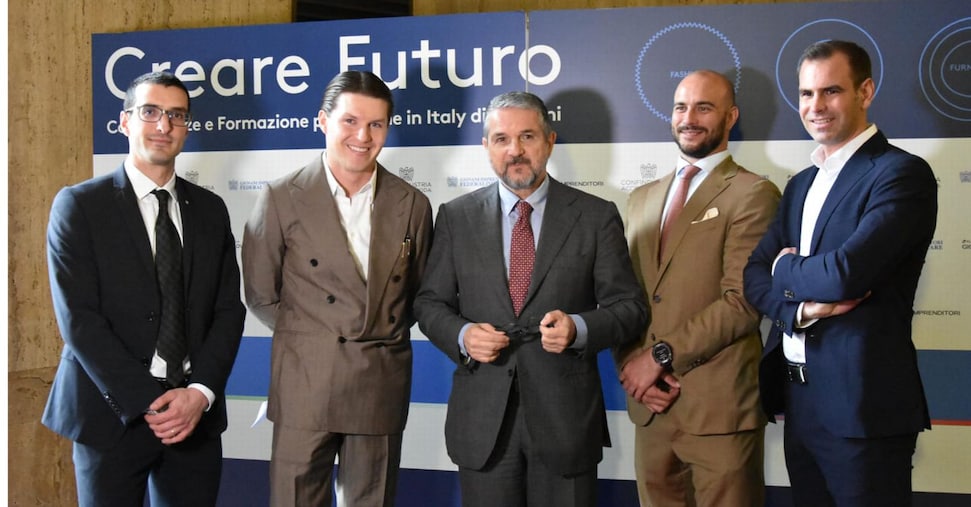
The challenge of the new generations
At the centre of the ‘Creare Futuro’ Forum is the importance of investing in the new generations and the delicate issue of the difficulty of finding, attracting and retaining professional profiles that are suitable and necessary for development. According to projections by Unioncamere – Ministry of Labour and Social Policies, Excelsior Information System, in the five-year period 2025-2029 Italian companies will need to hire between 3.3 and 3.7 million workers. On an annual basis, this translates into a demand for around 247-268 thousand Its Academy graduates or diploma holders, 185-216 thousand technical-professional upper secondary school or high school graduates, and around 125-126 thousand people with training or vocational training qualifications.
Training also proves to be a central element in the recruiting policies of companies, which nowadays predominantly demand technical figures, and the 3 ‘F’ sectors do not escape this dynamic.
As shown by the analyses shared by Umana, a partner in the initiative, an effective synergy between the world of work and the world of training, such as the dual system, is one of the most effective responses to this shortcoming: the Its institutions, for example, express a placement that reaches 90 per cent one year after graduation, although they are still unable to fully fill the market gap.
The voice of young entrepreneurs
“The new generations, who have grown up in a context that is increasingly oriented towards immediacy, find it difficult today to fully grasp the value, care and work that characterise Made in Italy,” said Carlo Briccola, president of the Gruppo Giovani Confindustria Accessori Moda (Young Confindustria Fashion Accessories Group), in his speech. This is why it is necessary to evolve the language with which the sector is told, making it more effective and closer to young people. This is not just a cultural issue: many young people do not know the production processes and, above all, do not perceive the richness and complexity of what happens every day inside companies. For this reason, today more than ever, it is essential to strengthen the dialogue between companies and the new generations. Made in Italy does not need to reinvent itself, but to tell its story better and speak to young people in particular’.
For Guglielmo Gennaro Auricchio, president of Federalimentare’s Young Entrepreneurs, ‘In the current economic context, talking about business increasingly means talking about a supply chain and system, not individual isolated realities. Competitiveness is not built alone, but through structured models, capable of integrating skills, resources and strategic vision along the entire value chain. For young entrepreneurs, this implies a change of mentality: overcoming the individualism that has historically characterised our country and contributing to the construction of a true Sistema Italia. The challenge for the new entrepreneurial generation is clear: making a system is not an option, but a responsibility’.
Dining and Cooking