
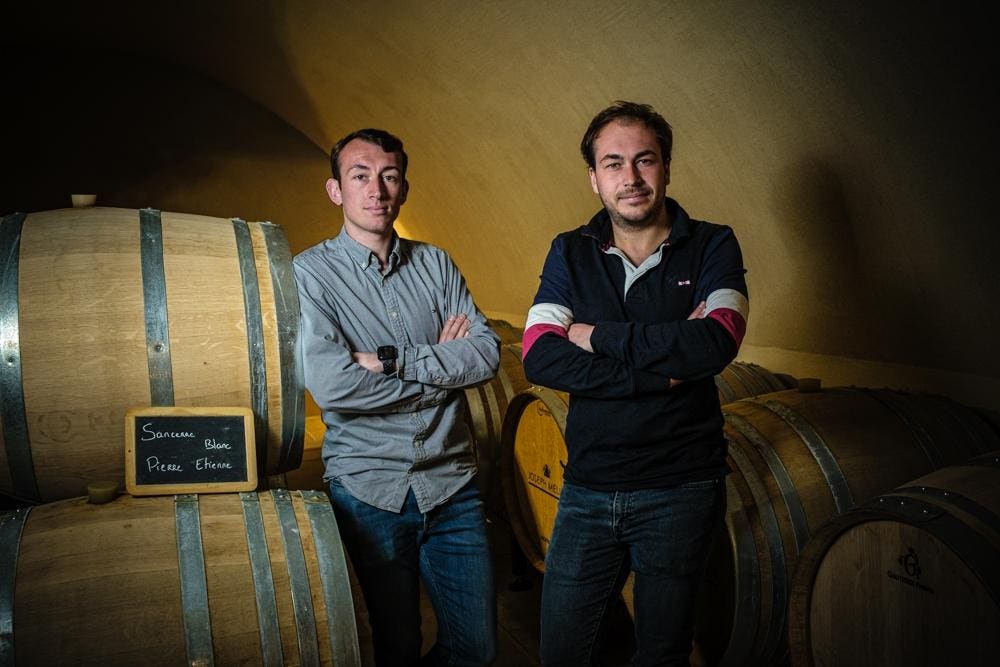
Armand and Adrien Mellot
Armand and Adrien Mellot
When Henri de Lorgeril returned to his family’s estate in the Languedoc after years working in tech and startups, he didn’t arrive with a disruption roadmap, to steal terms from going to market in the digital world.
Instead, he arrived with questions. How could labels be easier for consumers to read? Should the grape varieties buried in fine print? How can decisions about vineyards, which take four to five years before they produce a single bottle, be made by thinking a decade ahead?
“Adaptation is a continuous process, not a rupture with our past,” he says. The Lorgeril family has farmed the same land for 13 generations and more than 400 years. Henri is the latest heir to take on the challenge every generation faces: how do you run a centuries-old business in a market that didn’t exist when your ancestors planted the first vines?
Rémy Grassa, co-owner and fifth-generation at Domaine Tariquet in Armagnac country, says “Innovation is part of our DNA, but it always serves tradition rather than replacing it.” That energy is playing out across some of France’s most prestigious wine estates right now.
A wave of next-generation leaders including children and grandchildren of founders, some with MBAs, some with startup experience, all with an acute awareness of what the American market demands, is taking the reins of properties that were founded before the United States was formed.
What they are discovering is that the values that built these estates and the instincts required to compete in the world’s most competitive wine market are not, in fact, in conflict. But reconciling them requires more organizational discipline, clearer communication and a more deliberate long-term strategy than any previous generation has needed.
French Wine In The International Market
The U.S. market is the leading export destination for French wines in general and for Bourgogne (Burgundy) wines in particular. “For us Burgundians, it has been a traditional and historic market for over a century,” says Alberic Bichot, CEO and sixth-generation leader of Maison Albert Bichot.
That long relationship, however, has never been more contested. Competition from New World producers like California, Argentina, New Zealand and Australia can be intense. Shelf space, even with the generosity of ecommerce, is finite. Distributor attention is fragmented. And American consumers, while increasingly drawn to quality French wines, are also demanding. They want transparency, readability, provenance and a coherent story behind the label.
“While overall U.S. wine consumption is softening, the premium segment is growing, and France leads it,” says Armand Mellot, son of Catherine Corbeau-Mellot and the next generation at Maison Joseph Mellot in Sancerre. “French wines fit naturally into the U.S. trend toward drinking less but better.”
Staying Close To The Customer
Bichot’s response to the American market’s complexity was structural. In a move that set him apart from most European wine producers, he created Albert Bichot USA, a dedicated importing subsidiary, to put his own team on the ground rather than relying solely on third-party distributors.
“One of the most important keys to success is staying as close as possible to our distributors and to the end consumers,” Bichot says. His USA team now numbers 15 people, traveling the country year-round to run tastings, educate retail partners and build the kind of relationships that translate into consistent shelf placement and menu listings.
That investment reflects a lesson many European producers have learned slowly: the export market does not reward passive presence. Producers cannot simply ship great wine and wait for recognition. They have to tell the story, repeatedly, to the right people, in the right rooms.
Domaine Tariquet, the Armagnac-country estate co-owned by Rémy Grassa as part of its fifth generation, also leaning on its partnership with Albert Bichot USA to reach American consumers while staying focused on producing estate-grown wines with exceptional price-to-quality ratios. “Our strong local partnership with Albert Bichot USA is essential to spread our message and to adapt distribution channels to each of our wines to target the right audience,” Grassa says.
What The Next Generation Is Changing
For Henri de Lorgeril, the most immediate changes after joining the family estate were not in the cellar. They were on the label.
“U.S. consumers increasingly look for transparency and readability, so we have made our labels more explicit, highlighting the appellation, region and adding grape varieties on the front labels,” he says. While this might sound simple to wine drinkers accustomed to labels from the New World, it’s quite complicated. In practice, for an estate with a centuries-old origin-based identity and a portfolio of wines across multiple appellations, it required real decisions about hierarchy, design and what information consumers actually need at the point of sale.
Lorgeril also pushed the estate to think further ahead on planting decisions. A white wine from high-altitude terroirs, now in development, is a direct response to what he observed during recent visits to Portland and Seattle, where he found that U.S. buyers want freshness and balance, and the supply to meet that demand takes years to build. “Because vineyards take four to five years before producing wine, we anticipate demand early,” he says.
At Maison Joseph Mellot, Armand Mellot is making similar structural moves, strengthening allocations, moving toward long-term distributor relationships rather than short-term placements and sharpening the brand architecture around the estate’s most distinctive wines. This is particularly true for its single-parcel Sancerres from silex soils, which he says resonate strongly with American fine-wine buyers.
“We evolve technically and organizationally, but the soul of the domaine remains unchanged,” Mellot says. “The goal is not to make different wines, but to make wines with great clarity and consistency.”
Not every estate in this conversation is targeting the same buyer. Grassa is explicit that Tariquet’s American strategy is built around “exceptional price-to-pleasure value” and a style that is “crisp, easy-drinking, often lower in alcohol.” Serious quality at an accessible price point, from a 100% estate-grown property fills a sought-after slot on shop and restaurant lists. It also speaks to a younger American consumer who is drawn to French wine culture but is also value conscious.
The Climate Variable
Every estate in this conversation is also managing a threat that previous generations didn’t have to face with the same focus: climate change. The producers say it is reshaping harvest timing, alcohol levels and the character of wines that consumers have come to expect. It is also, paradoxically, creating new opportunities for higher-altitude vineyards that once struggled to ripen grapes are now producing wines of real complexity and freshness.
“We are investing heavily in sustainable viticulture, protecting biodiversity, preserving soil health and adapting to climate change,” says Grassa of Domaine Tariquet. “These long-term choices ensure both environmental responsibility and consistent wine quality despite changing conditions.”
For Bichot, the commitment extends to how the wine reaches the U.S. Starting with the 2024 vintage, all of the maison’s Grand Crus will be shipped to America by sail-powered cargo vessel through a partnership with Grain de Sail, a decision that is as much about brand consistency as it is about carbon footprint. Burgundy has been a UNESCO World Heritage site since 2015, recognized as a model of terroir-based viticulture. Arriving by sailboat is, in its way, a coherent extension of that identity.
The Lorgeril family has invested in wine tourism alongside sustainability. Their chateau, built in 1620, now hosts a restaurant, cellar visits, guest houses and vineyard trails. It is, Lorgeril says, a way of building long-term brand equity that no distributor relationship can fully replicate, because consumers who visit become advocates in a way that a well-placed shelf tag never achieves.
Buying Heritage Has Its Rewards
There is a version of the family-winery story that is purely nostalgic, but that is not what these families are relying on entirely. Heritage, in the American premium market, is equal to credibility at the moment of the buying decision.
“American consumers, particularly in the premium segment, are looking for wines with a sense of place and history, not just a flavor profile,” Lorgeril says. “France represents craftsmanship, appellation structure and generational continuity.”
Bichot says French wines, and Burgundy wines especially, are “truly distinctive wines of distinctive identity-related quality.” Wine lovers know that these indicators capture something important. These are not wines whose value is purely in the glass. Their value is also in what they represent, a specific place, a specific family, a specific set of choices made across generations.
That is a harder thing to build than a tasting note. It is also a harder thing to copy.
Grassa says the goal at Tariquet is to “be robust and resilient and keep the brand relevant for future generations. If this language sounds more like a CFO’s memo than a winemaker’s manifesto, that is precisely the point. These are businesses, run by people who think in decades, operating in a market that can shift in a single harvest.
Which may be why, even as the competitive environment sways, the families running these estates are betting that the work of being genuinely rooted in a place and genuinely committed to making it better than you found it, is a sustainable competitive advantage available to them.
“Every decision we make is about honoring our heritage while building the foundation for the next generation,” Mellot says.
More From ForbesForbesBeaujolais Is French Wine That’s As Easy To Love As It Is To UnderstandBy Jill BarthForbesThe Southern French Wine Escape Smart Travelers Are Booking For 2026By Jill BarthForbesWhy Now Is A Great Time To Join A Wine ClubBy Jill BarthForbes50 Years After Judgment Of Paris, Chateau Montelena Pioneers AgainBy Jill Barth
Dining and Cooking