
Sutter Creek
From spaghetti-eating contests to a world-class bocce tournament, this Amador County Gold Rush town showcased its rich Italian heritage for the 136th year in a row over the weekend.
Founded in 1881 by hotelier Bartolomeo Bianchetti, the 125-member Italian Benevolent Society of Amador County has celebrated Italian independence day ever since with the Italian Picnic and parade on the first weekend in June. Bianchetti’s contemporary, Italian immigrant Angelo Noce, attended school nearby and campaigned successfully to have Columbus Day declared a national holiday.
Behind the benevolent society’s red-and-gold flag, about 20 Italian American men paraded down Main Street in a float pulled by a pickup driven by Dave Richards, 90, and his son David Tilden Richards, 38, who live in the Sutter Creek home of his great-grandfather, Antonio Fontana Rosa.
Rosa’s father, Giovanni Fontana Rosa, left Chiavari, Italy, for New York in 1849, joined the California Gold Rush in 1855 and opened a boarding house, becoming one of Amador County’s first Italian settlers. Tilden Richards, an attorney in town, is one of the society’s youngest members.
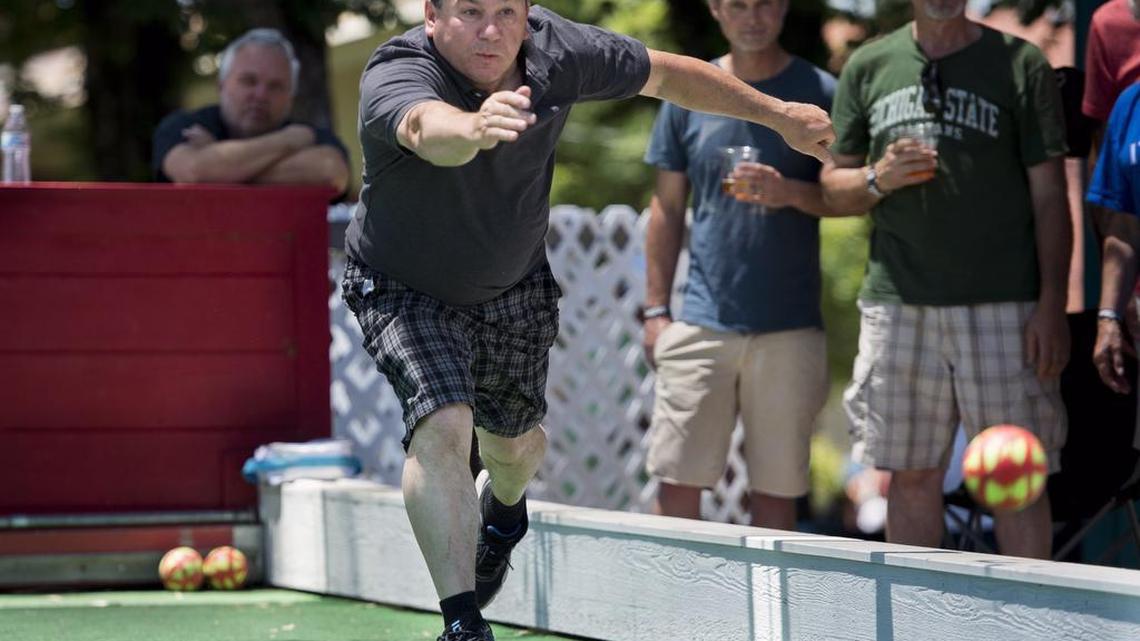
Along with the descendants of northern Italian pioneers who came here seeking their fortunes – and fleeing military service during Italy’s war of independence – a new wave of Italian Americans have joined the enclave. Rick Wagstaff, a retired emergency rescue fire captain from Sacramento and a former U.S. bocce champion, brought the game to the Italian picnic grounds here in 1996.
“The beautiful thing is bocce brings generations together: Grandparents can play with their grandchildren,” said Wagstaff, who is of German-Italian heritage. The picnic hosted a 10-team tournament Sunday featuring four world champions – three from Stockton and one from Sacramento’s East Portal Bocce Club.
Veteran player David Camarado of East Portal instructed novices how to play on the three bocce lanes. “Don’t try to get fancy with back spin, just toss the darn ball,” he growled. “And don’t hit the back wall or it’s out!”
While bocce dates back to the Roman Empire, the society launched its first-ever spaghetti-eating contest in honor of the pasta some say was invented by Etruscans in southern Italy. On Saturday, eight people mounted a stage – five men, one boy and two women. Each had to eat a heaping half-pound bowl of spaghetti, drenched in the society’s secret marinara sauce, with their hands.
Mark Chamberlin, a beefy volunteer firefighter from Mokelumne Hill, had just eaten a hot dog “to help out the 4-H,” but he began shoveling big handfuls of spaghetti into his mouth while his girlfriend, Cricket Meyer, cheered him on. Juan Reyes kept up through one and a half bowls before Chamberlin, 39, demolished a second bowl and threw up his arms like he’d scored a winning field goal.
“I eat a lot of food and do firefighting, so my girlfriend makes big meals,” said Chamberlin, who successfully defended his title Sunday. The pasta was al dente, and the sauce “was very good and had a hint of oregano that made it pop.”
The society’s Tom Esposito, who ran the contest, refused to divulge what was in the sauce. “If I told you, I’d have to kill you,” he said.
After the contest, the society held a sit-down ravioli-chicken dinner for 450 people that included father-son accordion players Stefano and Mike Trucco, who have been performing here for 20 years. They made the dinner crowd swoon with classics such as “O Sole Mio” and “Volare.” The hosts included club president Bob Bovero, local ravioli maker Jim Vinceguerra, dinner co-organizer Matt Tomo and sergeant-at-arms Gordon Fazzio, a retired sheet-metal worker from Castro Valley who moved up here 18 years ago.
“The club took care of the miners that didn’t strike it rich, the sick and those who couldn’t get on their feet,” said Fazzio, and it still raises money for scholarships and charitable causes.
Along Sunday’s parade route, 25-year-old Bailey Huffman reflected on the tradition started by Bianchetti, her great-great uncle. He patterned the society after one he’d seen in Richmond, Va.
“It was founded to help new immigrants get settled in,” she said.
The club collected dues and paid benefits to disabled members, covered funeral expenses and even provided disaster relief for Italians in times of crisis, including the San Francisco earthquake, added local historian Carolyn Fregulia.
“I’m the last of my bloodline,” said Huffman, who would like to join the society but can’t because it’s all male. “I would love to be a part of it, but at the same time, I respect the tradition. Maybe some day I’ll have a son and he can be part of it.”
This story was originally published June 5, 2016 at 7:26 PM.
Dining and Cooking