
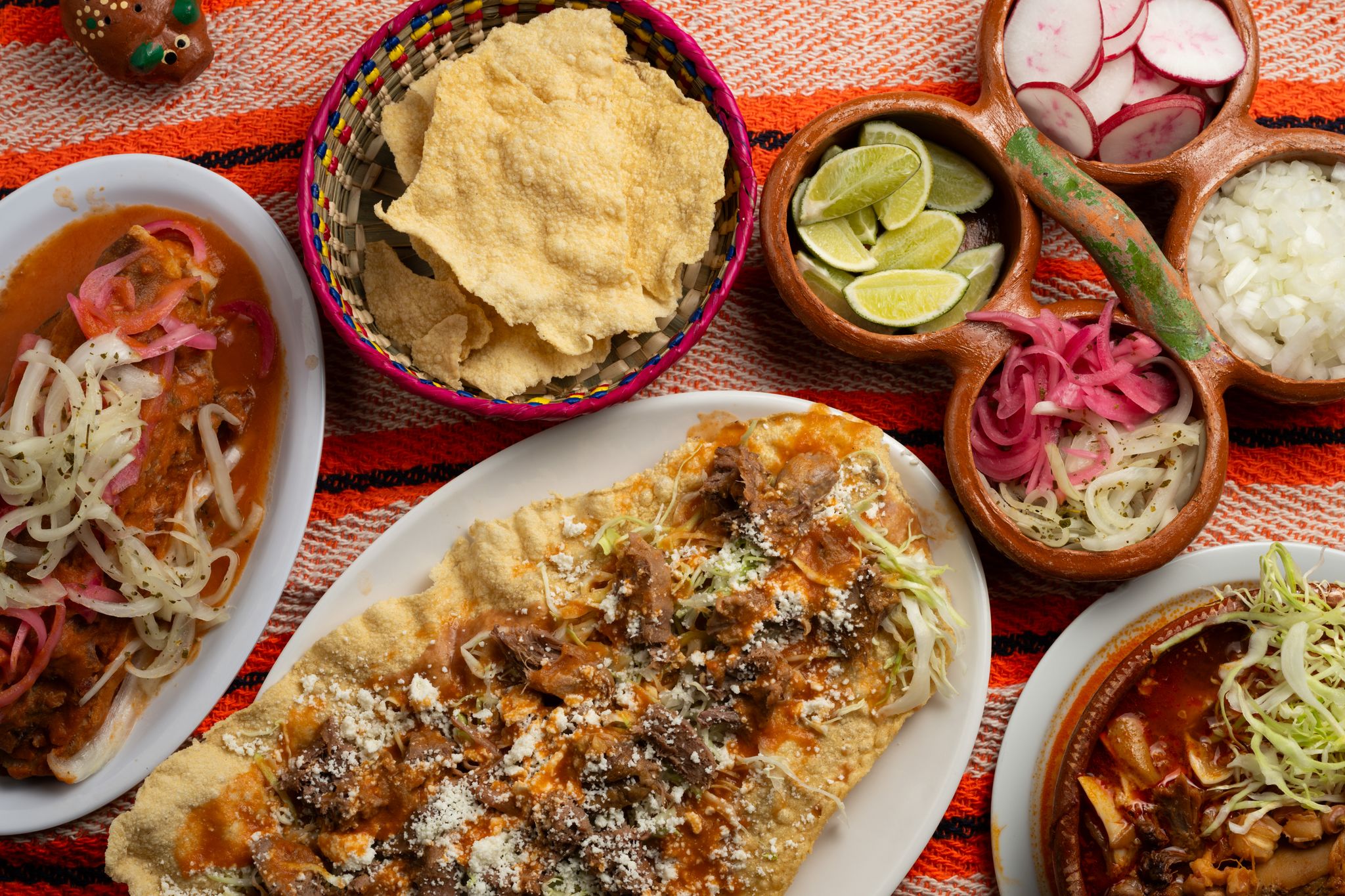
The house specialty of Cenaduria Elvira is the tostada raspada, center, a dish with ties to Zapotlanejo in Mexico’s Jalisco state.
Colin Peck/For the S.F. Chronicle
Cenaduria Elvira serves the best Jalisco-style torta ahogada in the entire Bay Area.
Colin Peck/For the S.F. Chronicle
The expertly fried tacos dorados can be filled with a choice of potatoes, peppers or ground beef, before they’re bathed in a tomato sauce.
Colin Peck/For the S.F. Chronicle
Cenaduria Elvira began as an underground restaurant operating out of owner Elvira Varela’s childhood home in East Oakland in 2020. It was a Jalisco-style spot by way of Zapotlanejo — the Varela family’s hometown, located just outside the capital city of Guadalajara — that specialized in tostadas raspadas, “scraped” tostadas about half the size of a skateboard topped in a slew of garnishes, salsas and meat.
Varela distinguished her operation in part by making monthly 1,500-mile sojourns to Mexico to source most of her key ingredients, such as chiles and the signature tostadas raspadas, which her family makes in Zapotlanejo. The arduous sourcing process impressed me in 2022, when I first reviewed the operation; by the following year, Cenaduria Elvira was in the national spotlight, with the New York Times naming its tostada raspada as one of the best dishes in the country. It outgrew Varela’s parents’ house and transitioned to a brick-and-mortar in Oakland’s Jack London Square this past January.
Article continues below this ad
Cenaduria Elvira’s dining room features clay-colored walls and photographs of barro (terracotta) dishware, evoking Jalisco’s pottery traditions, along with plants and rattan pendant lights that dangle from the ceiling.
Colin Peck/For the S.F. Chronicle
Cenaduria Elvira creates a holistic restaurant experience that is similar to what you’d find in Jalisco — not just in cooking, but in decor, hospitality and crowd. Inside, the walls are the color of clay and are decorated with framed photographs of barro (terracotta) dishware, evoking Jalisco’s pottery traditions, but also of Varela teaching her daughter how to fry tostadas. Inspired by basket-weaving traditions, rattan pendant lights dangle from the ceiling, at differing lengths, lending the space an easy, warm glow. Natural light pours through arched windows, an architectural cue found throughout the central Mexican state. Cenaduria Elvira seamlessly blends the chic and the rustic, drawing inspiration not from an imagined Mexico but the real, contemporary place.
Most Jalisco-style Mexican restaurants in the Bay Area, of which there are many, compromise on the details that make Cenduria Elvira sing: the sharpness of the chile de arbol salsa, made with hotter peppers from Mexico; the ethereal crispiness of its tacos; and the laborious craftsmanship in its tostadas.
San Francisco Chronicle Logo
Make us a Preferred Source to get more of our news when you search.
Add Preferred Source
One thing Elvira does not have is a burrito, that monolith of Bay Area Mexican food. It would make enormous financial sense to offer one — all of the aforementioned former home restaurants do — because it’s what so many local diners expect as a default.
Article continues below this ad
I asked Varela if she would ever serve one. “No, nunca,” she said. Never.
Burritos, while a deservedly venerated symbol of Bay Area Mexican cooking, should not have a monopoly over cuisine, and restaurants like Cenaduria Elvira display the varied world beyond tight aluminum wrapping. Its patrons decidedly seek not burritos, but tostadas and pozole, the delicacies of Zapotlanejo. Waits can reach up to two hours, according to Varela, especially during the weekend service, when Mexican families bring their entire bloodlines.
Deep bowls of pozole filled with purple hominy can be topped with meat, including cuts like trompa (pig snout) and pata (pig feet).
Colin Peck/For the S.F. Chronicle
On those busy days, a sea of brown faces inhabit the place: tweenage girls with thick eyeliner, guys with face tattoos, teenagers in soccer jerseys and dirt-clodded cleats. It’s a family restaurant in the truest sense, where it’s common to see three generations present at tables; children attack tostadas raspadas, while abuelas burrow into deep bowls of pozole ($13) filled with prodigiously toothsome purple hominy and bedecked with every offal cut on offer, such as trompa (pig snout) and pata (pig feet).
I was moved to see kids having such early exposure to tostadas raspadas, given that they rarely make an appearance at restaurants in California, though you can find mass-produced versions at most Latin American grocery stores.
Article continues below this ad
Nearly all tostadas are made from tortillas, but raspadas add an extra step: scraping off uncooked masa from a partially cooked tortilla. This can result in a round shape, which is served at Los Angeles restaurants like Antojitos Los Cuates and Michelin-starred restaurant Holbox. Cenaduria Elvira offers the more elusive sled-shaped raspadas, which require dexterous hands, like those of Varela’s aunt and uncle, Eduardo and Paz Varela, who still shape every single tostada raspada served at Cenaduria Elvira. If the tortilla is not scraped with a patient, smooth touch, the masa won’t spread evenly. Even Varela hasn’t mastered the technique, which some claim emerged in Zapotlanejo roughly 40 years ago; others trace it back nearly a century.
Paz places a par-cooked tortilla on a metate — a sloped, Mesoamerican grinding stone — then scrapes it with the stone tool called a mano, until the masa is spread thin, becoming a foot long and six inches wide. The smearing of the masa fills the crevices of the stone. The resulting crags blossom into an excess of bubbles when the masa is later fried. Using a metal spatula, she liberates the dough from the stone, producing a jagged sheet of corn that looks like a wood plank. Every month, without fail, she repeats this five-day process 2,500 times.
The last crucial step involves drying them out, which Varela does at the restaurant; this helps them fry better and ensures expansion when rehydrated in scalding oil as they are fried with the precision of a Japanese tempura master.
Owner Elvira Varela was working as an accountant when she began operating Cenaduria Elvira out of her childhood home in East Oakland during the pandemic.
Colin Peck/For the S.F. Chronicle
A stack of 2,500 tostadas lasts Elvira about 10 days — at the home restaurant, it was about a month — so Varela must replenish her stock weekly. Now she has a network of people who travel to Zapotalnejo to transport the tostadas to Oakland. The repeated, daunting journeys for sourcing underscores the restaurant’s commitment to transporting patrons to Jalisco. You can overhear diners seating on the outside patio regularly discussing the dearth of options for “food like this.”
Article continues below this ad
The tostadas raspadas, with their chicharron-like crunch, remain the marquee item. The fully composed dish sees the arm-length corn planks painted with beans, then topped with cabbage, crumbled cheese, tomato salsa and choice of meat, such as shredded pork or cueritos (pickled pig skin). Newer options, stewed in tomato sauce — lengua, thick chunks of tongue with striking bounce, or oreja, pig ears sticky with fat — are both top notch.
If you don’t want to commit to a whole tostada, a new botanas, or appetizer, called the pedacera provides a middle ground: a snack of bubble-studded tostada pieces in a basket with a sidecar of adobo-spiced refried beans ($10) or choice of meat ($12-$13). On its own, you can better appreciate the tostada’s complexities: its wafer-like lightness, faint sweetness and toasted-bread-like nuttiness. Use the pieces to make bite-size tostadas and take full advantage of the complimentary salsas and toppings, such as precious pickled onions. The red salsa, made with a medley of chiles de arbol varietals and served in squeeze bottles is vital to the experience. It’s a lip-stinger and a face-flusher, but once you adjust, the biting earthiness and subtle florality reveal themselves.
In Jalisco, crispy tacos dorados are often an accompaniment to tortas ahogadas, or drowned sandwiches.
Colin Peck/For the S.F. Chronicle
The salsas are a vital accompaniment to another highpoint: the expertly fried tacos, filled with your choice of potatoes, peppers or ground beef, then bathed in a tomato sauce. Plucked from the fryer at the point of absolute goldenness, these taco dorados brandish a razor-thin shell with an astonishing crackle. In Jalisco, they serve as something of a sidekick to tortas ahogadas, the salsa-drowned sandwich, and Cenaduria Elvira makes the finest in the region. On one visit the bread — the hardest detail to nail — had a powerful, well-salted crust; the carnitas were juicy; and the tomato salsa was well-balanced. On a separate outing, however, the bread was not fully warmed through, nor was it the freshest batch, and the tomato sauce was too sweet, missing the subtle harmony of the prior sandwich.
Another area of improvement: When the restaurant is swamped, service can be sluggish. But when they manage to get to you, the waiters are adequately hospitable. I would, however, love to hear them sell the story and artisanship behind the dishes a bit more, especially to newcomers to the food.
Article continues below this ad
Still, it’s not often that we see an ambitious Mexican restaurant that shifts the food culture through centering its community over trying to appeal to the widest possible audience. Cenaduria Elvira has potential to become one of the great Mexican restaurants of the Bay Area, not just for its standout cooking, but because it is a Mexican restaurant for Mexicans. It shows cultural pride at a time when it feels dangerous to do so, as Mexicans — citizen or not — are being pulled off the streets and birthright citizenship, the bedrock principle that gives children of immigrants like Varela and me our claim to being American, is being challenged. In face of it all, Cenaduria Elvira chooses to be radically Mexican.
Cenaduria Elvira
468 3rd St., Oakland. cenaduriaelvira.com
Hours: 11 a.m.-9 p.m. Wednesday-Monday.
Accessibility: All on one floor. Wheelchair accessible tables. Outdoor patio seating available.
Meal for two, without drinks: $35-$50
What to order: tostada raspada with carne desebrada or lengua ($18), torta ahogada ($13)
Meat-free options: pedacera with frijoles ($10), taco dorados ($3.50)
Drinks: Beer, soft drinks and agua frescas.
Pro moves: Weekend wait times can be long, so join the list early. Order an appetizer of tostada pieces served with refried beans.
Dining and Cooking