
When temperatures threatened one of the world’s most prized wine regions, some growers reached for fire — while others turned to a more icy solution.
Published Apr 3, 2026 9:39 AM PDT
|
Updated Apr 3, 2026 9:39 AM PDT
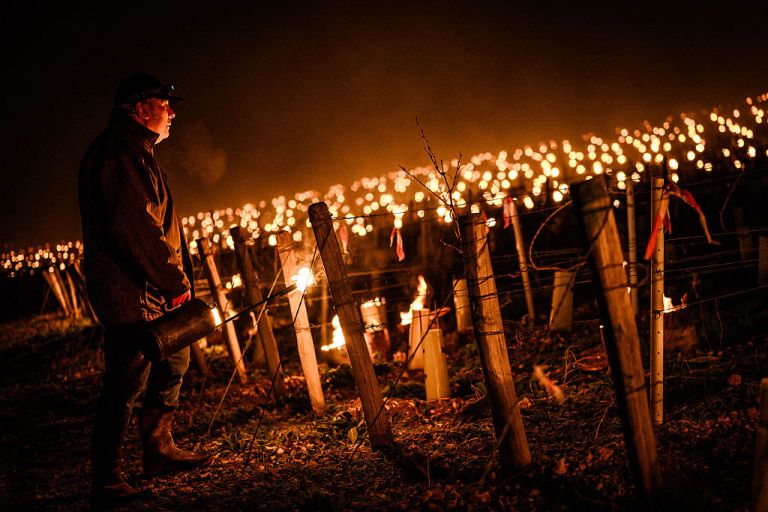
A winegrower lights anti-frost candles in their vineyard near Chablis, Burgundy, on March 27, 2026 as temperatures fall below zero degrees celsius during the night. The announced frost episode during the night pushed many Burgundy winegrowers to take measures to protect their vines. (Photo by ARNAUD FINISTRE / AFP via Getty Images)
Winemakers in France’s Burgundy region turned to an old-fashioned solution when temperatures dipped near freezing on multiple nights in late March, threatening to damage sensitive buds on their vines.
Hundreds of anti-frost candles were lit across the vineyards on the coldest nights, generating enough heat to ward off a hard freeze.
Winegrowers light anti-frost candles in their vineyard near Chablis, Burgundy, on March 27, 2026 as temperatures fall below zero degrees celsius during the night. The announced frost episode during the night pushed many Burgundy winegrowers to take measures to protect their vines. (Photo by ARNAUD FINISTRE / AFP via Getty Images)
Some growers took a different approach by spraying water directly onto the rows of vines to coat them in a thin layer of ice. The method sounds counterintuitive, but ice can actually shield plants from even harsher conditions if air temperatures drop well below freezing.
Ice is pictured in the Chablis vineyard after water was sprayed on it in Chablis on March 27, 2026, as temperatures fell below zero degrees celsius during the night. The technique of sprinkling vine rows with low-flow water has proven effective, allowing the bud to be covered with a pocket of ice that protects it. (Photo by ARNAUD FINISTRE / AFP via Getty Images)
Warmer weather has since returned to Burgundy, with overnight lows expected to hold in the mid-40s to mid-50s F (7-13 C) over the coming week.
Report a Typo
Dining and Cooking