
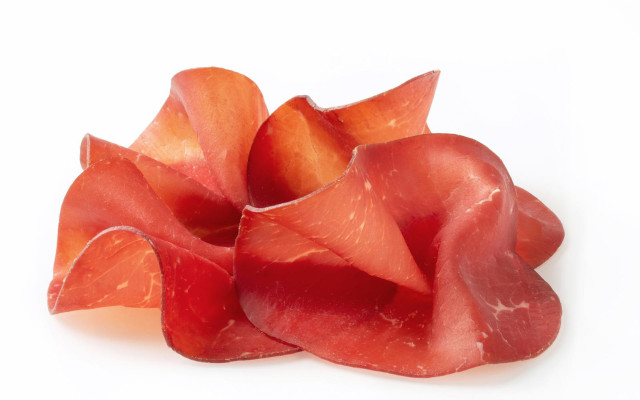
La Bresaola della Valtellina PGI consolidates its position in the Italian delicatessen industry through a combination of technological rigor and specific climate conditions. Analysis of the sector reveals an efficient production model, capable of transforming select beef raw materials into a functional food characterized by an excellent protein profile and growing penetration into international markets, including the Halal and Kosher certified segments.
Market dynamics: growth volumes and values
The product is ranked eleventh in the general classification of Italian DOP and IGP food products, confirming its position as top-quality salami of the Lombardy PDO economy and the province of Sondrio. The latter, thanks in part to bresaola, has grown by 10% in value and remains among the top 20 in Italy. Exports reach EU markets (Germany, France, Switzerland, Belgium) and non-EU markets (USA, Canada, the Middle East, Asia), with particularly strong growth in Gulf markets, also favored by the product’s halal status, as it is made exclusively from beef.
International demand is supported by the growing interest in high-quality foods high protein content e low fat, the spread of the Mediterranean diet and the perception of quality and safety associated with European geographical certifications. The premium segment, although still limited, is experiencing above-average growth rates in Northern European and North American markets (Ismea & Fondazione Qualivita, 2025).
Genesis and territory: Alpine drying
The origins of bresaola date back at least to fifteenth century, when in the Alpine valleys meat preservation techniques based on salting and seasoning, necessary to face the long winters. The oldest documentary sources attesting to their production date back to the second half of the 400th century, in the Valtellina area.
THEetymology of the term is uncertain: it could derive from ’ember’ (embers), referring to the heated environments used for drying, or from ‘brisa’, a dialect term for the salivary glands of cattle. A local tradition instead associates the term with the suffix ‘-saol’, attributable to the use of salt in preservation.
Over the centuries, production has evolved from a domestic and artisanal practice to an organised industry, maintaining a strong link with the Valtellina territory, whose climatic conditions — fresh air, natural ventilation, controlled humidity — contribute significantly to the organoleptic characteristics of the product.
Production standards: the PGI specification
Il disciplinary The Bresaola della Valtellina PGI, registered under Regulation (EC) No. 1263/96 and subsequently updated, precisely defines all production requirements. The latest significant changes concern Article 3, which was integrated in 2022 with a temporary amendment (until December 31, 2024) to reduce the minimum age of cattle from 18 to 12 months. The proposed ordinary amendment to the specification was published in 2024 with Lombardy Regional Communication No. 64 of June 5, 2024, and the process is currently ongoing. Finally, on March 10, 2026, an application for an ordinary amendment to the Bresaola della Valtellina PGI specification was published in the Official Journal of the Italian Republic (MASAF, 2026).
Name and production area
La name ‘Bresaola della Valtellina’ – reserved exclusively for cured meat products that comply with the production specifications – is untranslatable and does not allow for qualifications not expressly provided for (art. 1 – Denomination).
All processing stages – including slicing and portioning – must take place in the territory of the province of Sondrio, to preserve the qualitative characteristics of the product (art. 2 – Geographical area).
Raw material
Bresaola is produced exclusively with meat obtained from the legs of cattle aged between 18 months and four years. The muscle mass of the boneless beef leg, from which bresaola is obtained, is five: topside, round, flank, silverside, and underside (art. 3 – Raw material).
Sourcing from cattle raised outside the PGI area is permitted; in 2024, approximately 80% of the raw material will come from South America (Brazil, Paraguay, Uruguay, Argentina) and 20% from Europe.
Method of production
The process is divided into the following phases:
trimming accurate selection of muscle mass for production ‘with removal of the external fat and the external tendinous parts, taking care not to cut them, because they form, entirely and individually, the pieces to be salted and dried’;
dry salting ‘with sodium chloride and/or spices and/or aromatic plants and/or natural flavours’. You can add ‘wine, sugar and/or dextrose and/or fructose, sodium and/or potassium nitrate, sodium and/or potassium nitrite, in the maximum dose of 195 ppm as a limit of the quantity introduced or in any case absorbed, ascorbic acid and/or its sodium salt’. Salting has a ‘average overall duration from 10 15-days according to the weight of the pieces’;
bagging: each single piece is placed in natural casing, although it is ‘the possible use of artificial casing is also permittedAnd’;
drying: ‘It has an average duration of one week and must allow for rapid dehydration in the first few days of treatment’ (art. 4 – Processing method);
seasoning: ‘The maturation process must be carried out in ideal climatic conditions to allow for a slow and gradual reduction in humidity. It is conducted in specially air-conditioned rooms that ensure optimal air exchange, at an average temperature between 12 and 18°C. The maturation time, which also includes drying time, varies. 4 to 8 weeks depending on the size of the product and market demand. (…) Both for drying and for seasoning immense techniques that involve dehydration can be adopted acceleratedVentilation and exposure to natural humidity are permitted, taking into account the climatic factors present in the production area.’ (art. 5 – Aging).
Characteristics of the finished product
When released for consumption, Bresaola della Valtellina PGI must have the following organoleptic, chemical-physical, and product characteristics:
organoleptic properties: firm, elastic consistency; compact appearance when cut, free from cracks; uniform red color with a barely visible dark edge for the lean part; white color for the fatty part; delicate and slightly aromatic aroma; pleasant taste, moderately flavorful, never acidic;
chemical and chemical-physical characteristicsMaximum humidity varies between 60 and 65%, depending on the cut and packaging; max. fat 7%; min. ash 4%; max. salt 5%; min. protein 33% for pre-sliced bresaola packaged in a vacuum or protective atmosphere, min. 30% for all other types of packaging;
product characteristics: ‘vaguely cylindrical shape, although in some cases for specific needs, the cuts can be pressed into the shape of a brick’The minimum weight of Bresaola della Valtellina PGI varies, depending on the muscle groups, from 0,800 kg to 3,500 kg (art. 6 – Features).
Marketing and labelling
Bresaola della Valtellina PGI can be sold whole, loose or vacuum-packed, in pieces, in slices or sliced, vacuum-packed or in a modified atmosphere.
THElabel of the product must include the following information:
‘Bresaola della Valtellina’, untranslatable, ‘in clear, indelible characters, clearly distinguishable from any other writing’;
the acronym PGI and the EU symbol, in the language in which the product is marketed, immediately following the name in print of the same size.
‘The addition of any qualification not expressly provided is prohibited. However, the use of indications that refer to names, company names, or private brands is permitted, provided they do not have a laudatory meaning or are likely to mislead the purchaser.’ (art. 8 – Designation and presentation).
Nutritional analysis: protein density and micronutrients
According to the CREA tables, 100 grams of Bresaola della Valtellina PGI provide on average:
fat: 2 g (of which saturated: 0,7 g);
As regards the minerals, the food is characterised by:
rich in zinc: 4,5 mg, equal to 45% of the Nutritional Reference Value indicated in Annex XIII to Regulation (EU) No. 1169/11 (10 mg);
rich in phosphorus: 269 mg, equal to 38% of the NRV (700 mg);
rich in potassium: 630 mg, equal to 32% of the NRV (2000 mg);
source of iron: 2,6 mg, equal to 18% of the VNR (14 mg).
From the point of view of the vitamins, the product stands out as:
rich in vitamin B1 (thiamine): 0,41 mg, equivalent to 37% of the NRV (1,1 mg);
rich in vitamin B6: 0,52 mg, equal to 37% of the NRV (1,4 mg);
source of vitamin B12: 0,77 μg, equal to 31% of the VNR (2,5 μg);
source of vitamin B3 (niacin): 2,74 mg, equal to 17% of the NRV (16 mg);
Peer-reviewed studies confirm that meat — and particularly low-fat meat products — provides proteins with high biological value, with excellent digestibility and a complete profile of essential amino acids (Geiker et al., 2021; Libera et al., 2021). The content of salt requires moderate consumption, especially for subjects with a predisposition to arterial hypertension (WHO, 2023).
Intended uses: catering and functional consumption
The versatility of the bresaola makes it suitable for numerous uses in the kitchen, from tradition to contemporary catering:
gourmet: carpaccio with citrus fruits, berries or aromatic herbs;
contemporary cuisine: rolls, tartare, fish pairings, single portions and finger food;
Professional catering: a high-nutritional, low-calorie ingredient, ideal for diet menus, sports menus, and for the silver generation.
Conclusions
Economic data confirms the industrial strength of Bresaola della Valtellina PGI, with significant increases in both value and volume. Transparency throughout the supply chain and compliance with the chemical and physical parameters required by the specifications ensure a product that meets the demands of a global market increasingly oriented toward low-fat, highly digestible foods. The future of the sector lies in integrating premium markets with emerging collective dietary needs.
Dario Dongo
Cover Credit IVSI (Italian Cured Meat Promotion Institute)
References
Commission Regulation (EC) No 1263/96 of 1 July 1996 supplementing the Annex to Regulation (EC) No 1107/96 on the registration of geographical indications and designations of origin under the procedure laid down in Article 17 of Regulation (EEC) No 2081/92. http://data.europa.eu/eli/reg/1996/1263/oj
Geiker, N.R.W., Bertram, H.C., Mejborn, H., Dragsted, L.O., Kristensen, L., Carrascal, J.R., Bügel, S., & Astrup, A. (2021). Meat and human health — current knowledge and research gaps. Foods, 10(7), 1556. https://doi.org/10.3390/foods10071556
Libera, J., Iłowiecka, K., & Stasiak, D. (2021). Consumption of processed red meat and its impact on human health: A review. International Journal of Food Science and Technology, 56(12), 6115–6123. https://doi.org/10.1111/ijfs.15270
MASAF – Ministry of Agriculture, Food Sovereignty and Forestry. (2026, March 10). Proposal for an ordinary amendment to the production specifications for the protected geographical indication «Bresaola della Valtellina» (26A01094). Official Journal of the Italian Republic, General Series, 57. https://www.gazzettaufficiale.it/eli/id/2026/03/10/26A01094/SG

Dario Dongo, lawyer and journalist, PhD in international food law, founder of WIISE (FARE – GIFT – Food Times) and Égalité.
Dining and Cooking