
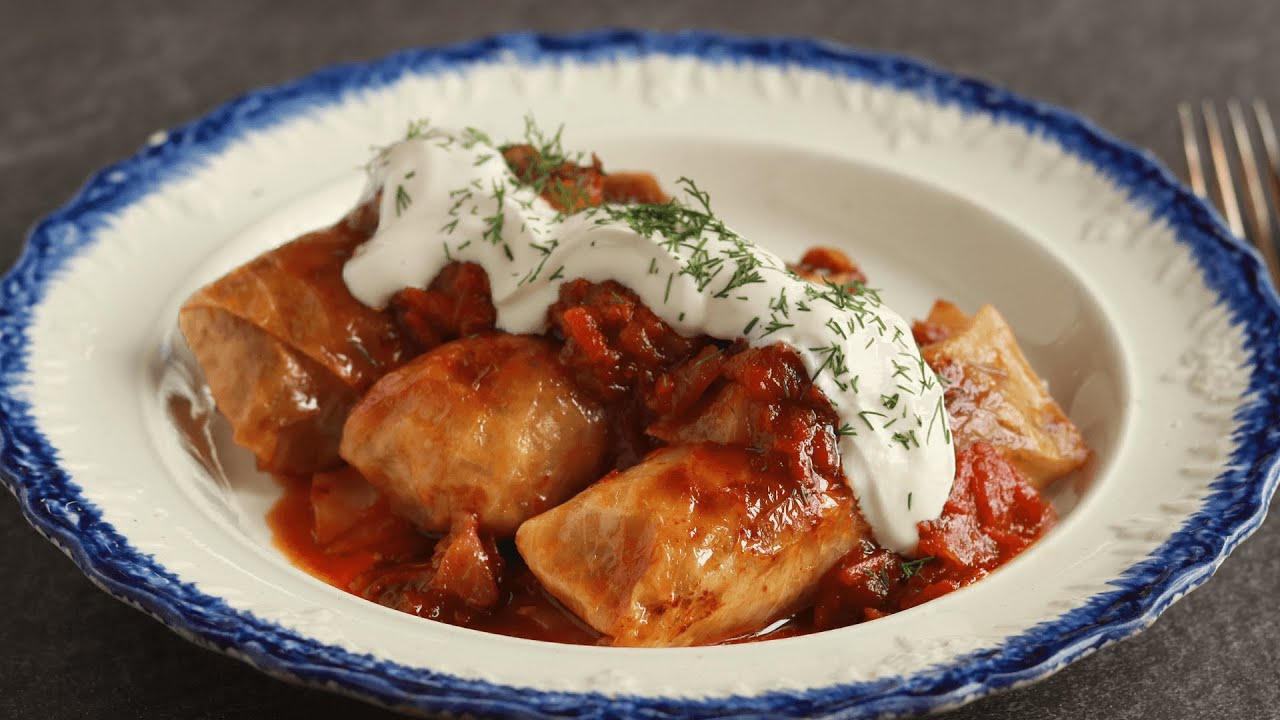
Stuffed Cabbage (a.k.a. Golubtsi / Holubtsi / Halupki / Golumpki)
00:00 Intro
00:31 Blanching the Cabbage and Cooking Rice
02:42 The Filling
05:32 Stuffing the Cabbage Leaves
06:25 The Sauce
08:00 Baking
08:31 Browning and Serving
Serves 6
1 large head of green cabbage (about 4 Lb / 1.8kg)
1/2 cup (100g) jasmine rice
220g carrots (2 medium)
190g yellow onion (1 medium), coarsely chopped
100g celery rib (1 medium), coarsely chopped
2 garlic cloves, sliced
3 Tbsp cold unsalted butter, cut into 3 pieces
Remove the core from the cabbage. Bring a large oven safe pot of water to a boil. Add salt. Add the cabbage and cook turning frequently. Every 30 seconds or so remove a leaf from the cabbage and set it on a baking sheet to cool. When the leaves become very small, fish out the remaining cabbage from the water (use it in some other dish). Add the rice to the water. Boil for 10 min. Drain and rinse under cold water. The rice will go into the filling.
When the cabbage is cool enough to handle, trim the thick ribs to make the leaves flat. Chop the ribs to add to the filling.
Fit a food processor with a grating disk and grate the carrots (set aside for the sauce). Fit a food processor with a chopping blade and process the onion, celery, garlic, and butter until finely chopped. Put into a large bowl to use in the filling.
Filling:
1/4 cup cold water
10g unflavored gelatin (3.5 tsp)
Pureed onions, celery, garlic, and butter from above
2 Lb (900g) meatloaf mix (or half beef, half pork)
Chopped cabbage ribs
Par-cooked rice from above
30g panko bread crumbs (1/3 cup)
Black pepper
13g salt or to taste
Bloom gelatin in water for 5 min, then microwave in 10 sec intervals just until dissolved. Add the liquid gelatin to the bowl with pureed veggies and butter. The gelatin step is optional, especially if you are using a meatloaf mix, but very helpful if using only beef or pork. Add all the other filling ingredients and mix thoroughly with hands (or with a paddle attachment of a stand mixer).
Stuff the cabbage leaves with the filling starting with the biggest leaves. When you get to the smaller leaves, use 2 for one roll. If you have leaves leftover, reserve 3-4 leaves to cover the top of the cabbage when baking and chop up the rest to use in the sauce.
Sauce:
2 Tbsp olive oil, plus more as needed
Chopped up remaining cabbage leaves
Grated carrots from above
190g diced yellow onion (1 medium)
2 garlic cloves, minced
1/2 cup dry white wine
750g canned or diced chopped tomatoes
1 tsp sugar
1 tsp pomegranate molasses or balsamic vinegar
Preheat the oven to 325F (165C).
Set the pot you used to blanch the cabbage over high heat and add the oil. When the oil is hot, add the chopped up cabbage and cook without stirring until brown. Stir and let it brown again. Repeat a few times until the cabbage is nicely brown. Remove to a bowl and set aside.
Add the carrots, onions, a pinch of salt, and another 1-2 Tbsp olive oil to the pot. Reduce the heat to medium and cook stirring occasionally until the onions are translucent and the vegetables start to brown. Add the garlic and cook stirring occasionally for 1-2 minutes. Add the wine, tomatoes, sugar, pomegranate molasses and salt to taste. Bring to a simmer. Stir in the browned chopped up cabbage.
Remove most of the sauce from the pot leaving a thin layer. Arrange the stuffed cabbage tightly in the pot. You’ll end up with 2 layers. Pour the sauce on top. Cover with the remaining cabbage leaves and a lid or foil. Bring to a simmer on the stove top. Bake in the middle of the oven for 1 hour or until the cabbage is tender and the filling reaches 160F (71C). Make sure to check the top middle rolls since they’ll be the coolest.
Serve as is, or for best results, cool completely and refrigerate overnight, then brown.
Browning and serving:
Remove the cabbage rolls from the sauce, and dry well on paper towels. Set a non-stick skillet over medium heat. Add 1 tsp of butter + 1 tsp of olive oil for every 3 cabbage rolls. When the butter is melted and the foam starts to subside, place the cabbage rolls in the skillet, cover and cook until brown, about 5 min. Regulate the heat so that they don’t brown too fast. Flip, cover, and brown the other side. Flip again, add the sauce, cover and cook until the sauce is bubbly and the filling is at least 130F (55C). Place the stuffed cabbage on a serving plate. Reduce the sauce until syrupy. Taste and correct for salt. Pour over the stuffed cabbage and serve with sour cream and dill.
Support my channel
https://www.patreon.com/helenrennie
My Online Cooking Classes:
http://www.helenrennie.com
FACEBOOK: https://www.facebook.com/HelensKitchenCooking/
TWITTER: https://twitter.com/HelenRennie1
INSTAGRAM: https://www.instagram.com/helen.rennie/
Pretty much every Eastern European country has some version of stuffed cabbage. The one I grew up eating in Russia is called Golubtsi. Today we are going to make my version of it. In other words, we’ll use the traditional ingredients
In a slightly untraditional way. My version is all about caramelization. I want my cabbage browned. I want my sauce reduced and I want my filling to be juicy and succulent. Let’s start with the cabbage. This is the most basic cabbage variety that some people call white,
And some call green. You want to buy a nice big one that’s about 4 lb. Let’s cut out its core so that we can blanch and separate the leaves. Start by making a square around the core with a paring knife. Then stab the knife into
The corners of that square angling the knife towards the center of the core. Keep working your way around, pointing the tip of the knife into the center, until the core yields. Nope, that’s not enough. If we are not thorough with this step, the first few leaves will fall
Off just fine and the rest of them will be stuck. So let’s go around again until most of the core is gone. By the way, if the outer leaves are wilted or damaged, just discard them.
Fill a large heavy pot with water a couple of inches from the top and bring to a boil. Add a good bit of salt. Dump in your cabbage. Yes, the cabbage will float, so you’ll need to flip it periodically so that it softens evenly. Every 30 seconds or so,
Pull off the most outer leaf and set it on a baking sheet to cool. Some people shock the leaves in ice water. I don’t bother. I simply pull them out before they get too soft. Don’t worry, they’ll continue to soften as they cool off. Since we’ll be cooking
This cabbage for an hour after we stuff it, doneness isn’t very important at this stage. Once you are down to very small leaves, it’s time to quit. Fish out the remaining tiny cabbage and add 1/2 cup of jasmine, or some other long grain white rice to the water. Stir once,
And boil the rice for 10 minutes, then drain and rinse it under cold water. It shouldn’t be completely done yet. It will finish cooking when we bake the stuffed cabbage. Don’t wash the pot just yet. We’ll use it for the sauce.
When the cabbage leaves cool enough to handle, trim the thick center rib with a paring knife. This will make the leaves a lot easier to roll and will produce a much tighter package. Instead of discarding the ribs, I chop them up and add to my filling.
Actually, this is a good time to talk about it. I mean… the filling. Ground meat baked for an hour doesn’t taste particularly succulent if you leave it to its own devices. But of course, we are not going to do that.
I have 4 tricks up my sleeve to soften that ground meat and to trap every spec of moisture in it. Instead of beef, I’ll use the meatloaf mix that combines beef, pork and veal. Pork will give us more flavor, and veal will give us more gelatin — yes, that magic water trapping substance.
If you can’t get your hands on a meatloaf mix, just bloom some unflavored gelatin and add it to your ground beef or pork or whatever meat you are using. I’ll add bread crumbs to soak up even more moisture and to give my filling a softer texture.
And finally, I’ll add some butter. Fat is what gives French pâtés their softness and succulence and believe or not that trick works outside of France, so why not? Now that you know the method to my madness, let’s do it.
Put 1/4 cup of cold water into a cup. Sprinkle 10 grams of unflavored gelatin evenly on top and let it sit for 5 minutes to soften while you prep the veggies for the sauce and the filling. If you
Don’t get back to your gelatin after 5 minutes, that’s totally fine, it can wait indefinitely. Fit a food processor with a grating disk and grate 2 medium carrots. Reserve them for the sauce. Fit your processor with a chopping blade. Add 1 coarsely chopped yellow onion,
1 coarsely chopped celery stick, 2 sliced garlic cloves, and 3 Tbsp of chilled unsalted butter. Process everything until very finely chopped, scraping down the processor a few times. In the end, it should look like this. Put the veggies into a large bowl. Microwave the gelatin mixture in 10
Second intervals just until melted and pour into the veggies. Add 2 Lb of meatloaf mix, the cabbage stems, the rice, 30 grams of panko bread crumbs, black pepper and salt. Here is how to take all the guesswork out of your salt measurement. Take the weight of your
Meat in grams. Divide it by 100. Add 4 grams to account for all the non-meat ingredients, and that’s your salt weight. As always I strongly suggest weighing small quantities on a high precision scale. If you don’t have one, take a look at the nutritional info on your salt
To convert the weight to teaspoons. If you are sensitive to salt, use your own judgement instead of my measurements. You can always cook a tiny bit of filling in a microwave and taste it for salt. Mix it all up with your hands very thoroughly. By the way,
A mixer with a paddle attachment works great for this if you have one. To stuff the leaves, position them with the thick rib facing you. Put a dollop of the filling into the leaf. Wrap it up very tightly and pull gently toward you. Fold in the sides and finish rolling away from you.
I start with the big leaves since they are the easiest to roll. When I move down to the smaller leaves, I use 2 of them for one roll. How much filling to use will depend on the size of your leaves, so play with it.
As you finish each leaf, put it onto the baking sheet that was holding your cabbage and line up your rolls nice and snug. This will prevent them from unrolling. If you have any little leaves left over, reserve a few to cover the top of the pot and chop up the rest.
Preheat the oven to 325 degrees. Set the pot back over high heat. Add 2 Tbsp of olive oil and the chopped up leaves. No need for salt since they were cooked in salted water. Cook without disturbing until they start to
Brown. Stir, and leave them alone again. Do this a few times until the leaves are nicely brown. By the way, I don’t always have leaves leftover like this. It depends on the size of the cabbage.
But if I do have them, I don’t want to waste them. Remove the cabbage from the pot and set aside. Add the grated carrots and 1 diced yellow onion. A pinch of salt, and another tablespoon of olive oil. Turn down the heat to medium and cook stirring occasionally until the onions are
Translucent and the veggies are starting to brown. Add a couple of minced garlic cloves and cook for a minute until aromatic. Add ½ cup of dry white wine, 750g of chopped canned or boxed tomatoes, 1 tsp of sugar, 1 tsp pomegranate molasses or balsamic vinegar,
And if your tomatoes are unsalted, like mine, add some salt to taste. Bring to a simmer, stir in the browned cabbage if you are using it and scoop out most of the sauce leaving a thin layer on the bottom. Arrange the stuffed cabbage very tightly
In the pot. You’ll need to do this in 2 layers. Pour the sauce on top and spread it out. Cover with a few cabbage leaves if you still have any. Cover with a lid or foil and bring to a simmer.
Place in the middle of the oven for an hour. Check if the cabbage is tender and if the filling is at least 160F. Don’t worry if the filling temperature is way higher. It will still be very tender and juicy. Make sure you are checking the middle bundles in the top layer since
They’ll get the least amount of heat. If the cabbage is still tough or the filling isn’t hot enough, put the pot back in the oven and check every 10 minutes. You can certainly serve this dish as is. But I prefer to brown the cabbage bundles
In the skillet to make them way more savory and interesting. This is a lot easier to do if you cool the dish for a few hours first, though I usually cool it overnight. Here are my golubtsi
After a night in the fridge. Let’s excavate them from the sauce. Wipe anything that clings to their surface back into the pot and dry them on paper towels. This will help them brown nicely. Set a
Non-stick skillet with 1 teaspoon of butter and 1 teaspoon of olive oil for every 2 to 3 rolls. I am using a little pan because I am warming up just one portion. When the butter is hot and the foam starts to subside, add your golubtsi in a single layer and cover.
If you are starting from a really cold state like I am here, turn down the heat to moderately low so that the first side takes about 5 minutes to brown. This slower browning will give the filling
A chance to reheat. If you are starting from a warm state, you can crank up the heat so that they brown faster. You’ll have to experiment with your burner and your skillet to figure what heat setting works best for you. If you don’t have a non-stick skillet, stainless steel works
Fine, but you might encounter a bit more sticking, so make sure you dry your golubtsi very well. Flip and brown the other side. Since mine were cold, I am doing it slowly and gently for about 5 minutes.
Flip again. Add the sauce, cover and bring to a simmer. If you were starting from the fridge temperature, it wouldn’t hurt to check that the inside is at least 130F. Remove the golubtsi to your serving plate, and reduce the sauce to your liking. Mine looks
Like it’s nice and syrupy as is, thanks to all that gelatin that we’ve added. Taste and correct for salt. Pour the sauce on top of your cabbage. Top with sourcream and dill and serve. This is comfort food with all the flavor knobs cranked up.
As you might have noticed, this was a lot of work, so here are a few tips on speeding things up. In the video I showed you each component in a logical order to help you
Make sense of the dish. But in real life, I do a lot of these tasks in parallel. For example, while my rice is cooking, I am chopping up the veggies for the filling and the sauce. And I am making my sauce while I am stuffing the cabbage leaves.
If I have some cabbage leftover after I run out of the filling and my sauce is already cooked, I don’t worry about browning that extra cabbage, I throw it in the sauce as is. Here are more culinary tutorials for you to check out,
And a link to my online classes is in the description below.
47 Comments
OMG .. to die for <3
It really sucks that I can't you tell you my Babci's recipe because the special ingredients put it over the top. I can tell you, I, myself add ground lamb and beef along with my Babci's ingredients. RIP Babci.
In Sweden we have kåldolmar. Super tasty with a cream sauce (of course).
I’m going to modify the way I make my stuffed cabbage to incorporate some of the techniques you used. This really can go without being said, but this absolutely looks delicious! Thank you for your wonderful YouTube channel and FYI, you are an excellent teacher Helen.
Can I use Napa cabbage?
Thank you!! I enjoyed this cooking video immensely!! You're a wonderful teacher and cook ☺️ I've subscribed and can't wait to see what other videos you have already posted!
I get delightfully nourished just listening to this wonderful lady.
Can we make a larger batch and freeze them for later?
We are Americans of 100% Polish immigrants. When my grandmother baked her golabki, she lined the pan with cabbage leaves and these caramelized with the tomato based sauce. I would always ask for this cabbage as it was always my favorite part! Thank you for sharing this caramelization technique for the golabki themselves. Truly Slavic comfort food! SLAVA SLAVYANAM !!!
i love your process. definitely wanna try this recipe. Thanks Helen!🤤
Awesome sauce 😊
My Czech father’s favorite meal. Truly a labor of love. When my mother was preparing it, my father would be coming into the kitchen all afternoon checking to see if it was done yet! We called them pigs in the blanket or piggies for short.
So happy to find your channel. It so similar to the way I was taught! Thank you for this video.
Any tips for not using pork? Beef and veal?
O porcărie.
Love your videos. My mother didn't fix cabbage rolls the way you do, however your recipe sounds a lot better. Will definitely fix. Thank you for all the time you take to explain what to do in detail, it's very helpful.
It's almost one year since I made my last comment. I have a couple of large cabbages to harvest in my garden. My last year's batch of Golubski kept well in the freezer. They were delicious. Now I'm going to try the recipe again and have another year's supply. This year I'm going to pay special attention to properly preparing the gelatin as you advised. Wish me luck! Cheers.
No need to bloom and microwave the gelatin. Just process the dried gelatin with the veg. The veg juice starts it blooming and the hot meat juices from the long cook does the rest.
Thank you. Your recipe looks fantastic!
I realize there are thousands of ways to make them, but, I have decided to make this recipe. Have a beautiful day. 👍 ✅ 😃
THIS WAS SOOOOO GOOD. I made it just like the recipe. I wish I could put pic on here. The sauce was delicious. Everyone in my family LOVED it, especially my hubby & 4 yr old granddaughter. I made cornbread to and that was the icing on the cake. This is my NEW stuffed cabbage from here on out. Thank you🥰🙂
Slava Ukraine! May Russia rot in hades for it's crimes against humanity.
This appears to be overcomplicating it. But Im sure it tastes good.
Awesome recipe, your instructions are easy to follow. Thank you😊
Sarma.
We call it sarma
Thanks for sharing your way on how to cook the cabbage and how you roll 😀 👍
Thank you for being so informative ,so creative & helpful..trying 1st time to create my grandmas, browning I'm gonna try looks& sounds delicious, as ur lovely accent does!!!
Delicious! My hubby loved his mother's cabbage rolls (she used Campbells Tomato Soup for her sauce.) 😯 I'm going to bet that yours is better. 😉 He passed in 2014. If this gets made, I'll be able to hear him say Granny made the best cabbage rolls." He would say that about her Chili mac, vegetable soup, and nut rolls during the holidays. Pretty much anything to be honest. She cooked for a family of 7 and then 2 more when they moved to VA from PA. Then she was a cook on the overnight shift at a 24 hr diner for many years. I recently retired so there is no reason not to get these made.
Holubzi or Gołąbki, it's not russian, but ukrainian or polish!
I sauté my onions and garlic before putting in the meat mixture. Also add barley and rice together and tomato purée in my meat mixture.
How about browning the rolls before cooking in the sauce?
Hello 👋🤗
Very labor intensive I just made this it’s in the oven now. Too about 45 min to prep 😊 looking forward to dinner in an hour
Edit: it was very good next time I’ll boil the cabbage a bit longer 😊 that’s the only change I would make
What if you seared them all before putting them in the oven with the sauce
Why don't your brown the cabbage before you bake it?
Thank you ❤
Hi Helen, I have a family member who can't have tomatoes or otherwise acidic sauces. Is there any other sauce you could recommend for this dish?
Wow! This is the best recipe that I have found. Your instructions are very clear. I love that you browned the cabbage rolls before serving.
Nothing thrown out, using the ribs of the cabbage. My kinda woman, common sense, of course she's Russian! Love the recipe, my German grandmother did the same…..
The best kind of cabbage to use for stuffed cabbage is curly cabbage. The leaves are a lot thinner too.
Actually, technically, it’s Sarma. Lmao!
I made this for my family, everyone loved it. Thank you for the fantastic recipe!
there is an easier way to core your cabbage…..at least it works for me. Just place it on the counter or preferable on your heavy chopping block, core side down; pick it up with both hands and slam it down on the surface. Wa La, cabbage cored. Just pull out the core.
I've been looking for a recipe for these. Watching many videos. I think this is the one. However. I've not seen them pan fried at the end before. I'm thinking maybe skip that part. Remove from sauce, and reduce the sauce some. Is that reasonable? Or is that a bad idea?
Is there an alternative to boiling the cabbage if we don't want to lose vitamin from the cabbage being boiled?
sacreligious
Yum 🥬