
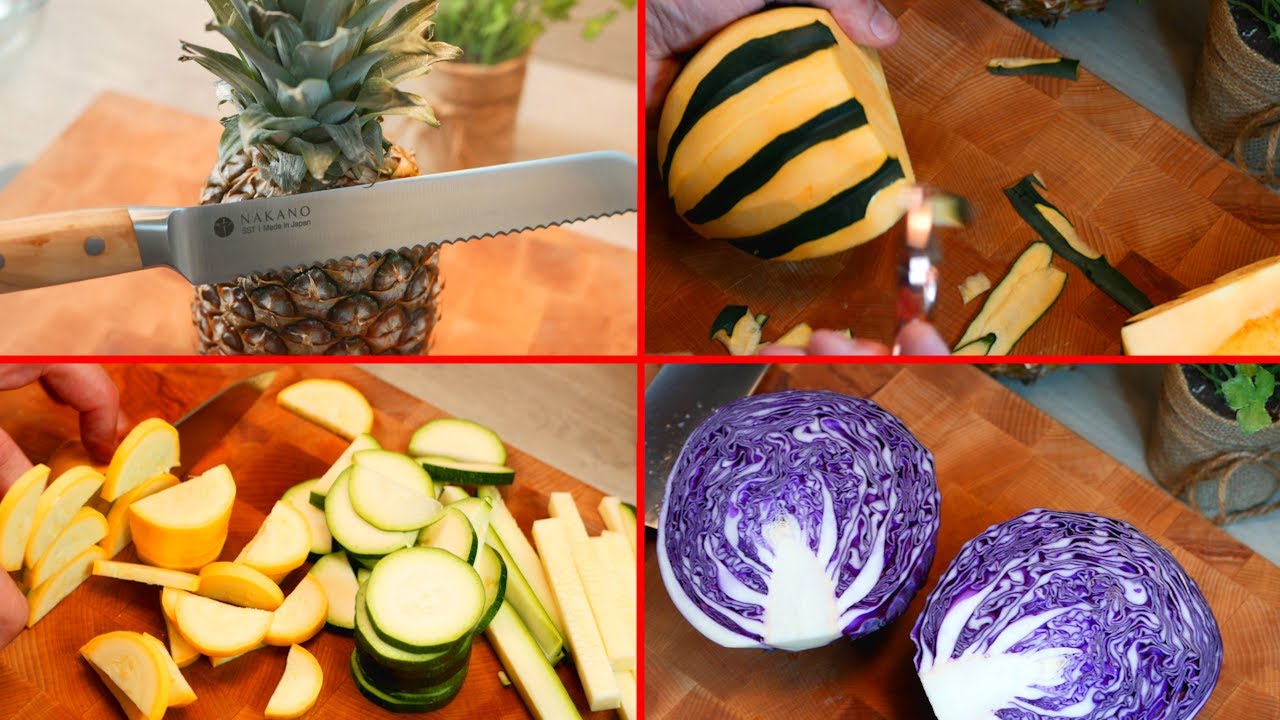
Today, I’ll be sharing how to cut some of the most common fruits and vegetables at home. In the process I’ll be putting to the test a set of knives from Nakano-Knives.
If interested in these knives or any of their other knives and accessories, use promo code ZONE07 at checkout to get 20% discount, and if you signed up for their voucher, you’ll get an additional 25% discount for a total of 45% off of your purchase! Link below.
Below I also listed the fruits and vegetables with timestamps that will take you straight to the ones you want to reference.
Thanks for Watching!
Nakano Link: (affiliate)
https://nakano-knives.com/zone07
20% PROMO Code: ZONE07
Equipment: (affiliate)
Nakiri Knife: https://amzn.to/3GXIR57
Pairing Knife: https://amzn.to/3S4yva0
Knife Guards: https://amzn.to/41EUdEC
Microplane Zester: https://amzn.to/3NKK82X
Chapters:
0:00 Intro
1:46 Acorn Squash
2:54 Asparagus
3:20 Avocado
4:06 Basil
4:24 Bell Peppers
4:59 Broccoli
5:21 Butternut Squash
6:14 Cabbage
6:49 Cantaloupe
7:24 Carrots
8:12 Celery
8:39 Cauliflower
9:23 Garlic
10:17 Ginger
10:52 Grapes/Cherry Tomatoes
11:15 Jalapeños
11:49 Lemons
12:30 Lettuce
12:54 Limes
13:38 Mushrooms
14:16 Onion
15:28 Parsley/Cilantro
16:03 Pineapple
17:00 Potato
17:51 Scallions
18:35 Squash/Zucchini
19:13 Strawberries
19:45 Tomatoes
20:59 Closing
============================================================
Music by:
Pixabay: https://pixabay.com/users/madirfan-50411/
https://pixabay.com/music/beats-madirfan-nightballad-caught-in-the-rain-21597/
Pixabay: https://pixabay.com/users/migarajay-24992711/?amp;utm_medium=referral&utm_campaign=music&utm_content=119428
Pixabay: https://pixabay.com/users/fassounds-3433550/?utm_source=link-attribution&utm_medium=referral&utm_campaign=music&utm_content=112191
Uppbeat (free for Creators!):
https://uppbeat.io/t/pecan-pie/evening-kisses
License code: JA1NMA1P6WKIQWLR
In today’s video, I’m going to show you how to chop some of the most commonly used vegetables and fruits, and I’ll be chopping away with a set of knives from the folks of Nakano. So, let’s take a look at what they sent me. The packaging looks solid and well put together.
Although the box is sturdy, it’s not recommended as a permanent home for the knives. They do offer an attractive magnetic block designed to safely hang them. Unfortunately, they didn’t provide me with a sample, but they did provide me with these images.
Another viable option if you plan to keep them in the drawer is to use knife covers. I like to use the Noble Home and Chef brand because they’re lined with felt, giving them an extra layer of protection. I have links in the description for all these items, including my own Nakiri and paring
Knives that I’ll also be using throughout the video. Okay, so the first knife is their Chisana, also known as the petty knife, used for small, precise cuts. It’s bigger than a paring knife, with a size of 5.3 inches. It’s well-balanced and feels good in the hand.
Their second knife is the 8-inch Gyutou, Japan’s version of an all-purpose chef knife. The blade is thin and very sharp. It’s well-balanced at the pinch point, and it feels great in the hand. All the handles are made of natural olive wood, with the blade being a French-inspired full tang.
The next knife is the smaller Santoku at 6.7 inches, which is great for chopping vegetables and is convenient for cooks with small cutting boards or those that don’t feel comfortable with larger knives. Last is the Pankiri, known as the serrated bread knife, with a length of 8.2 inches.
Now, they say that the blades are constructed from high-carbon stainless steel, so we’ll see how they hold up. Right now, you can get 20% off any purchase using the coupon code Zone07. And at the posting of this video, they’re also offering a 25% access voucher that, when
Combined, will give you a 45% discount. When you get to their homepage, scroll down, and you’ll get a popup with a 25% voucher. And at checkout, enter code Zone07 for the additional 20% off. Enough intro; let’s get started.
Acorn squash: Start by slicing off a small piece to stabilize it on the cutting board and keep it from rolling all over the place. Next, carefully slice off the ends. Slicing instead of chopping is not only safer but also makes working with dense vegetables more manageable.
Take the tip of the knife and drive it through the center and press. This one was a bit harder than usual, so I had to put some muscle into it and use my elbow to help it cut through. Insert the knife again and do the same on the other side.
Pull it apart and scoop out all the seeds. Now you can peel off the skin with the peeler, but it’s going to take a while because of all the crevices you have to get into. All you have to do is just hold it in one hand and start peeling away.
You can also peel it like most people by using a knife and cutting around. You won’t lose much flesh, and it’s much faster to do this. Stand it up and cut around as close to the skin as possible. Just work your way around it until you get most of it.
Then pick it up and trim off the end pieces. Now cut it into slices by laying it flat and slicing across, making about one-inch-thick slices. This is perfect for roasting or adding them to soups. From here, you can keep going and cut them into cubes.
This is great for sautéing to caramelize them and then roasting them. Both ways are great for roasting in soups. Asparagus: Instead of snapping them and wasting a bunch of good asparagus, simply cut about an inch off the ends and check if it looks fresh.
If it’s not, cut off another inch, but I’m sure an inch is enough. Now take a peeler and peel them about 3/4 from the top down and all the way around. You can poach, grill, or roast them just like this or cut them diagonally into bite-sized pieces.
These bite-sized pieces also work great for sautéing. Avocado: Stick the knife until it hits the pit in the center and cut all the way around. Once done going around, just twist it apart to expose the pit. Lightly tap the pit with the knife, twist, and pull it out to get the pit off.
Just pinch it with your thumb and pointer finger, and the pit will easily and safely pop off. Now use the spoon to carefully scoop out the flesh as a whole. To cut it into thin slices, put it on its flat side and slide the tip of the knife from end to end.
Lightly press it to spread it apart, and now you can lay it as it is on toast or as a garnish on a dish. Just remember to sprinkle some salt and pepper on top with a few drops of lime juice.
You can also cut it into chunks with a spoon and scoop it out to make guacamole or other spreads. One thing for sure is that if you need a knife to cut into the avocado’s flesh, the avocado is not ripe enough.
Basil: Now I ran out of basil, so I’m using baby spinach leaves. This will work the same for any leafy herb. Stack the leaves on top of each other from larger to smallest, roll tightly like rolling a cigar, and thinly slice it.
This is called chiffonade, and it’s great for adding to sauces or using as toppings. Bell Peppers: First, cut off the stem part. Then stand it and cut around the core, trying to leave as much of the white part with the core as possible, as it’s a bit bitter.
To cut into slices, you can either stack some pieces or do one at a time, whichever makes you feel more comfortable. I find it easier skin side up because it ensures that it cuts all the way through. There’s nothing more annoying than having to run your knife a second time through the
Same cut. Here I’m cutting them into quarter-inch slices, which are great for sautéing or making stir-fries. From here, you can turn and cut them into dice, which is great for breakfast home fries or an omelet. Broccoli: Carefully stand it on its florets and start cutting them off while going all around.
Once they’re all off, you can cut the bigger ones in the center to make them all the same size. Now don’t just get rid of the stem, as the center is very tender. Just cut off the woody hard sides all around and trim the dry bottom.
Cut into slices, and it’s ready to eat or to be cooked with the florets. Butternut Squash: First, I’m going to peel it by running the peeler from top to bottom. This “vegetable” gets slippery as the skin comes off, so you may want to use a towel to help your grip.
Once it’s all peeled, firmly cut straight through just above the bowl, which is the round part just below the neck. You’ll want to cut it by rocking the knife back and forth while pressing down for a stable cut.
Now that it’s in more manageable pieces, you can cut off the ends, stand it up, and cut straight down by rocking the knife back and forth again. Now we scoop out all the seeds, lay it on its flat side, and cut it into about 1-inch
Slices, which look great in soups or even roasted. From here, you can keep going and cut it into cubes, which also works great for sauté. Now we do the same with the neck. Just be careful as the vegetable is very dense but delicious.
Stand it up, cut it all the way down the middle by rocking the knife, cut it into slices, and then cut them into cubes. Cabbage: The first thing I do is carefully slice off the root end. Then I remove the first or second layers, which are sometimes dried or mangled.
Next, slice it down the middle, being careful as this vegetable is very dense. I then cut into wedges and wrap what I’m not going to use with Saran wrap. Now extend the wedge on the side and cut off the heart at an angle.
If you want to make coleslaw, then using a mandolin would be best, but you can also use a knife to shred it. Start at the tip end and work your way all the way across. Take your time and just use a slice-in motion.
When you get towards the end, lay the smaller piece down for stability and continue slicing. Cantaloupe: Stick the tip of the knife in the middle and press down. Insert the knife again and do the same on the other side. Pull it apart and scoop out the seed. Next, cut it into wedges.
Now a trick for cutting anything into wedges is to cut it slightly off-center to the wedge. Put one side of the knife opposite the other side of the wedge. It will make it a lot easier, and folks won’t even notice.
To remove the skin, run the knife parallel to the skin and just slice it off. Just make sure you stay above the green part of the skin, as it doesn’t taste so good. You can serve it as wedges, or from here, you can cut them into cubes and serve them
With toothpicks or throw them into a salad. Carrots: Hold the carrot from the root end and run the peel from end to end while going all around. Without worrying about the end, we’ll get them next. Once you go all around, flip the carrot, and peel the root end.
Now cut off the tip and the root. First, I’m going to focus on the larger piece. I usually trim off the small piece to stabilize the carrot and keep it from rolling all over the place. Now I cut it into about 4-inch slices to eventually turn them into julienne.
Now you can cut them into quarter-inch sticks to use them for dips. From here, you can turn and dice them into cubes for sauces, soups, or for sauté. Another way to cut them is using the roll-cut technique, which is great for stews or roasting, and it gives them a nice look.
Simply cut it diagonally, roll the carrot, and repeat. It’s very easy to do; you can cut them into different sizes depending on what you’re going to use them for. Celery: Peel up the branches you need if not using the whole bunch.
They’ll definitely have dirt, so make sure you wash them thoroughly before cutting. To make celery sticks for dipping, trim the bottom and leafy ends and cut them to the desired size. You can leave the U shape for scooping dips or filling them with peanut butter.
You can also cut them in the middle to make thinner sticks. You can finally dice them for soups or dice them into quarter-inch thick pieces for sauté or to have more texture in other dishes like salads.
Cauliflower: Using a smaller knife, trim off the root end if it has one, as some of this just come with a few leaves. A smaller knife in this case will make this easier, as you’ll have to maneuver the knife around trying to cut off the leaves before the florets.
Stick the knife in between the leaves and cut them from the stem. As you can see, this one had a lot of dirt in it. Just wash off the dirt and clean the cutting board. Once you have removed most of the leaves but before cutting the florets to prevent them
From getting dirtier, once most of the leaves are off, carefully place the knife at an angle towards the center of the core and cut around it to release the florets. Once the core is off, you can just gently break off the larger pieces or cut them in
Half if you want to make them smaller. You can also slice them thinly if you want to speed up the cooking process for when making a puree. Garlic: To separate all the pieces, press down with the root end facing up. Now, this works if it’s not refrigerated.
If it is, you’ll have to smack it harder or separate them with a knife. To easily peel them, cut off the root tip and slightly smack it with the flat end of the knife to loosen the skin. The skin will easily come off.
You can finally slice it to make garlic chips or for sauces. From here, you can cross chop it to mince it. You can also pat them by placing them at the edge of the cutting board. Make sure the knife’s handle is past the board so that you don’t break or bend the knife.
We need to make sure that the blade lays flat on the board. After peeling it, just smack it firmly a few times while pushing away to completely flatten it. Then cross chop it. As you can see, you don’t have to put much effort when cross chopping.
Just let the knife do all the work. Take a look at how I’m lightly gripping the end of the knife and just let it rock back and forth to do double the work in half the time. Of course, you can also use a garlic press or a fine grater.
Ginger: Just break off the piece you want to use. Remember that a little goes a long way because of its intensity. Now, the best way I found to peel the ginger is to use a spoon because its skin is so thin. Just scrape it off.
The great thing about the spoon is that you can get it into all types of crevices with no problem. Now the skin is completely off. You can thinly slice it and use it in drinks. From here, you can cross chop it to finally mince it and use it in other recipes.
You can also puree it using a Microplane. Just be careful when grating the ginger not to catch your skin. Just slide it back and forth as most of it will stay attached to the plane. Flip it over and scoop it out.
Grapes and other small fruits like cherry tomatoes: Instead of cutting each piece in half and taking the lifetime to make a bunch, simply use two lids with the rim and sandwich the grapes between them. Apply light pressure with one hand on top to keep them steady and carefully run the knife through them.
You’ll be done in no time. If you don’t have lids or need more area, just use the bottom of two rim plates. Jalapenos: Cut off the stem, slice them in half, and with a teaspoon, scrape off the veins and seeds.
This will become little canoes for hummus, soft cheeses, or whatever you want to fill them with. From here, you can take it a step further by turning them on their flat side and cutting them into strips to be used for sautéing or in salads.
And from here, you can go even further and turn them again and dice them into cubes for guacamole or to be used in sauces. You can also take a whole jalapeno and cut them into thin rounds to be used in sandwiches, burgers as toppings, or even for pickling.
Lemons: To turn into wedges for cocktail drinks or to serve on the side, we must first cut off both ends, slice them in half, and pick off any seeds. Next, make a small cut with the tip of the knife so that it can sit on the rim of a glass.
Next, lay it flat and try to cut them into even wedges. No one will notice if you’re off by a little bit. You can clean them up a bit by trimming off any of the white bitter center.
You can also cut them into cubes to be served as a side for squeezing into dishes. Some folks just want a small amount and not a whole wedge. You can also cut them across in the middle and lay them flat on the grill and sear them
Enough so that the ends caramelize and soften to be served with fish or chicken. It makes a huge difference when sliced like this. Lettuce: Cut off the root end and cut it in half. Here, you can cut them in half again to make wedge salad, to finally shred it to be used
On sandwiches and salads. Just start off at one end and work your way to the other side. I changed knives midway because I figured a larger knife would make things easier. My Nakiri knife would have worked great here, but since we’re testing these knives out,
I figured we use the chef knife, which also works great. Limes: Limes are often rounder than lemons, which means that you can just cut them in half to make wedges. After cutting them in half, make a small cut in the center with the tip of a knife.
This is so that they can sit on the rim of a cocktail glass. Lay it flat and cut it into even wedges by angling the knife a bit towards the center of the lime. The little slice is perfect for placing them on the glass.
You can also cut them across and then slice them to give them a stylish look. In this case, you don’t have to make the center cut as they are naturally sliced. The other way holds much better, though.
When cutting a bunch to be used later, you can cut them into cubes to serve them as a side for soups or to be squeezed over fish. To cut them into cubes, simply cut them half in half again, turn it, and cut it into thirds.
Mushrooms: The one misconception about mushrooms is that they can’t be washed, or they will absorb water. You can put them in water and rinse off any dirt. Do dry them first if storing or sautéing them. You don’t want to store wet mushrooms as they will rot faster.
You can take the woody end off or keep it. It depends on the mushroom type. Some are very woody. You can thinly slice them for quick sauce sauté sauces or if you want them to disappear in your dish. Here, I did one with and without the stem.
The stems give them the natural look we’re used to seeing, and that plays a part in some plating dishes. You can slice them a bit thicker for a meatier texture or if you want to show them off in your dish. Onion: First, remove the ends.
Make a thin slice from root to tip and peel off the skin. Some folks take off the first layer along with the skin, but you can just peel off the skin. It’ll just take a bit more time. To cut them into thick slices for fajitas, cut it in half from root to tip.
I like to trim off the root size so that it can easily fall apart after I cut them to give them a more uniform shape. Cut it into half-inch slices with a knife on a slight angle towards the center of the onion.
Once you cut them, you can pull them apart, and they’re ready to use. You can also cut them thinner to be used in sandwiches, pickling, or caramelizing. This is the most common thickness for this type of cut.
To dice it, this time we leave the root end intact so that it helps hold the onion together while we dice it. Make thin slices along the top from root end to tip without going all the way to the root.
Be careful when getting close to the end, as some duller knives may slide and catch your finger. Now, the onion is naturally layered, so you don’t have to make the horizontal cuts to make the perfect dice. The cuts are naturally made by the onion.
Next, turn the onion and cut across once you reach the end. Turn it once more and dice the end part. Some recipes call for bigger pieces like for soups or for when dicing is not needed. In this case, simply cut across, turn, and cut it into thirds. This saves a lot of time.
Parsley or cilantro: This works the same for all similar herbs. Grab the bundle by the stems, slice off the leaves, and watch them just fall off. You can pick off any stragglers near the stems. For parsley, it’s not recommended to use the stems as they can be a bit bitter, but cilantro
Stems have a ton of flavor, so they can be safe for adding to soups or stock. After slicing off the stems, pull them in tightly and rough chop them by slicing through them. Keep a grip on the leaves and gradually move down the bundle as you make your way with a knife.
To finally chop them, just turn them halfway and chop them again. You can then rock the knife back and forth for an even finer chop. Pineapple: Cut off the bottom end and leave the top to use as a handle.
Cut the skin off all the way around as close to the edge as possible. I’ll remove the eyes after removing the skin. This way, I can get the most out of the pineapple. Once we’re done with the skin, hold the pineapple from the top and, using a smaller knife, cut
Off the eyes by making small slits on each side. Sometimes you can catch three in a row. You can work your way around from top to bottom or vice versa. Here, I started from the bottom, and I’m not sure why, as I almost always start from the top.
I guess my angle was off because I was trying to stay clear of the cameras. The more often you do this, the faster you get, so don’t worry if it takes a bit long the first time around. After we’re done, I cut off the top and stand it.
I split it down the middle and then split them down the middle again into quarters. In the center is the tough woody core, which I remove by setting it up and running the knife along the cord, leaving only the best part of the pineapple.
I then laid them down flat and cut them into slices, leaving them ready to eat. You can also cut them a bit thicker and then cut them again into cubes. Potato: The best way to peel them is from end to end first and then finish off each end piece.
The skin doesn’t always need to come off; it can be edible depending on the type of potato or how you plan to cook them. To cut them into one-inch cubes for boiling or roasting, first slice off an end to stabilize the potato and keep it from rolling off.
Cut into one-inch slices, cut them in the center, turn, and cut them into one-inch cubes. Now, if you have a larger potato, you might want to cut it into thirds first. Just try to keep them about an inch thick. For fries, cut them about a quarter inch thick.
Now, you don’t need a ruler; just eyeball it, and it’ll be fine. Lay it flat and cut them into quarter-inch sticks, or what we call julienne, and there you have your fries. For home fries, turn the sticks again and cut them into quarter-inch cubes. This will cook faster on the stovetop.
You could also roast them in this size, but you just need to keep an eye on them, or else they can dry out or burn. Scallions: First, cut off the root ends. Typically, I remove the first layer as sometimes it’s not the freshest.
I sometimes separate the green leafy end from its white counterpart and cut it into large pieces on the bias for stir-fries or to use as a garnish. From here, you can also finally chop them to spread over a dish.
The most popular cut, which is even so dried, is slicing them across, making small rings. You can also fold the whole piece in half and cut both ends at the same time to save time. You want to cut the white ends in half, then dice them, as they are denser than their leafy
Counterpart. Thicker scallion root ends might require cutting them in half twice before dicing. This allows them to cook evenly. Squash and zucchini: First, cut off the ends. You can cut them into thick slices, which are great for grilling. From here, you can turn them into julienne by cutting them longways, about a quarter
Inch thick, for a quick sauté or for salads. From here, you can dice them by turning and cross-cutting them to be used in soups or for a quick breakfast sauté with eggs. You can also make the popular disc by making quarter-inch thick slices across or cut the
Squash down the middle and slice them to make half-moons. The yellow squash is very similar, pairing these two gives your dishes a nice color contrast. You can slice two at the same time if they’re small enough and you have a large enough knife. Strawberries: Pick off the leaves to expose the stem.
Now, use a paring knife to cut out the stem end. You don’t want to serve them with that. Use your thumb to prevent the knife from going in too deep by placing it about half an inch from the tip.
Insert the knife at an angle towards the center and spin the strawberry while cutting out the stem. For garnishing, stand it up and cut almost all the way down but leave enough to keep the slice together. You can then fan them out, and they’ll stay put.
To make individual slices, just cut them all the way down. This will look great in desserts or drinks. Strawberries: Pick off the leaves to expose the stem. Now, use a paring knife to cut out the stem end; you don’t want to serve them with that.
Use your thumb to prevent the knife from going in too deep by placing it about half an inch from the tip. Insert the knife at an angle towards the center and spin the strawberry while cutting out the stem.
For garnishing, stand it up and cut almost all the way down, but leave enough to keep the slice together. You can then fan them out, and they’ll stay put. To make individual slices, just cut them all the way down. This will look great in desserts or drinks.
Tomatoes: First, I have to remove the core. I place my thumb about an inch above the tip of a small blade to prevent the knife from going in too deep. I angle it towards the center of the tomato and insert it near the core.
Now, just spin the tomato while slicing until the core comes out. For salads, slice it in half, lay it flat, slice it in half again, and slice them in half one more time to make wedges. These are ready for salads.
From here, you can go a step further and run the knife along the bottom to remove the seeds. This is great for stir-frying. Just remember that tomatoes cook very fast, so they need to be added at the end of the stir-fry.
With the seeds gone, you can make julienne slices by cutting the wedges in half one more time. From here, you can crosscut them and turn them into perfect seedless dice. To make slices for sandwiches and burgers, just crosscut the whole tomato. The thickness depends on the use.
For sandwiches and thin burgers, a quarter inch is best. For burgers that are half a pound or more, closer to half an inch will be better. A half-inch thickness also works great if planning on frying them.
From here, the fastest way to turn them into julienne or to dice is to stack the slices and cut them into julienne. To dice them, simply turn the julienne slices and cut them into cubes. Here, I’m showing the bread knife in action, cutting into sourdough bread since it didn’t get enough screen time.
Well, the knives worked out very well, and they were able to keep up. They make a great gift for anyone looking to expand their culinary journey, update their knives, or even as a gift to yourself. Do check the video description below for discounts if interested.
Well, I hope you found this video useful, and thanks for watching.
1 Comment
Nice to see a video of yours again.