
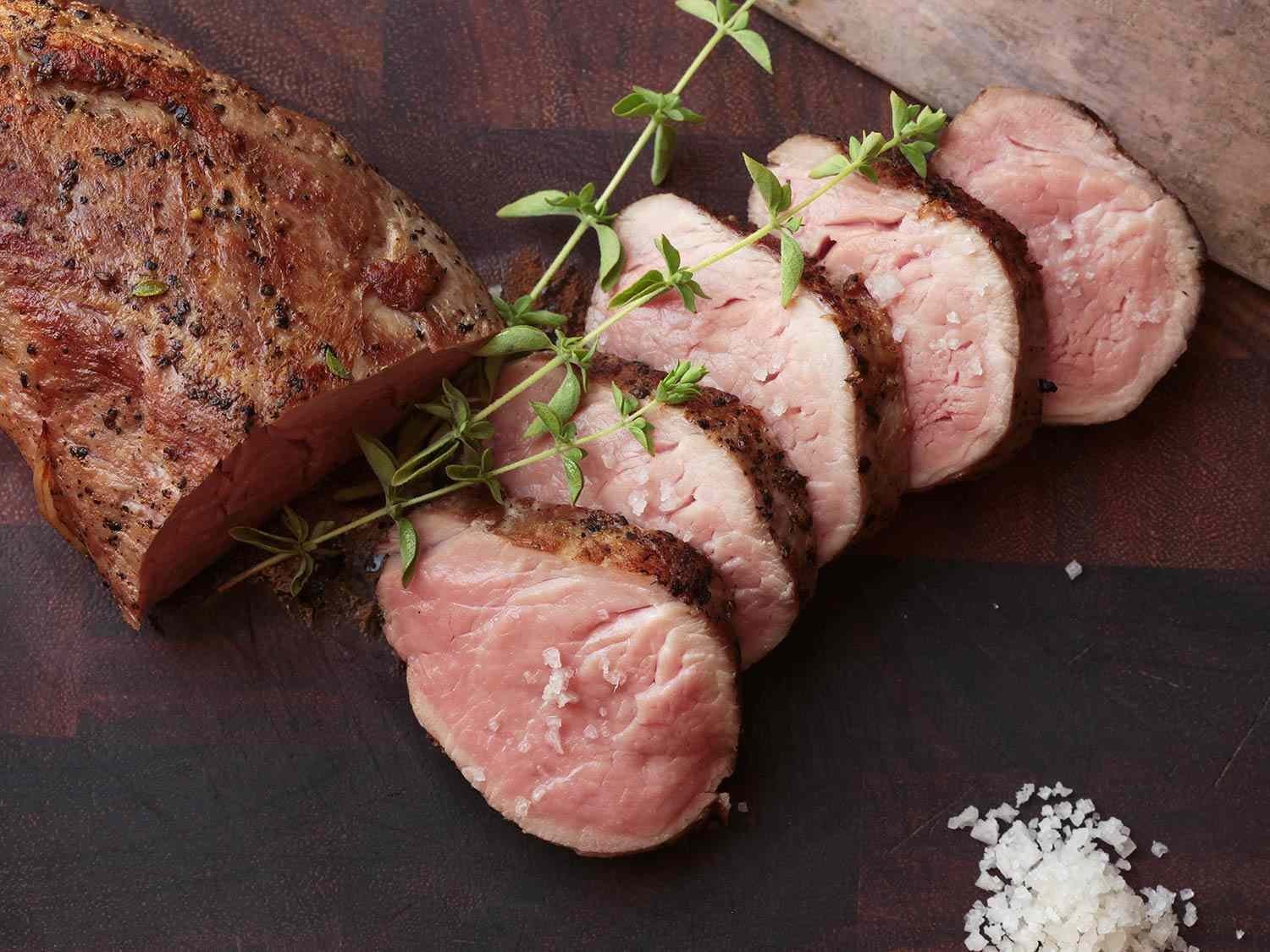
I'm planning on making people tenderloin according to the recipe found here:
https://www.seriouseats.com/sous-vide-pork-tenderloin-recipe
My girlfriend is hesitant for me to cook at 130F and wants well done. I don't want Sahara levels of dryness. Please say something to calm her fears so I can show her.
by Infamous_Librarian72
14 Comments
Do 140 then.
As long as the meat is held at 130 for at least 30 minutes, trichinosis can’t survive.
The number one cause of trichinosis poisoning in the US is bear meat. Think how few people eat bear.
The US has about 15 confirmed trichinosis cases per year. The likelihood of contraction is incredibly rare.
Why not just how her the article you linked? Kenji explains the food safety and even links another article that goes way more in depth about it.
138 is my sweet spot.
Trying it at different temperatures is the only way to find out what’s best for you.
I think 138 is a safe choice to start with, 140 for something a little bit less pink.
As with all meat, each tenderloin will be a bit different depending on animal breed and lifestyle etc
The recipe gives temperatures and then says 1 to 4 hours for all the temperatures (med rare to well done)….why such a wide range? Why would someone do four hours when they can do one? (I’m brand new to sous vide.)
I’ve been enjoying pork tenderloin at 130 for a few years now. As long as the tenderloin is held at 130 long enough, you’re good. Plus the pink juicy center is probably one of the best ways I’ve ever eaten pork.
I just made one at 140 for about 2 hrs, still moist tender and delicious, so you could start there. I pat it dry, freezer for 10 min then sear. I guarantee it wasn’t at Sahara levels of dryness!
I do mine at 133F. My wife, who was raised on well-overdone pork, loves it. I hope that yours does too.
I did 140F last night for 4 hours and it was a bit meh in terms of juiciness. That said, I was trying a suggestion to sear using my oven’s broiler, which I think just dried it out to be honest. I have better success searing with my cast iron or stainless steel, so I’ll probably stick with that for the future.
I go for about 60C (140f) for one hour with as little sear as possible just enough that it doesn’t look anaemic. Blow torch is actually best here if you want more colour as the heat doesn’t penetrate… this temp gives a medium steak equivalent for juiciness and cooks it enough so that well done folk can’t visually tell it’s not well done.
Source: SO is a weirdo who likes everything well done.
130 is considered safe but that is pretty rare for most people. I go 140 to feed my family but even for myself I don’t think I’d want less than like 136.
Here is mine at 130 for 2 hours. It was perfect but I could understand it looking too “pink” for some that are nervous. You could always cut it in half and cook them separately.
https://preview.redd.it/c6rl8wn31lhe1.jpeg?width=4032&format=pjpg&auto=webp&s=9f073675d3b442d9db3f7f13ed9af1289cca3025
Tell your soon to be ex-girlfriend to calm herself. Lol jk
Few things to tell her. For non-poultry, non-ground meat. 145⁰F/63⁰C held at least for 3 minutes, has been the FDA recommendation for, I think, like 15 years. And that was only because no one fucking listened to them when cooking pork. 165⁰ pork is meant for the hockey rink.
I personally cook my lean pork to 135⁰/57⁰ as anything above that can feel a little dry for me personally if it’s a super lean cut. I like the lower temp too especially when reheating leftovers so they don’t get to overdone. (Im just one person so left overs are a big deal for me.)
Let’s talk about pathogen log-reduction in meats. YAY science. I’ll make it as easy as I can.
So make sure to do your own research from multiple credited sources like usual but here is an outline from the FDA of ‘merica.
Pathogen log reduction is basically how well you can eliminate or reduce the amount of nasty microbes and such. It’s not exactly possible to fully eliminate all the bad bugs and still keep the meat edible. So that’s why we have an immune system and keep the pathogen population to a minimum. So how do we do that in meat we want to cook and eat?
1 log is 90.0% reduction in pathogen population.
2 log is 99.0%
3 log is 99.9%
4 log is 99.99%
And so forth. The amount of 9’s is directly linked to the log reduction number. If you had a 9 log reduction. That would be 99.9999999% reduction.
We can do this a few ways but I’ll detail what we are here for.
[Time and temperature charts – PDF download](https://www.fsis.usda.gov/sites/default/files/media_file/2021-12/Appendix-A.pdf)
*
Not sure if the picture will show in the post but page 35 is what you want. This will show you how long and what temp gets you the log reduction for safe consumption.
A lot of this is coming from memory and few Google searches to get the chart links. So hopefully, I still have this all right, and please add or correct me if I messed up.
Also, trichinosis is very rare in commercial pork. Now, for legal reasons. This is just my opinion but I eat many non- ground meats at “undercooked” temps because I have no kids or old people or immuno-compromised people that would have an increased risk. Where food poisoning could be very bad or fatal for them but I also live in America. I have close access to a hospital if things get really bad. And if things go for the absolute worst ending. Eating undercooked meat won’t be a problem ever again for me. Lol