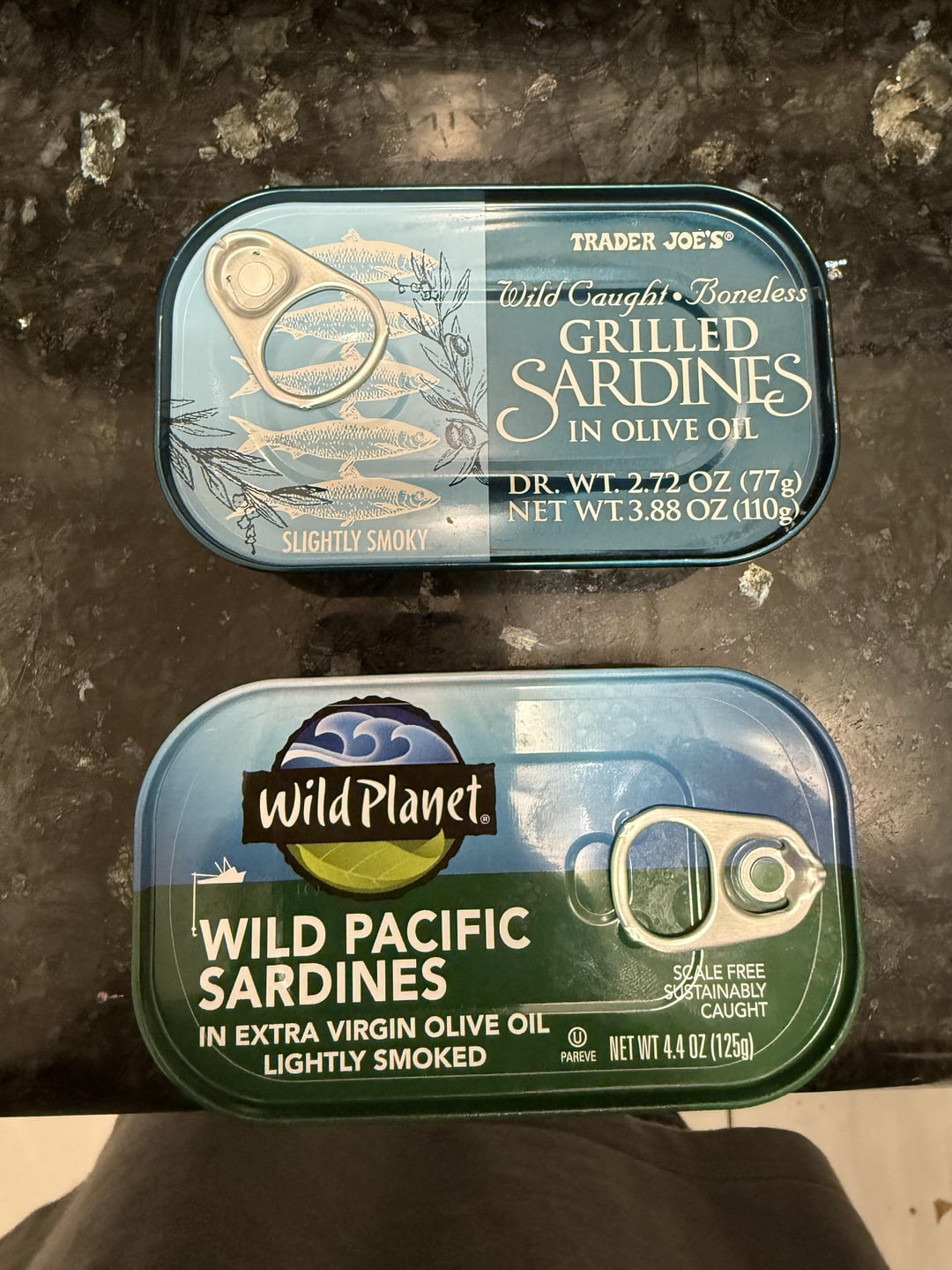
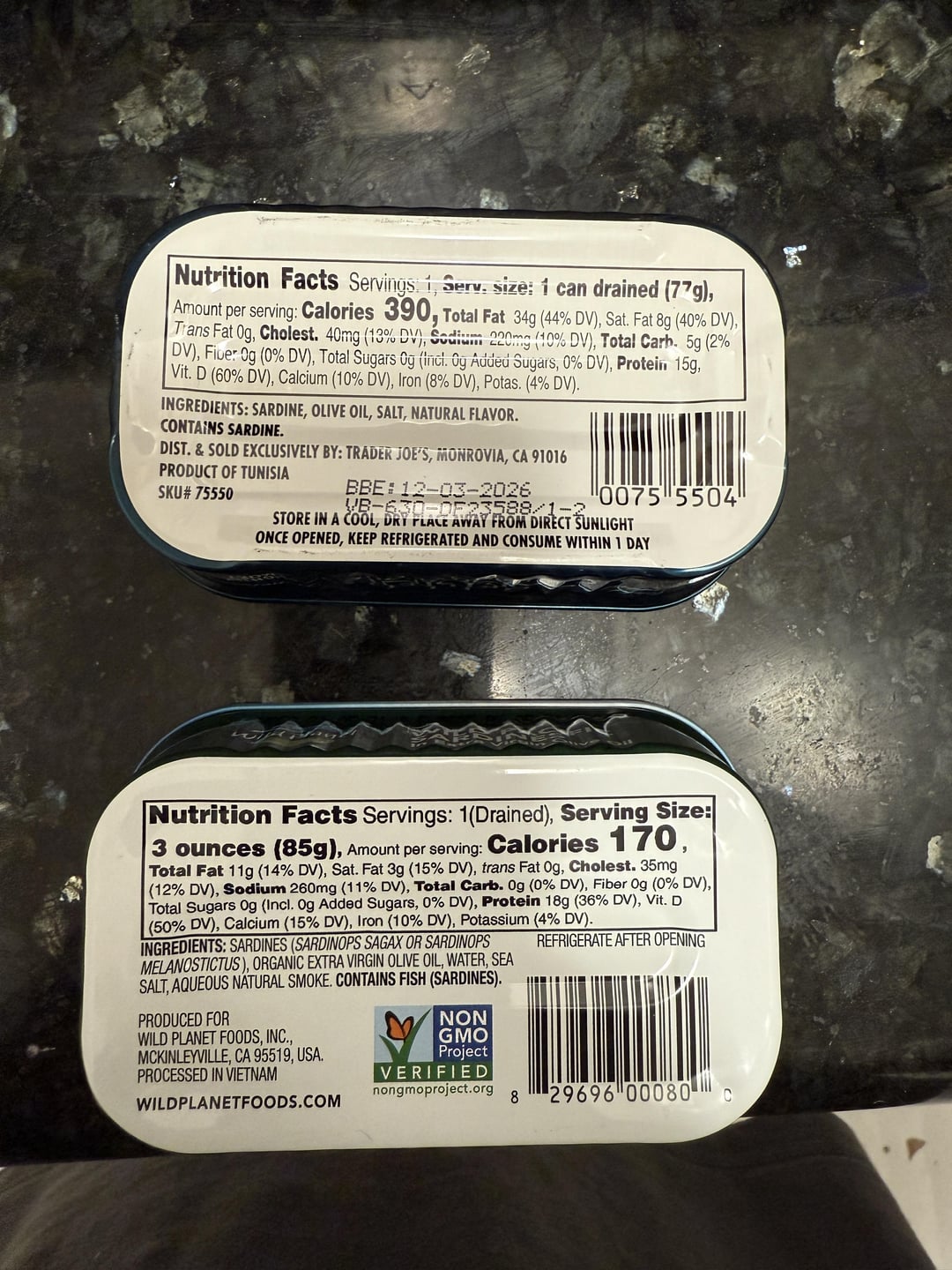
I’m really perplexed here, comparing these two I can’t understand why the Trader Joe’s tin would have so many more calories of a comparable amount of drained fish.
by zimtastic

I’m really perplexed here, comparing these two I can’t understand why the Trader Joe’s tin would have so many more calories of a comparable amount of drained fish.
by zimtastic
12 Comments
my guess? Someone isn’t counting the calories from the oil. BUT if you don’t drink or use the oil you aren’t eating it…so there’s that. I use my deen oil as a salad oil.
I think the higher calorie count is correct. Even if you drain the can there’s going to be a thin coating of residual oil inside and outside of the fish that you eat, and oil has a lot of calories. This is why I buy tinned fish in water. I never found the taste of the oil to be worth ~200 cals more than the fish stored in water.
Servings 1 vs. Servings 1 (drained).
We had this come up before and think there’s an issue with the label on the grilled sardines. Perhaps it says drained, but has the info for undrained.
Oil/boneless
vs
Oil & water/boneless skinless
According to the ingredients list, the 390 calorie one has sardines in oil, the 170 calorie one has sardines in oil and water. That could explain at least some of it.
One of those cans is a product of Tunisia (Atlantic/Mediterranean sardines) and the other says Pacific Sardines (processed in Vietnam). I wonder if the species is either slightly different genus or the difference in what they feed on where they’re caught leads to different fat content in the fish itself.
The top one is probably wrong, and is including the olive oil.
It says it is 34g fat vs 3g for the bottom one, but they are both similar amounts of protein (15g and 18g). I find it unlikely that the Tunisian sardines contains 10 times more fat that Pacific sardines.
27g of olive oil is ~240 Cal which is similar to the 220 difference.
Most people think that the grilled sardines can is mislabeled, because it’s also twice the calories of the non-grilled TJs sardines.
Boneless has more meat and skin per volume. Skin has more fat. Also perhaps from different fisheries.
Boneless vs bone in. Bone in healthier and less fattening
You can always reverse engineer a nutrition label
1g fat = 9 cals
1g carbs = 4 cals**
1g protein = 4 cals
**MOSTLY, fiber is different
Insoluble fiber = 0 cals
1g Soluble fiber = 2 cals