
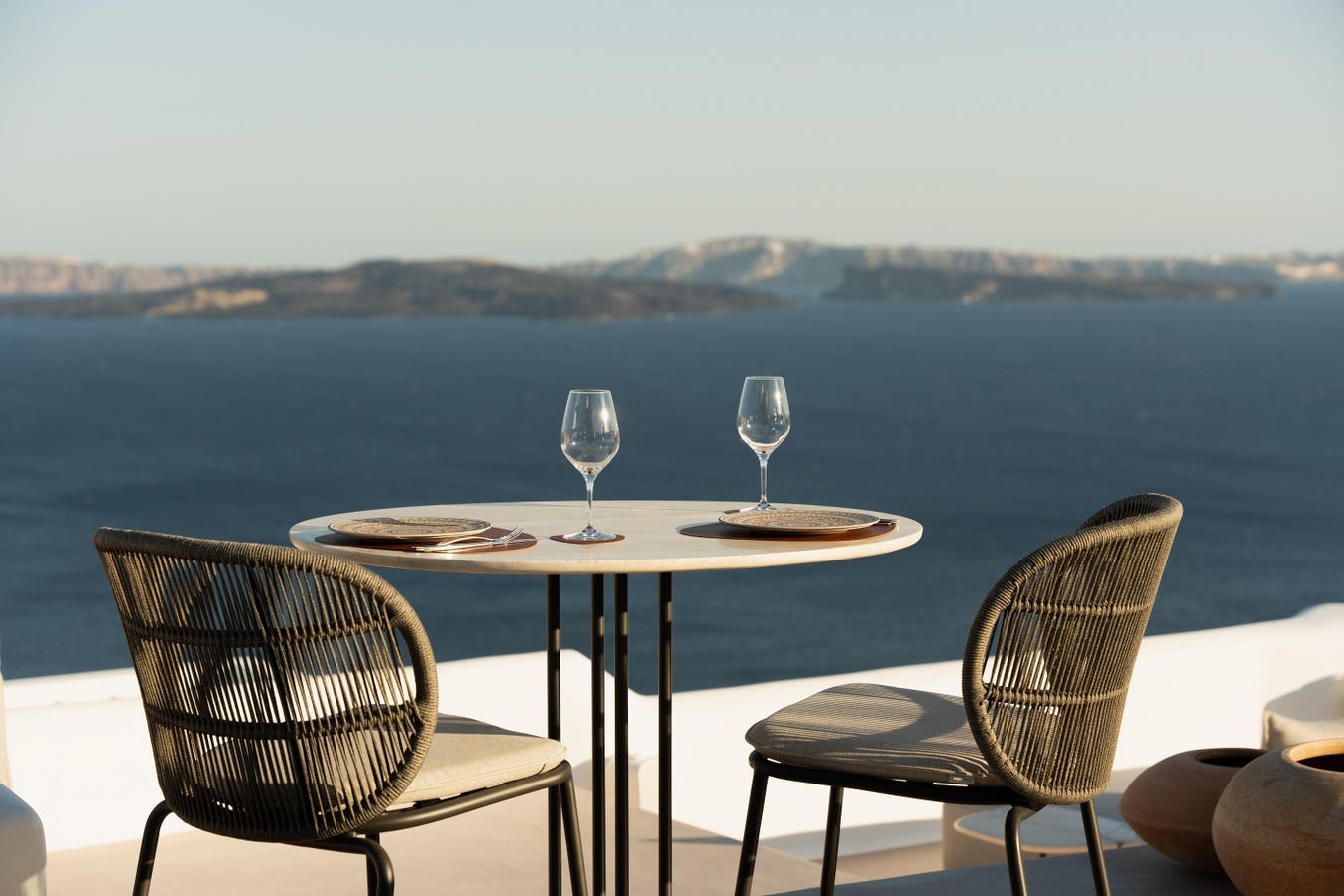
Beyond its breathtaking ocean landscapes and sunsets, Santorini has emerged as a burgeoning wine region.
Canaves Collection
While perhaps best known for its striking white architecture set against the bright blue waters of the Aegean Sea, Santorini’s winemaking tradition is recapturing the interest of oenophiles.
At the heart of this experience is the assyrtiko grape, a variety deeply intertwined with the island’s unique terroir.
Santorini’s wine culture is one of the oldest in the world with a 3,500-year history,” says Elina Dakanali, wine director at the Canaves Collection, which runs several luxury properties across the Greek isle. “As a result of one of the greatest volcanic eruptions of all time, Santorini’s strong agricultural tradition is rooted in its soil which has a unique texture and includes lava, volcanic ash and pumice stone. The vineyards in Santorini are self-rooted as they were never affected by phylloxera, combining the unique natural landscape with the great agricultural heritage.”
Dakanali further emphasizes the role of the volcanic soil in shaping the island’s wines. In this rarefied terroir, Dakanali says assyrtiko is king, accounting for 80% of the vines.
“The vineyards in Santorini are self-rooted as they were never affected by phylloxera, combining the unique natural landscape with the great agricultural heritage,” she explains. “Santorini’s volcanic landscape, resembling a moonscape, demands a meticulous approach to viniculture.”
On Santorini, assyrtiko produces powerful, full-bodied wines with an ABV of 15% per 750-milliliter bottle. Dakanali acknowledges that these wines are a bit unctuous, describing that they are similar to northern Rhône white but are most often compared to white Burgundy.
“They are distinguished by rippling acidity and a fine-grained mineral texture,” Dakanali explains. “Santorini wines have a cornucopia of flavors, such as bracing citrus and tangy sherbet through grapefruit, lemon or tangerine zest, orange flower, preserved lemon, honeysuckle and hibiscus—all of which are electric and lip-smackingly tannic.”
While Greece’s wine industry is smaller than some counterparts in Europe, Greek wine exports appear to be on the rise. In 2023, Greece exported $107 million in wine, marking a 3.42% increase from 2022. Most of Greece’s wines are exported within Europe and to North America, and they command higher prices abroad than at home.
Santorini’s wine culture is one of the oldest in the world.
Canaves Collection
The Canaves Collection itself takes its name from the traditional caves, or “canaves,” once used by local winemakers to store grapes. These caves have since been transformed into luxe hotel rooms, merging the island’s winemaking past with its current standing as a premier tourist destination.
Guests are invited to explore Santorini’s wine heritage through private tastings and vineyard tours, where they can sample local varieties made from aidani, athiri and mavrotragano grapes. Dakanali described the partnership with local winemakers as an essential part of the guest experience.
“Our position as a luxury resort in Santorini enables us to offer our guests rare and exceptional wines produced by local winemakers, who meticulously craft their wines with the highest quality,” Dakanali notes.
One of the key features of Santorini’s winemaking tradition is the kouloura method, a locally traditional and unique vine-training technique developed to protect grapes from the island’s harsh winds and sun by training vines to form circular, low lying baskets on the ground.
“The shoots are plaited into a wreath, creating a nest of branch and leaf inside which the grapes grow, protecting from endless winds,” Dakanali explains. “The kouloura also catch the night mists that come up from the sea. Irrigation is forbidden, and for months, these sea-frets are the vines’ only source of moisture. When a kouloura is about 80 years old, the crown is cut off and new growth encouraged, but the roots remain.”
This method, coupled with Santorini’s nutrient-poor volcanic soil, results in extremely low yields but exceptional wines known for their minerality and complexity.
“The quality of Santorini’s wines isn’t in question,” Dakanali says. “Santorini assyrtiko combines a fantastic dry extract with a salinity and power that is truly unforgettable.”