
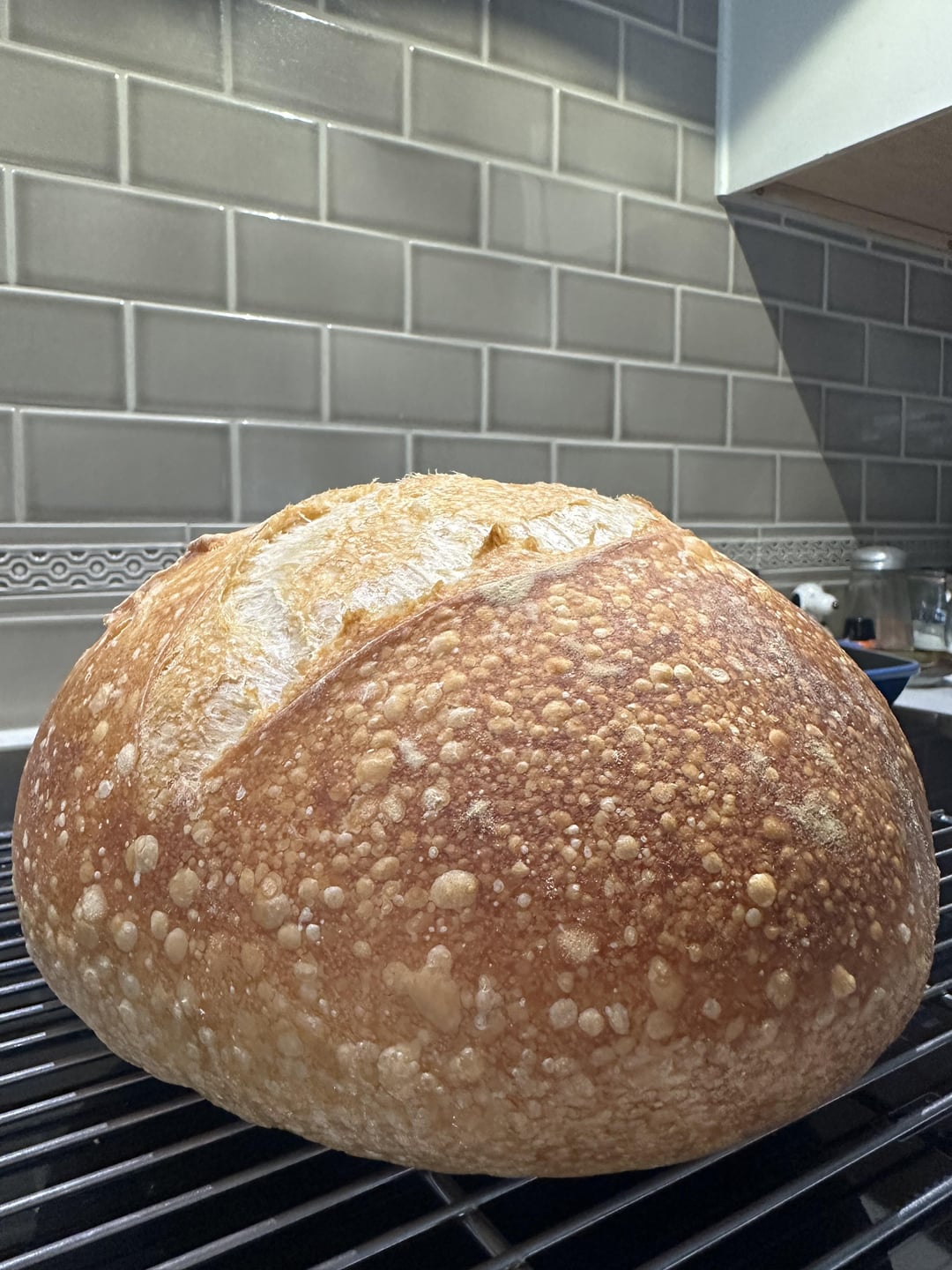
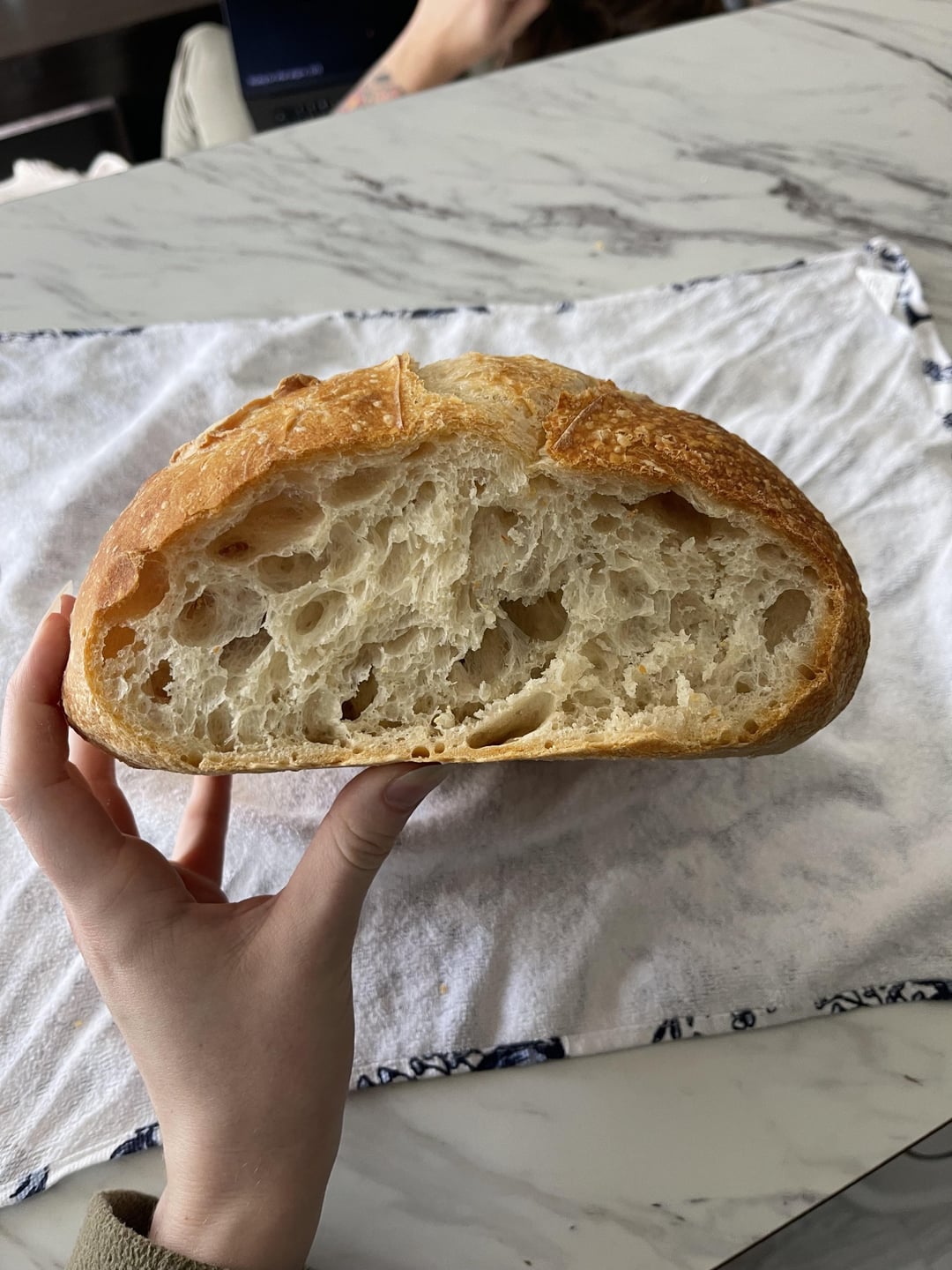
like the title says, what’s something you wish you’d known earlier or a trick you’ve figured out along the way that totally changed your sourdough game?
i watched a video recently ( https://youtu.be/-JRSF-zDgvksi=X3ImbP2balw9W3OQ ) that made me try a 10 minute initial mix that made my dough sooo much more “handleable” when doing stretch and folds. this was my first loaf that was properly gifted to a friend. i was nervous not being able to see the inside before handing her over but i think she turned out okay!
recipe:
mix 150 g starter and 350 g warm water, add 500 g bread flour and 10 g salt, mix well for about 10 minutes, let rest for an hour, (stretch and fold x4, rest one hour) x3, finish bulk ferment (~2 hours), shape, bench rest, shape, let sit in banneton until you can stitch close (~5 mins), cold proof over night, bake covered 20 mins at 450°F, lower to 400°F and bake 30 minutes uncovered, finally, it cooled for about 4 hours before getting cut open but that was only because we sat at brunch for two hours ☺️
by Dry_Paleontologist82
25 Comments
That if you push and pull the dough too tight it causes the crumb to be more dense, the crust to be thicker and harder, and they won’t expand as much as they normally would. Found this out by accident and it was a whole loaf game changer. Everything about my bread improved so much.
I learned how to properly develop my dough pre all other steps. This thanks to all the Richard Bertinet instructions. It changed everything
Whole wheat ferments faster and rises less
The delayed salt method has been a game changer for me. I feel like I get a much better rise
That’s a great video, thanks for linking to it. What she does that I don’t, but am going to try: After placing it in the banneton she lets it further proof for another 1-1.5 hours before putting them in the fridge. I’m going to give that a try on my next batch.
Those fermentation bubbles 😲 love it
5 minute headstart in the Dutch oven before scoring will give you so much more consistency with the ear. Wish I got my lame way sooner too.
The time of BF depends so much on the temperature of your kitchen! Learning to put my starter and dough in the oven with the light on has been SO good for my bread and the outcomes
I wish I’d known that the dough keeps fermenting more than I expected in the fridge. I used to bulk ferment for about 5-8hours, thinking it would slow down once I refrigerated it, but it just kept growing and sometimes it was unmanageable. So, I started shortening the bulk fermentation (not even doubling in size, but about 4 hours) and now put the dough straight into the fridge after shaping, instead of letting it sit outside for about 45 minutes. This change made a big difference, and I got much better results. I live in a tropical climate, so my kitchen is usually around 80°F.
I found very recently that I don’t need to stress about under-fermenting.
I got tired and wanted to go to bed, the aliquot showed no changed whatsoever from when I put it in (it had done about 3 hours after the stretch and folds in a cold kitchen).
Best bread I’ve ever made. I think because it makes the final shape easier because it’s not full of air.
l’ve found that I need to be a bit more heavy handed with my final shaping. Getting tension is a lot more important than keeping air in the dough.
Previously my dough would spread in the pan, which creates frisbees, whereas a less airy dough more tightly shaped holds its own in the oven and goes upwards rather than sideways.
Dough temperature is so important. Knowing how warm your dough is will give you the range of bulk ferment time. I usually run warmer at around 30 C
Also, using my ovens proofing setting helps to make my proofing environment consistent, instead of relying on ambient “room temp” which can vary wildly and speeds up bulk ferment time.
The proof setting is also super warm, 100 F (37 C) proofing environment in oven changed my bulk ferment from 6-7hrs on kitchen counter to 1.5-2hrs in oven before fridge. The dough remains warm going into the fridge so I can lean on a slow proof in fridge to allow me more wiggle room before I bake without worrying about overfermenting necessarily.
Doing the final rise for 14 hours in the fridge.
Everyone has bad loaves, everyone has a rough start. It’s not a perfect art and it’s okay to just bake the loaf and see what happens.
how did you get the bottom to not burn? It always happens to me.
Delayed salt. I’m going to try that.
I just wish I started baking 10 years earlier.
Are you supposed to cover it after you put it in the bannaton ?
The cup aloquat method only works for smaller batches of dough even if kept in the dough container. I consistently over ferment larger batches with that method even when temping.
A little whole wheat flour makes your dough 10x more manageable.
I wish I had known that my breb tastes better if I pray to the breb gods while it bakes. (Run around kitchen chanting breb breb breb)
I think that Claire Saffitz video is one of the best on the internet. I send it to all my bread newbies, along with the one from Grant Bakes. Because of Claire, I never make one loaf at a time.
Sourdough is way more forgiving than everyone makes it out to be. Once you get your bread to a decent baseline, you can be pretty lazy with it and it still comes out great.
I leave my starter in the fridge for months, feed it once and bake – no problems.
I get distracted and forget to do the stretch and folds for a few hours – still turns out great.
I wish I’d known earlier not all fridges keep the same temperature and just because one person sees a rise during cold proofing doesn’t mean you will. My fridge is very cold and I see very little additional rise. If I follow the charts and put it in the fridge at 60% rise, the bread is always underproofed. I saw a LOT of gummy loaves before I figured it out.
No matter what you think went wrong just bake it anyway. I’ve had so many that I thought were a fail but they ended up tasting good regardless.