
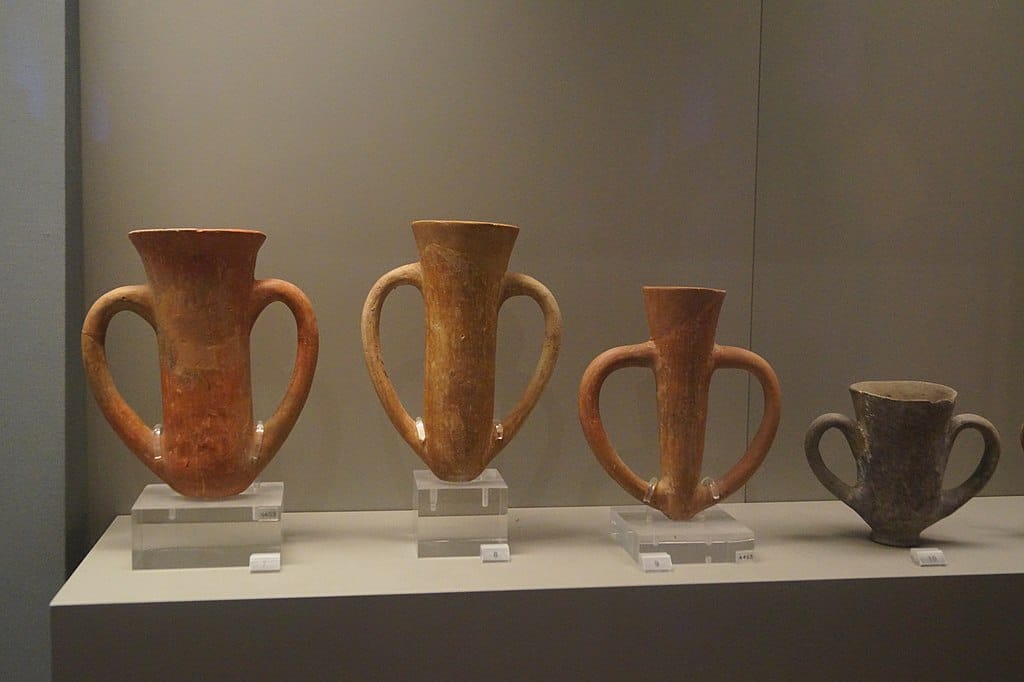
A clay depas goblet from ancient Troy, Early Bronze Age. Credit: Schuppi / CC BY-SA 4.0
For the first time, researchers have found solid chemical proof that people in ancient Troy drank wine, confirming a theory first suggested by Heinrich Schliemann, the 19th-century archaeologist who uncovered the ruins of the legendary city.
A team from the Universities of Tübingen, Bonn, and Jena identified wine residue in clay drinking vessels dating back over 4,000 years.
The findings, to be published in the April 2025 issue of the American Journal of Archaeology, show that wine was enjoyed not only by the elite of Troy but also by the general population.
Depas goblets
The study focused on a type of cup known as the Depas goblet or depas amphikypellon (Greek: δέπας ἀμφικύπελλον). This slender, two-handled vessel with a pointed base has long been familiar to archaeologists.
Measuring between 12 and 40 centimeters tall and holding up to a liter of liquid, more than 100 of these cups have been found at the Troy site alone, dating from 2500 to 2000 BCE. Similar examples have been uncovered across the Aegean, Asia Minor, and Mesopotamia.
Ancient texts support the findings
Dr. Stephan Blum of the University of Tübingen said Schliemann had proposed the goblets were used in celebratory settings, similar to scenes in Homer’s Iliad (Greek: Ἰλιάς). New evidence now lends weight to that claim.
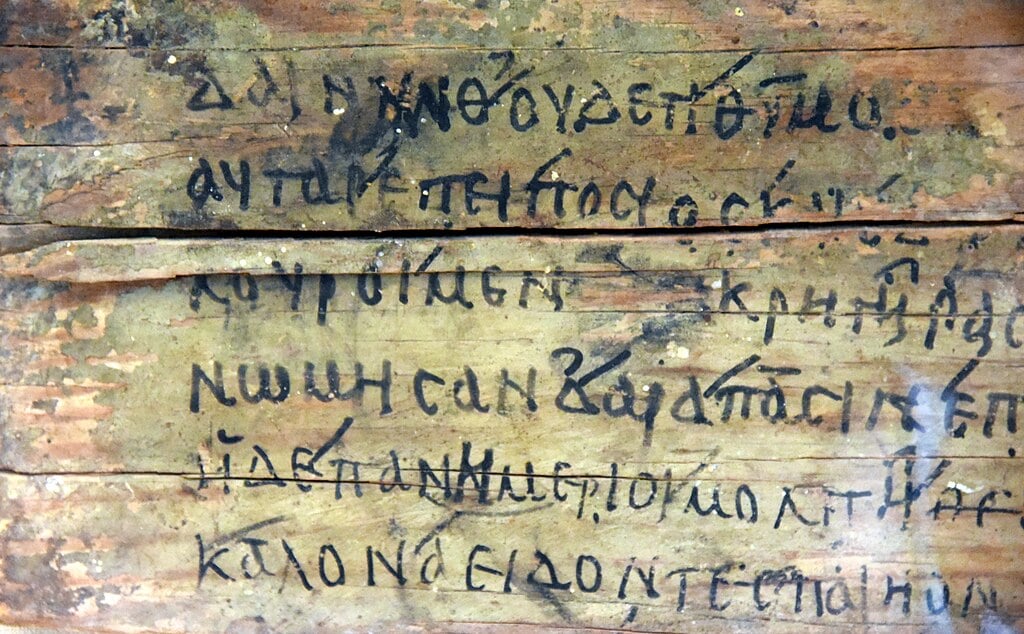
Book I of Homer’s Iliad. Credit: Osama Shukir Muhammed Amin FRCP(Glasg) / CC BY-SA 4.0
In the Iliad, Hephaestus, the god of fire and craftsmanship, serves a drink to his mother, Hera, before pouring for the other gods. He uses a double-handled cup—imagery that mirrors the depas goblets found in Troy.
Scientific testing confirms fermentation
Chemical testing on two fragments from Schliemann’s original collection revealed traces of succinic and pyruvic acids – markers that only appear during the fermentation of grape juice into wine.
Maxime Rageot of the University of Bonn, who conducted the analysis, milled a two-gram sample from the shards and heated it to 380°C. Using gas chromatography and mass spectrometry, he identified the acids that confirmed the presence of wine.
“The evidence of succinic and pyruvic acids was conclusive: They only occur when grape juice ferments. So now we can state with confidence that wine was actually drunk from the depas goblets and not just grape juice,” Rageot said.
Wine was not just for the wealthy
Wine was considered the most expensive drink of the Bronze Age, and depas goblets were among the most valuable cups of the time. Their presence in temples and palaces has led scholars to believe they were used in elite circles for special occasions. But new tests on simpler clay cups tell a broader story.
Researchers analyzed vessels found in Troy’s outer settlement, beyond the city’s fortified center, where everyday people once lived. These cups also held wine, indicating it was consumed widely – not just by the upper class.
“Wine was an everyday drink for the common people too,” Blum said.
Ongoing work at the Troy excavation site
The University of Tübingen led excavations at Troy from 1987 to 2012. Scholars continue to study the recovered materials to better understand life in the ancient city.
“Research into Troy has a long tradition at the University of Tübingen,” said Professor Karla Pollmann, president of the University of Tübingen. “I am delighted that we have been able to add another piece to the puzzle revealing the picture of Troy.”