
Anyone who has endured a disappointing meal in France recently and wondered if chefs there are trading on a reputation they no longer deserve has found an unlikely ally in the country’s trade and tourism minister. “French gastronomy has been facing the rise of foreign gastronomy since the end of the 1990s and has been outstripped by the performance and influence of other countries,” Olivia Grégoire admitted.
“It would be a mistake to rest on our laurels and we are going to reassert our pre-eminence,” she added as she unveiled a government plan to encourage France’s most promising young chefs to learn from the best — by heading abroad, including, quelle horreur, to the UK.
Those words must have stuck in her throat like a rare fillet steak because, in an age of uncertainty, there has always been one constant in a proud Frenchman’s life: an unshakeable belief in the superiority of French cooking, especially when compared with that of their rosbif neighbours across the Channel.

Emmanuel Macron wants young chefs to go abroad to learn
ANTOINE GYORI/CORBIS/GETTY IMAGES
Only last month a poll in France of national cuisines confidently ranked British as the worst, and this week diners shared with this newspaper’s Paris correspondent memories of food poisoning and inedible jelly on trips to England, opinions freely delivered, irony of ironies, while queueing for a table at the city’s latest must-be-seen-at venue — a public house famed for its pies and run by the British chef Calum Franklin.
Let’s face it, the minister is not wrong about French restaurants trading on past glories. It used to be said that you could pitch up at any table in France and dine like a king. I’m not sure that was ever true but it certainly isn’t the case now. Madame is no longer in the kitchen, the chefs are all working to the 35-hour week and the order of the day is likely to be from a dated identikit menu bearing no relation to the region you are in and everything to do with what the mass-catering company could supply. The only nod to creativity is the squiggle of ready-made coulis they use to decorate the plate. Oh, France, proud homeland of Marie-Antoine Carême and Auguste Escoffier, of mother sauces and Michelin stars, when did it all go wrong?
In the late Eighties and Nineties, is the consensus among chefs working in London. While cooking in this country and elsewhere took wing and became a riot of innovation as it absorbed influences from around the world, France doubled down and took refuge in its classic traditions. Like the executives at Decca dithering over signing the Beatles, they probably thought this newfangled way of cooking, of lighter sauces, more vibrant flavours, of mixing Mexican and Japanese, French and Indian, would never take off. Meanwhile the world around them changed and they were left with Ken Dodd.
• Macron wants French chefs to learn from the best … so he’s sending them abroad
“In the golden age we exported cuisine around the world, especially to countries with very little food culture, such as England,” Raymond Blanc says. “But the world is global now, whether you like it or not, and the French mistake was never to understand this. France was stagnating because tradition was so powerful, like a prison, with too few chefs daring to bring in other flavours and textures.”
He compares it to the Académie Française and its regular banning of English and American words in an attempt to prevent them encroaching on the French language. “But that’s what a free movement of culture is, and it’s so sad to see it being impeded. My cuisine is French but totally enriched by British culture, and French chefs have to learn to be more open.”

Raymond Blanc in the kitchen of Le Manoir aux Quat’Saisons
JOHN ANGERSON FOR THE TIMES
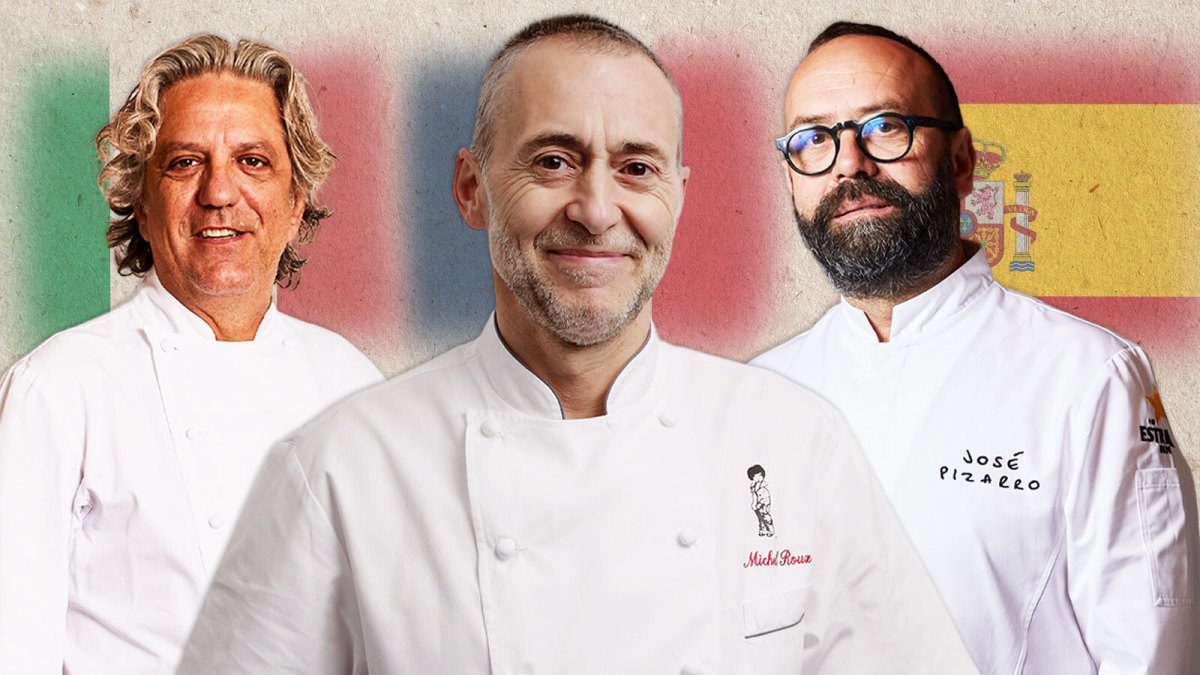
Michel Roux isn’t sure there is a problem in foodie cities such as Paris or Lyons but agrees that restaurants in the provinces are struggling. “They are in the doldrums,” he says. “You need chefs who have travelled the world and overcome the traditional arrogance that French is the only true cuisine. The French are rightly very proud of their heritage but they have been a bit blinkered over the past few, well, centuries, really.”
Gordon Ramsay recalls working as a young commis chef in Paris 35 years ago and the chefs ripping the labels off British produce such as Scottish girolles and langoustines and English venison, as if they were angry at even using it. “They couldn’t believe the quality and secretly resented it. Even ten years ago they were sitting on their laurels, with all their butter and cream, and ignoring the influence of Spain, Scandinavia and now Asia. The truth is we’ve been more adaptable and learnt to pivot quicker, and that’s because we are a more cosmopolitan nation.”
So does this mark a turning point? Has French cooking lost its influence on the world stage? Not so fast, says Giorgio Locatelli. “Paris is still a paradise if you want three-Michelin-starred French haute cuisine,” he says. “Just don’t try to eat Japanese or Italian there because it is of very low quality. But the way haute cuisine has influenced the world is incredible. If you are a European chef and you want to cook European food, you are going to end up using techniques codified by the French. They are the building blocks and you can’t deny that. French cuisine still has f***ing big balls.”
He agrees it’s not the big draw it used to be, though, just as Paris is no longer seen as the culinary capital of the world. “If you are an international company and have a big project like Nobu and want 20 locations around the world, you don’t open in Paris, you open in London,” Locatelli says. “They say if you make it in London, you make it anywhere in the world. Paris is like a provincial town in comparison.”

Escargots de Bourgogne are a classic French dish
GETTY IMAGES
He also believes that Italian has usurped France’s crown as the favourite food for the international diner. “When you open a five-star hotel it used to be de rigueur to have a French restaurant but now most of them have an Italian one. That is a commercial choice. They don’t open restaurants to make fluff, they open them to make money, and they know that having an Italian chef makes it much more likely to be successful. What can I say? Italian food is better than French, it’s just we haven’t been so good at advertising it.”
The other factor is the change in what we look for in our restaurants. We are no longer impressed by obsequious formal service, heavy linen tablecloths and wine lists the size of a book. “Paris especially is known for snooty, bordering on rude service,” Roux says. “It’s very formal and I’ve noticed they’ve started taking a leaf out of British service, which is more open and convivial.”
“Precisely,” the Spanish chef José Pizarro says. “A lot of French chefs do amazing things but people are sick and tired of the traditional starter and main course. They want to go out to have fun, not to worship the chef. It’s not about heavy linen tablecloths, it’s about having a good time. That’s why Spanish food is so good, and the French have to hurry to catch up.”
Let’s leave the final word, though, to a francophile, Henry Harris, whose Bouchon Racine is probably one of the best casual French restaurants in the world, not just in London. “It’s definitely not over for French food. French cuisine is the heartbeat of Europe and always will be. When done with pride, excellence and understanding, there’s no better meal on planet Earth. What can be better than sitting down to a plate of oysters, steak tartare with freshly made chips, and perhaps a little cheese to finish?”
Well, when you put it like that …