
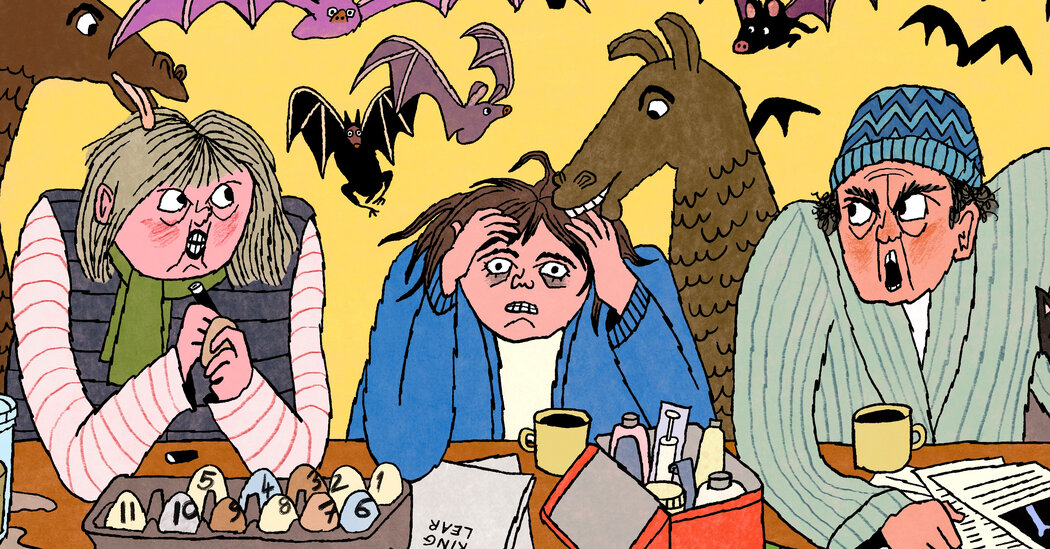
Miranda, confessing to a bit of eye trouble, is given a peeling tube of ophthalmic ointment that turns out to have belonged to Cornelius, a long-dead cat. Afterward, the rusty old biscuit tin called “the medicine cabinet” is returned to a cupboard under the stairs alongside such other relics as “a box of old syringes once prescribed for a boil on Dad’s leg.”
The hoarding and dilapidation, so deliciously cataloged, are easily enough explained. But some things are mysterious to the grown kids, at least slightly, like the parents’ difficult personalities and fractious marriage. Why is their mother so distant? Why is their father so cowed? As Miranda puts it: “Your parents are your parents: you don’t question what you have for dinner, or where you live, or how they talk to you; that is just the way things are. It’s when you’re older that you start to think, ‘Hey, that was a bit odd, wasn’t it?’”
Explanations are gently extended — if not to the daughters, then at least, via the mother’s old letters to a person named Kitty and the father’s confessions to his granddaughter, to us. A shroudedly unpleasant incident, referred to as “The Incident,” is first evoked on Page 59 and uncovered by the book’s end. As is the usual way — in Shakespeare and in life — grief and misunderstanding are to blame, and these are delicately rendered.
Mostly, though, “The Usual Desire to Kill” is about how aggravating it is that even one’s own parents and children are so other. To wit: “She slopped across the tiled floor making a sound very similar to her grandfather. Was there anything more annoying, I wondered, than the sound of someone else walking in slippers?” The book implicitly questions Lear’s famous assertion that nothing will come of nothing: There’s not much here, but it is everything.
Or, as Miranda herself puts it, “It has to be said, they may be barking mad, but I always come home with some good anecdotes.”
THE USUAL DESIRE TO KILL | By Camilla Barnes | Scribner | 256 pp. | $27.99