
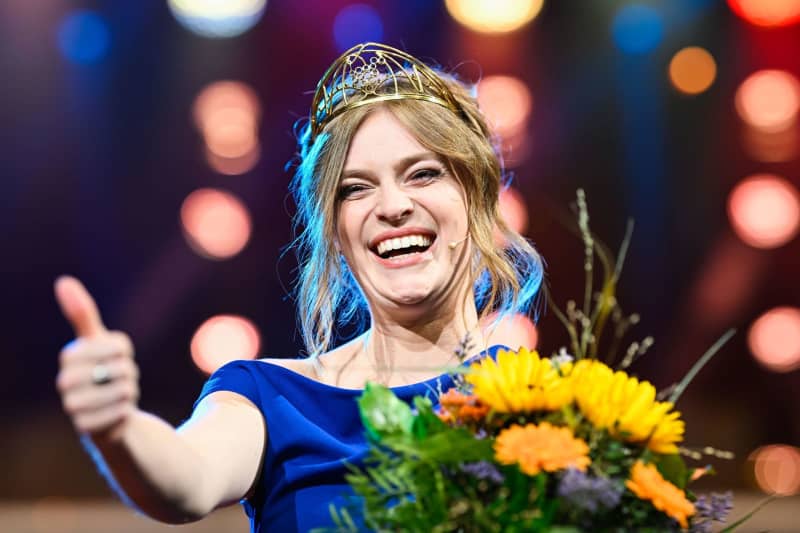
The question of whether and how to adjust German contests for the title “wine queen” has roiled rural Germany for several years.
Nationwide, the contest is open to men now too.
But in local communities, several have decided to retain the traditional title, fitting with the annual ceremony of selecting a young woman, clad in traditional dress, to represent the industry.
Others are broadening the contests and the title for greater inclusion and fairness. Here, they celebrate wine envoys, wine kings or other new roles.
Some areas are still working on it, as passions run high on both sides.
One of Germany’s main wine-growing areas, Neustadt/Weinstraße, in the south west, is sticking with tradition. “We are holding on to the title, format, and crown of the Palatinate Wine Queen,” Neustadt/Weinstraße Lord Mayor Marc Weigel told dpa.
“In my view, the dispute has been settled.”
The Pfalzwein association – the regional wine promotion organization for the nation’s second-largest wine-growing region, the Palatinate – also says hopefully that the 2024 solution proved so “viable and good” that it would continue to work in this direction.
In this area, the debate began after the Pfalzwein association said that after almost 100 years, the title of Palatinate Wine Queen should be changed to Palatinate Wine Ambassador, to allow for the possibility that a man might win the contest.
In a further upset, the organization was considering awarding pins rather than crowns, in a step to overhaul the traditional Palatinate wine region, a move some felt was long overdue.
But not all were pleased in Neustadt, a municipality where the annual coronation of the Palatinate Wine Queen is staged.
“The city of Neustadt was annoyed because it was not considered a partner and an attempt was made to appoint an ambassador instead of a wine queen,” says Weigel.
That planned step has since been abandoned.
“We had a good discussion with Boris Kranz, the chairman of the Palatinate Wine Promotion Organization. Everything has been cleared up in terms of the matter,” says Weigel.
Now, he says, the focus needs to be on the future – namely the October election of the next wine royal.
Current planning is guided by the 2024 compromise. If a woman wins the contest, she will be given the title of “Wine Queen” and a crown. If a man wins, he will wear a golden pin that shows he is the “Wine Highness.”
Weigel can live with this, but still has reservations about a gender-neutral competition, saying “I think it’s inappropriate for the idea of a wine queen.”
On the national level, the situation changed more rapidly with two men in the running for the top post. But he stands by his views.
For now, as Germany sees less frost, vines are beginning to wake and burst forth with new green growth. Vintners are feeding and spraying their vines. Grapes are a while off yet.
Crown-wise, the situation will come to a head around harvest time, when the national German Wine Queen is to be elected a week before the Palatinate Wine Queen.
And for the bigger contest, linguistic changes have been made too.
The German Wine Institute in Bodenheim recently said the traditional election is facing fundamental changes after almost 80 years since its inception.
The contest – also staged in the Neustadt/Weinstraße area, is set to be christened the “Election of the German Wine Royal” with a gender-neutral formulation.
The two men challenging tradition are Levin McKenzie from Germany’s largest wine-growing region, Rheinhessen, and Felix Grün from the Middle Rhine.
Should one of the two win, he would bear the title of German Wine King and receive a chain of office instead of a crown.
That all makes sense, says Charlotte Weihl, 25, a Palatinate local who won the title 76th German Wine Queen. She praises the changes as progress.
The increasing number of male candidates in elections for the wine crown is “encouraging,” she says.
“This shows that the office appeals to all those who are enthusiastic about wine, culture and the representation of our wine-growing regions – regardless of gender,” Weihl told dpa.
With male and female candidates, the office is becoming increasingly diverse and modern in line with the German wine scene, she says. “Men and women bring different perspectives and strengths that complement the office in new, enriching ways.”
Style too is changing, she says. No longer do wine queens just wear traditional folk clothing but they act as industry ambassadors, often with a presence online.
Weihl is representing the nation’s 15,000 winegrowers until the next vote in autumn.
Meanwhile Rheinhessen has already turned a corner. The region crowned a man Wine King last year, a first for Germany’s 13 wine-growing regions.
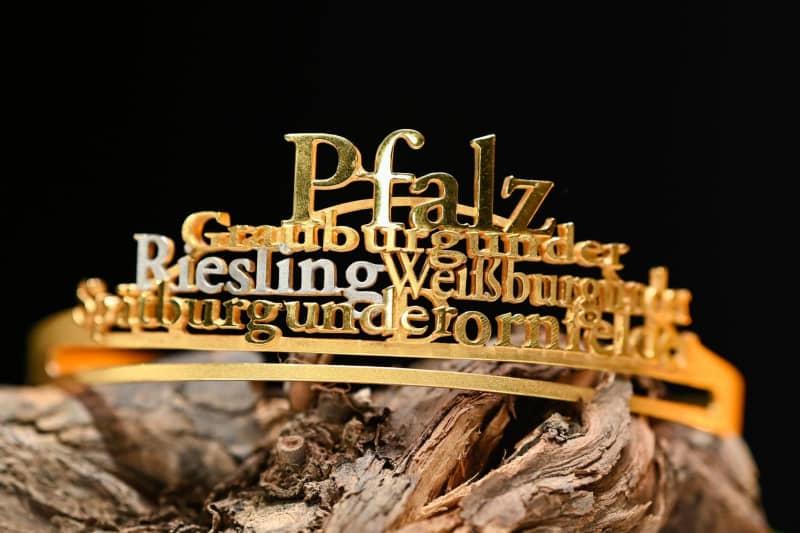
For the first time a man is competing for the title of the top wine ambassador in in the Pflaz region. Before the title was known as Wine Queen, as only women competed, but things have changed. Uwe Anspach/dpa
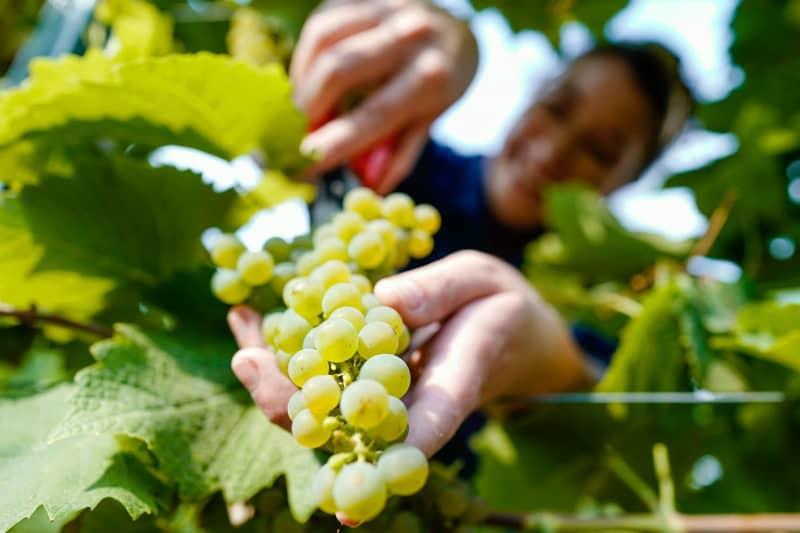
A Wine Queen in the Pfalz region cuts grapes. This year, for the first time, a man is competing for the top title. Uwe Anspach/dpa