
The Italian harvest was anything but straightforward, while parts of France have received an unseasonal soaking.
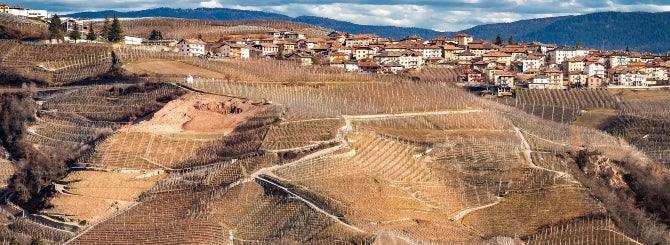
© Stevan Aksentijevic/Pixabay | Italy’s vineyards varied between bone dry and frankly damp during this year’s grape harvest.
As harvest comes to a close in Europe, spare a thought for Jura winegrower Jean-François Ryon of Domaine Des Coteaux du Val.
After his vines were particularly badly frosted earlier in the year (see Bad Weather Hammers French Vineyards), Ryon told local newspaper Le Progrès he will only make a total of 200 liters of wine (red and white) in 2024.
In Provence, however, things were rosy with regional bigwigs announcing a good-quality vintage, despite frost and hail in certain sectors and drought stress in the summer. Wine news outlet Terre de Vins said yields in the region were, as yet, unknown and “anomalous”. The tiny appellation of Bellet, which overlooks the coastal tourist city of Nice registered a late start to harvest after rains in the spring (two years’ worth of rain in one month) and an inclement start to summer put back the growth cycle in the vineyards.
Still in the south, we learned this week that the CAPL (the Agricultural Cooperative of Provence-Languedoc) had taken wine sector diversification to heart, developing a ketchup from grapes. According to local newspaper Le Dauphiné Libéré, the heads of the coop were giving tasters of the fruity sauce to visitors of their stand at the recent Med’agri [Mediterranean Agriculture] show in Avignon.
Here are some other headlines you might have missed this week:
Italian harvest ups and downs
The 2024 harvest in Italy has been a mixed bag, say industry insiders, with very generally speaking, a slight reduction in yields but good quality almost across the board. Italian weekly magazine L’Espresso divided the country’s fortunes in 2024 into three parts, classifying the north as “rainy and humid”, the center as “stable”, and south as “dry”.
“The 2024 harvest can be compared to a chiaroscuro-heavy fresco,” it said, underlining the heterogenous nature of the season across the country.
While the weather conditions were a mixed bag, quality is generally high. In the south especially, the high mildew pressure in 2023 was not repeated.
“[…] the northern [regions], especially in the northeast, had to deal with hailstorms, with a drop in volume in the center, while in the south the phytosanitary situation is generally good, especially compared to last year, when downy mildew ravaged the vineyards,” Federico Castellucci, president of the Confagricoltura Federation of Wine Producers told the publication. “Volumes aside, the quality is generally excellent everywhere.”
The latest official statistics predict an overall production of 4.1 billion liters – an increase of seven percent on 2023. However, this would still fall below the five-year average of just under 4.6 billion liters.
There are ups and downs across the country. Production estimates show that production in Franciacorta and Oltrepò Pavese in the north is down around 20 percent; Valpolicella is expected to post similar yields to 2023 while, in the northeast, Collio is due to be slightly down on 2023.
In the south, Etna is expected to bounce back from a tough 2023 (down 42 percent back then) with a year-on-year gain of 60 percent while the likes of Primitivo di Manduria is due to drop 40 percent.
“The harvest was exceptional in terms of quality,” said winemaker Donato Gentile, at the Cantine di Venosa cooperative in Lucania, best known for its Aglianico del Vulture wines. Gentile said the region started harvest two weeks early this year.
In Prosecco, however, 2024 was almost a repeat of 2023.
“In the Prosecco region, the 2024 harvest closed with yields comparable to those of last year, although slightly lower than expected,” said Giancarlo Moretti Polegato, president of major local winery, Villa Sandi.
Floods hit Condrieu, Saint-Joseph
This story was emerging last weekend following major rainstorms in the south of France last week. Following heavy rainfall south of Lyon around 17 October, floodwaters ravaged parts of Condrieu and Saint-Joseph, with major flooding occurring primarily in the Ardèche region to the west.
Saint-Joseph winegrower Bryan Deleu told wine news website Vitisphere.com floodwaters had swept away one hectare of vines. He said a 4ha parcel was no longer accessible by 4×4 and that, in places, 40cm of topsoil had been washed away.
“[Floodwaters] created cracks in the vineyard and collapsed embankments and stone walls,” he said, adding that remidation work would be long and laborious. A further blow: a plot planted in 2020 was due to come into production this year.
Further west, in the Ardèche region, floodwaters and rain appear to have put the cap on an already trying growing season, especially in the north of the region.
“A few plots near the riverbank were flooded, with vines under water although the posts remained intact,” said the unfortunately named Philippe Dry, head of region winegrowers’ group, Vignerons Ardéchois. “In southern Ardèche, we did alright. [But] we didn’t need this on top of everything else. The harvest was complicated by the rains and we had to juggle to do the best we could.”
Just further north, in the Loire department in Lupé (some 15km southwest of Condrieu) the underground cellars of Maison Baptistine were “turned into a swimming pool”. Winemaker Clément Farizon told Vitisphere that, overall, the damage looked worse that it was.
“[…] the barrels stayed watertight,” he said. ” There was a lot of cleaning and pumping to do. And electrical circuitry didn’t enjoy the soaking.”
Vineyard inheritance a “poisoned chalice”
We touched on this theme a few weeks back with the wider ramifications of luxury group LVMH’s purchase of 1.3 hectares (3.2 acres) of grand cru vineyard in Burgundy for the steep price of €15 million (see “LVMH snaps up grands crus sites, sparks outrage” in Ram-raid in Vosne-Romanée). In it, locals complained that such sums had effectively priced familes out of passing on vineyard holdings to the next generation (through a combination of land price, taxation, and – occasionally – the division of the outfit between the offspring).
The issue has since boiled up through the wider wine industry with representatives from Burgundy, Champagne and Bordeaux recently asking the government to look into the issue while the French parliament debates the 2025 budget.
Passing on vineyard holdings to the next generation would be a “poisoned chalice” Jérôme Bauer, head of the National Confederation of Appellations (CNAOC), said at a recent press conference. According to news agency AFP, Bauer said it would take the winegrower’s offspring 40 years to pay off the debts associated with the generational transfer, stifling – among other things – investment in the business and its vineyards.
“We want to be able to pass the legacy on to our children, to set up our young people, to keep it alive,” said Champagne winegrowers’ union boss Maxime Toubart.
Toubart pointed out that, in order for the next generation to take on one hectare of Champagne vines, it would now cost them €150,000 in taxes to the state. Toubart, along with other organisations including major agrictultural union FNSEA, are asking for the French government to consider expanding the so-called “Dutreil pact” (which enables family businesses to be passed on to the next generation at a significantly reduced cost if a number of conditions are met, including a pledge not to sell up for a period of time) to include agricultural outfits.
What Toubart et al. are proposing would, for example, slash the cost of transer by a two thirds, from €150,000 to €50,000 with the agreement that the acquired land would not be sold-on for a minimum of 15 years.
“We are losing heirlooms,” said Bauer, adding that only investors or major outfits had the means to take over these domaines and their vineyards.
Dourthe launches reusable bottle
Major Bordeaux négociant Dourthe is set to launch one of the first major wine labels geared towards wine bottle reuse in France. In collaboration with Nantes-based reusable glass enterprise Bout’ à Bout’ (a play on words meaning “end to end” but also referencing the contracted form of “bottle”, or “bouteille”, in French), the Bordeaux producer will release its Côtes de Bourg Promesse label in December.
Priced at €11.99, the 100-percent Merlot cuvée boasts a recycled paper label and no neck foil covering the cork. An additional label will show consumers where to return the bottle for cleaning and eventual reuse.
Although glass is often touted as recyclable, the energy used to re-mold bottles is very close to that used to create new bottles in the first place.
According to Terre de Vins, this approach will “reduce energy consumption by 79 percent , greenhouse gas emissions by 79 percent and save a third of the water used compared to the production of a new bottle”.
“This initiative marks a new move towards the revaluation of raw materials, offering a real solution with a circular economy and a model of sustainability,” said Valentin Jestin, brand director at Dourthe.
To join the conversation, comment on our social media channels.