
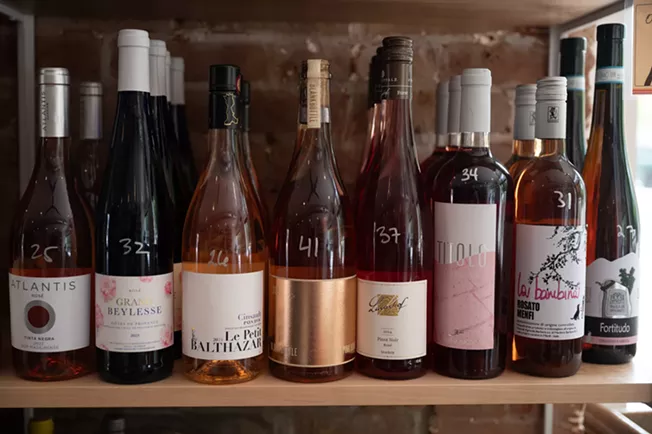
click to enlarge
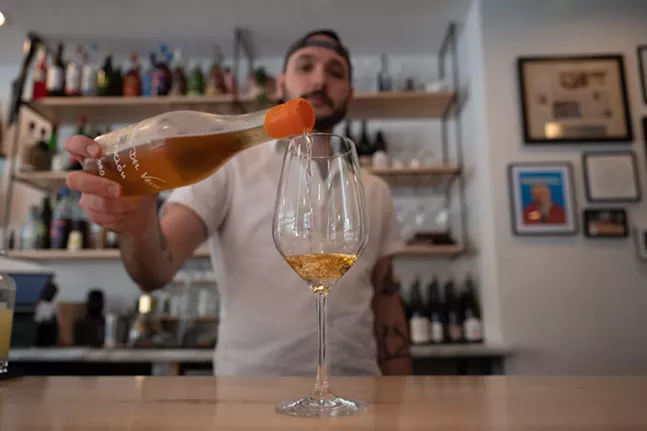
CP Photo: Mars Johnson
Tyler Borne, sommelier and co-owner of Solera Wine Co. in Lawrenceville
You’ve probably heard that Champagne can only be Champagne if it’s from the Champagne region of France — the words “American Champagne” send shivers down the spine of any wine snob. However, the 47th U.S. president wrote on Truth Social in March that his proposed 200% tariff on European wines will be great for “Champagne businesses in the U.S.”
Luckily, this 200% tariff has not come to pass, but the wine industry is still reeling over the proposed 10-20% tariffs, currently on a 90-day reprieve that would end on July 8.
In truth, Trump not using the correct terminology to talk about sparkling wine is just about the least of anyone’s concerns about this presidency. But it highlights the short-sightedness of slapping blanket tariffs on things that fundamentally can’t grow on American soil. (It’s worth noting that President Trump’s son, Eric, owns a winery at which you can get the Presidential Estate American-grown sparkling wine for a cool $245.47 … but hey, at least there’s no added tariff cost).
click to enlarge
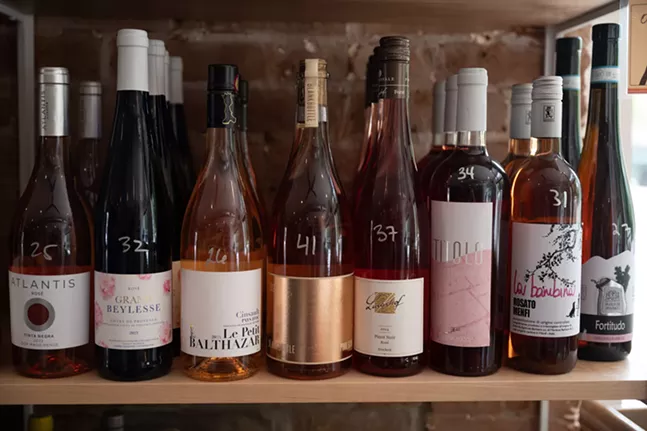
CP Photo: Mars Johnson
Solera Wine Co. in Lawrenceville
click to enlarge
CP Photo: Mars Johnson
Solera Wine Co. in Lawrenceville
click to enlarge
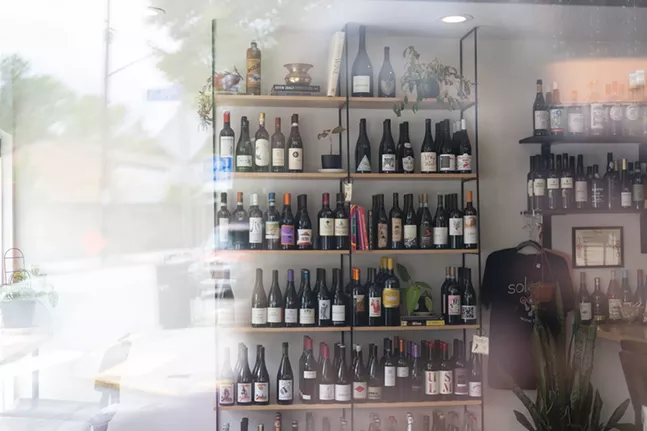
CP Photo: Mars Johnson
Solera Wine Co. in Lawrenceville
“It’s a very miseducated sort of system to put tariffs on wine,” longtime beverage director, sommelier, and Pittsburgh and Western Pa. Sales Representative at Skurnik Wine and Spirits Alyssa McGrath says. “There’s a three-tiered system across the United States since Prohibition ended. Any wines and spirits have to go through an American importer and an American company, and be distributed by an American distributor, to keep those jobs in the country.” McGrath estimates that a 200% tariff — though “highly, highly unlikely” — would put a $40 bottle of Champagne up to $200 and turn wine from a somewhat high-end good to a mega-luxury.
click to enlarge
Though the tariffs loom over the wine world as a whole, Pennsylvania’s independent wine shops and industry professionals are uniquely prepared for jumping through bureaucratic hoops.
In 1933, Pennsylvania Governor Gifford Pinchot put the state liquor laws into place with the explicit goal to “discourage the purchase of alcoholic beverages by making it as inconvenient and expensive as possible.” The result: the Pennsylvania Liquor Control Board (PLCB), the state-owned retailer that operates Fine Wine and Good Spirits stores.
State control of alcohol sales leaves sommeliers, general managers, importers, and wine shop owners at a disadvantage. Love the grappa at Grapperia and want to buy a bottle? Owner Dom Branduzzi legally can’t sell it to you due to state restrictions on hard liquor. Looking to buy some Aperol for a Sunday brunch spritz? Until a series of reforms that started in 2003 and came into effect in 2014-2016, state liquor stores were all closed on Sunday.
click to enlarge
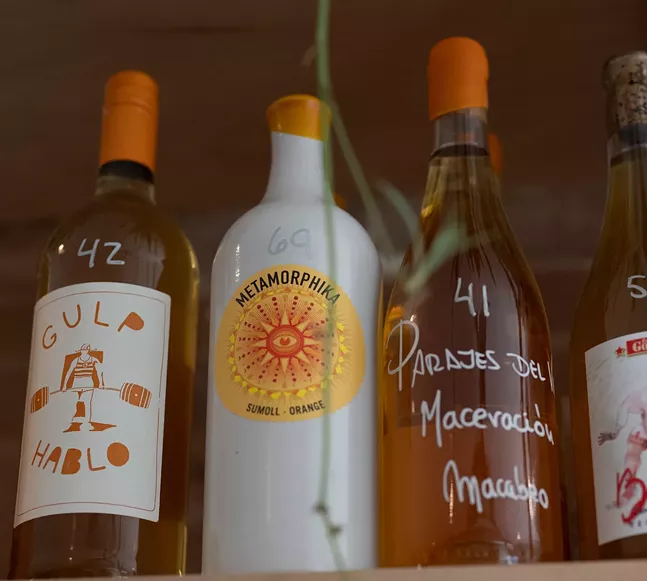
CP Photo: Mars Johnson
Solera Wine Co. in Lawrenceville
click to enlarge
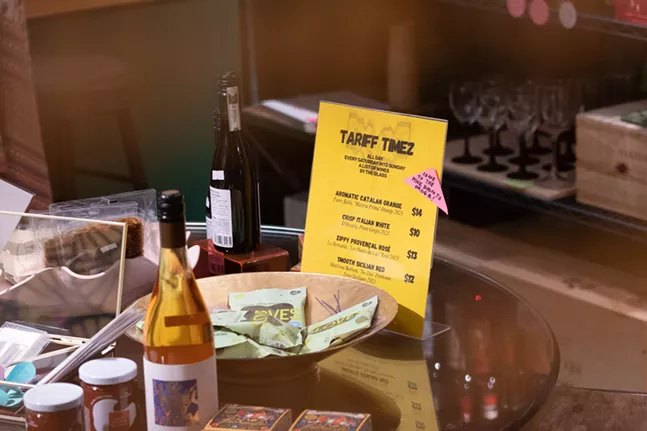
CP Photo: Mars Johnson
Nine O’Clock Wines’ tariff wine list special
Starting a bottle shop or developing a wine list in Pennsylvania requires an intrepid spirit. You can count most of the non-state wine stores in Pittsburgh on one hand — Cuvée in Squirrel Hill, Dreadnought Wines, Solera, Nine O’Clock Wines in Lawrenceville, and P’Vino in Shadyside, to name a few. In other words, if you don’t live in a neighborhood with a large population of young professionals, you’re probably going to be shopping at Fine Wine and Good Spirits.
Over the years, the state has loosened some of its control over wine, but it’s still an uphill battle for independent retailers. In order to develop an interesting and diverse wine list in a restricted state, all wine stores have to have close relationships with importers and try to focus on what they can do differently.
When sommeliers Tyler Borne and Aaron Gottsman started Solera Wine Co. in 2024, they wanted to create something that went beyond what the state store offered. Through working with importers and seeking out lesser-known European wine regions, Borne and Gottsman have one of Pittsburgh’s most diverse bottle shops.
“[This period of unrest] goes beyond just the tariffs,” Borne tells Pittsburgh City Paper. “It’s the way people go out, the inflation — all of these things are weighing on people’s minds. And it is a concern. It’s not something we can ignore. Some people are making contingency plans; some importers are preparing for the worst-case scenario. We’ll plan for the worst and hope for the best.”
Borne also points to the fact that wine production uses a lot of international goods. Portugal is the world’s largest producer of corks. Many of the barrels American wine ages in are from Slovenia or France. The muselet, the “wirehood” for sparkling wine, is typically made abroad as well.
Heather Pokrowka, mid-Atlantic regional manager for Viña Concha y Toro, agrees with Borne that the tariffs aren’t top of the line concern for an industry that’s already struggling. “You have the weight loss drug craze, which has been said to cause people to drink less,” she tells City Paper. “THC drinks are becoming a thing, as well as THC being legalized. So, more people are turning to different formats of ‘altering their reality,’ you might say.”
Pokrowka is finding that more people gravitate towards South American wines due to their lower price point, especially brands like Frontera and Casillero del Diablo. “Since people aren’t having as much expendable income, they’re trading down,” she said.
At Concha y Toro, they also plan not to pass any fees onto the consumer — so now, per Pokrowka, is the time to start exploring some South American wine. Grapes like Pais and Carmenere are some of the signature grapes in Chilean winemaking. And there’s always Malbec, Argentina’s most well-known grape, or Torrontés for white wine lovers. Or, if you prefer a name you might be more familiar with, Cabernet Sauvignon, Merlot, Pinot Noir, and Chardonnay all grow in Chile.
“European tariffs are pretty high, so we’re hoping that consumption of our portfolio will go up,” Pokrowka says. She and her colleagues recently hosted a Chilean wine dinner at The Commoner to introduce more people to the variations found in Chile and encourage interest in Concha y Toro’s portfolio.
Borne and Gottsman’s Solera prides itself on featuring South American wines and providing a welcoming environment to learn about them, as well. Borne has found one way out of rising costs, lower drinking rates, and bureaucratic hurdles as a wine bar — give people service they’ll really want to pay for.
click to enlarge

CP Photo: Mars Johnson
Tyler Borne, sommelier and co-owner of Solera Wine Co. in Lawrenceville
“The industry is preparing for people to be a lot more selective,” he says. “We really try to put an emphasis on the service and hospitality aspect of dining out. We try to make a connection to every guest as they walk through the door, so there’s a bit more experiential element to it where you’re really getting your money’s worth with us.”
McGrath has been selling wine, talking about wine, and drinking wine for decades and takes the long view of this turbulent moment. “Restaurant people are weathered. We went through COVID; this too shall pass,” she says. But what she thinks is a larger issue is that education around wine presents it as inaccessible.
“Wine should be something to be enjoyed,” McGrath says. “You shouldn’t look at a wine list and feel like shit because you don’t know what it means or you’re not a wine geek. It shouldn’t be for the elite. It’s a little piece of culture that everyone can enjoy — responsibly, obviously. It’s really sad to me that this administration has disregarded it so much.”
McGrath recently helped Borne and Gottman bring in Chilean producer Garage Wine Co. for a tasting at Solera. Since then, Solera has also invited French and Italian winemakers to lead tastings behind their bar. To attend, you can just walk right in.
A glass of fine Bordeaux or Champagne is nice, but there’s a growing movement to demystify wine by going beyond the generic. A Georgian, Slovenian, Austrian, or Chilean bottle can be a way to connect with a new culture and broaden both your palate and your mind. Regardless of tariffs or state restrictions, wine industry pros want consumers to know that to find the right wine for them, all they need to bring is their curiosity.