
Hello Breadit ! As I promised in one of my previous posts I’m posting the recipe I use !
I’m not anglophone so there may be some English mistakes, I hope there won’t be too many !
You’ll find in order :
– The materials that I use
– The recipe
– The way to shape a croissants
– The lamination tips
– The proofing method is you don’t have a proofing basket
– The bicolore technique explanations
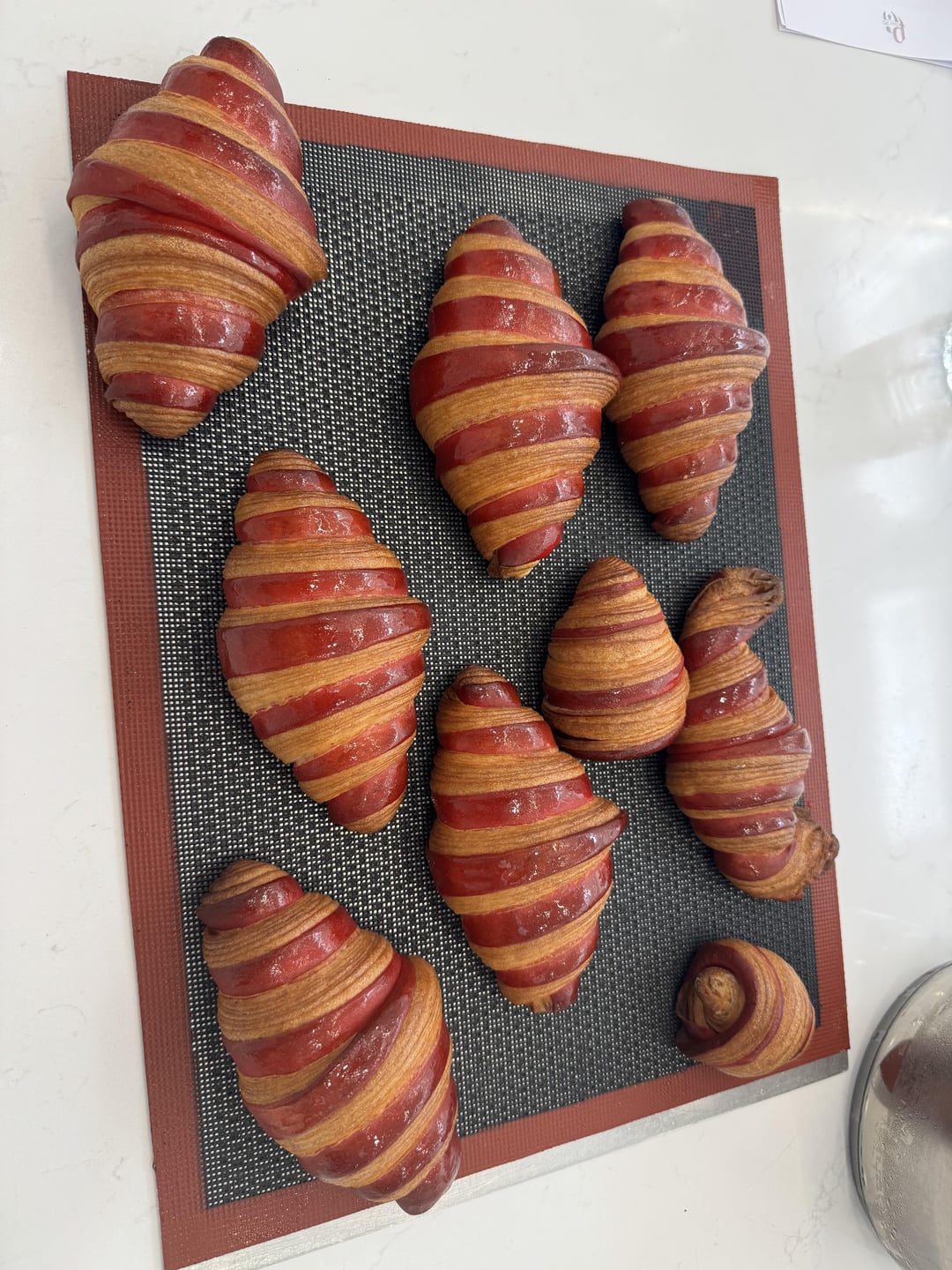
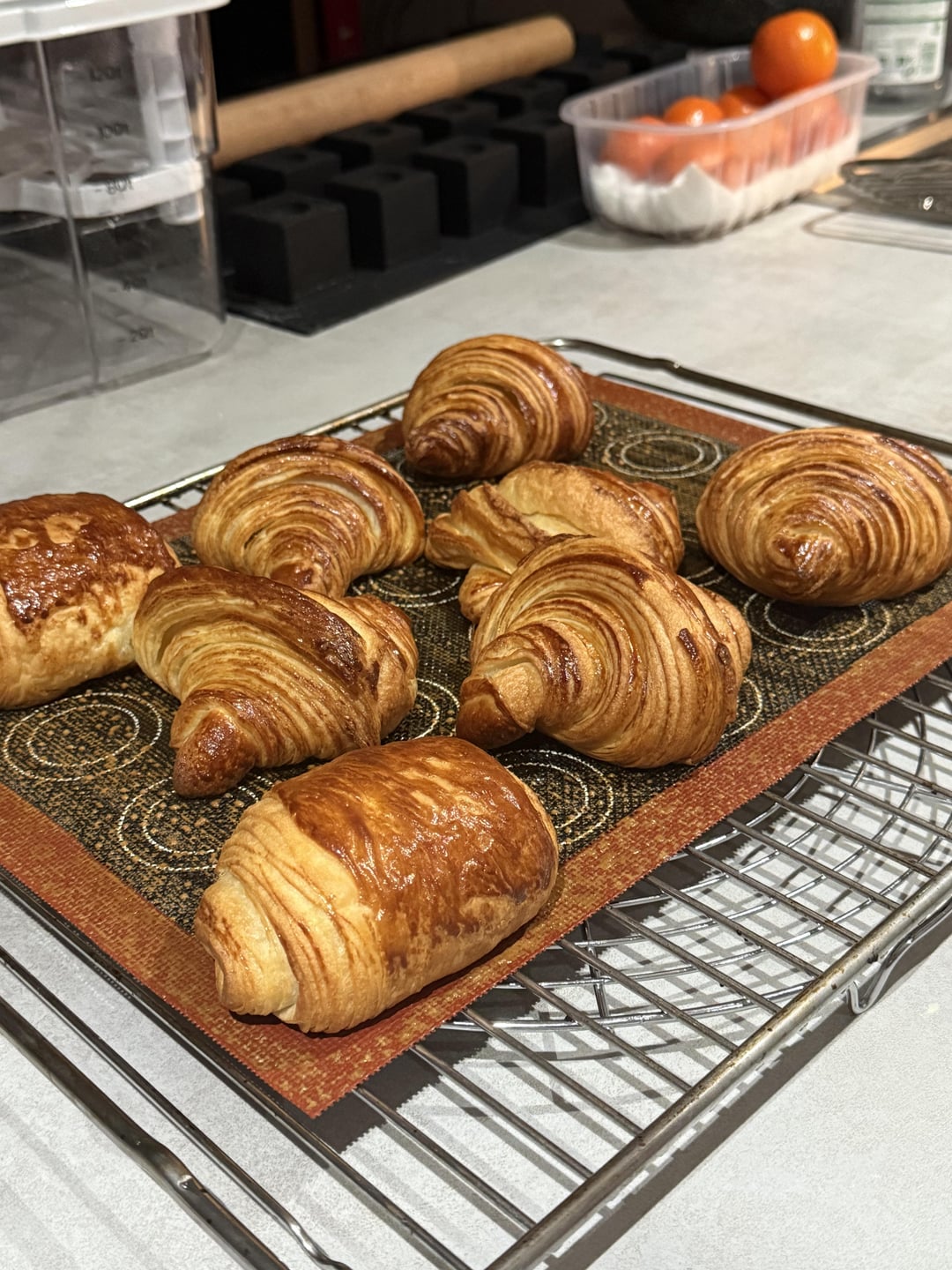
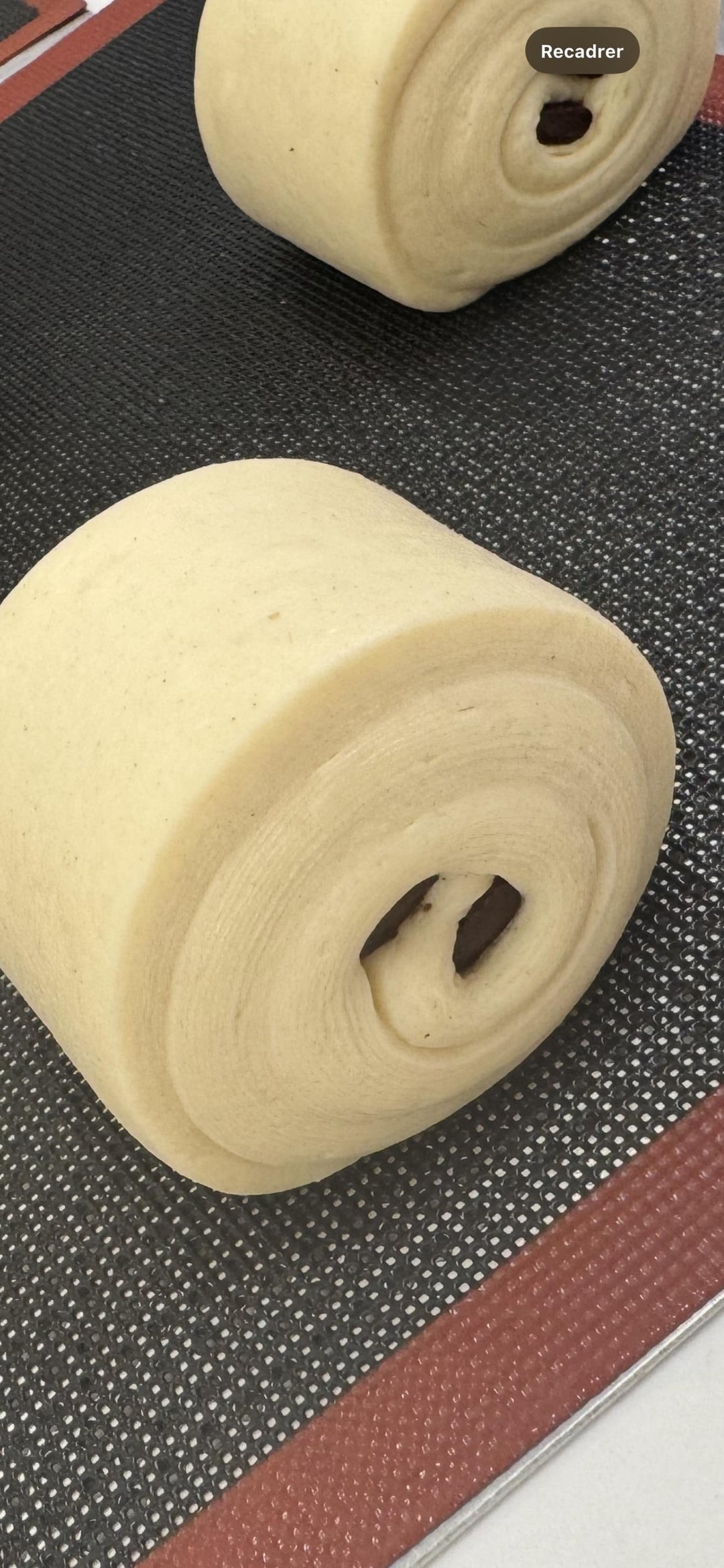
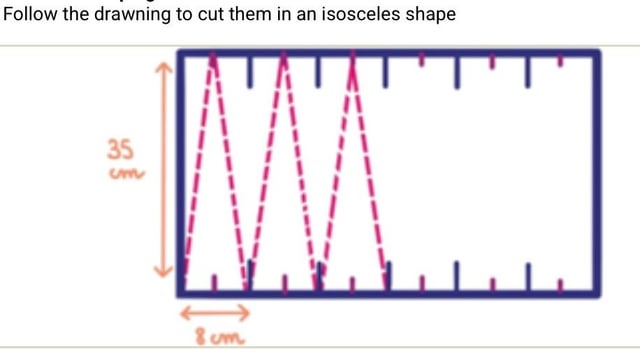
In the pictures I’ll put the first croissant that I made using this recipe, and the latest ones as well as a schema to make you understand how to cut them good and a picture of perfectly proofed viennoiseries as a proofing reference.
Croissants is all about techniques, understanding the mechanisms of the dough. What makes it deflate, how to know if it’s kneaded enough…
Having a good recipe won’t make you able to success at the first try, but you need to keep working on them, to try different kind of flour, to try different kind of liquid, different kind of butter, different percentages of hydrations…
Materials:
I use a kitchenaid to knead the dough
To spray the egg wash I use the Wagner 180P
My proofing basket is the Bröd&Taylor
Use a silk brush to brush the egg wash or the syrup
Recipe for 12 croissants :
500g flour
240g water
50g sugar
50g cold butter
20g fresh yeast
20g honey
9g salt
250g butter (ideally go for « beurre de tourage »with 84% fat)
Detrempe (pre-dough)
Place the KitchenAid bowl in the refrigerator for 30 minutes.
Start with the liquids and the honey, then add the remaining ingredients, except for the tourage butter.
Knead for 6 minutes on speed 1 with the dough hook, then 9 minutes on speed 3. After kneading the dough must be between 23ºC and 26ºC
Form into a ball and let rest for 45 minutes.
Lamination:
Shape the tourage butter between parchment paper. Make sure you have clean angle
Roll out the dough so it is twice the size of the butter.
Place the detrempe in the freezer for 10 minutes on each side.
Encase the butter, roll out the dough; the dough block should be 50 to 55 cm long; give it a single fold
Place in the freezer again for 10 minutes on each side. Give a second single fold.
Freeze again for 10 minutes on each side.
Roll out finally to 50 × 36 cm. Cut out 12 croissants at 8x36cm
Proof for 3 hours at 28°C.
Preheat the oven to 210°C; bake at 180°C.
Bake for 17 minutes.
For better baking, use perforated parchment paper or ideally, perforated silicone mats.
Shaping:
Gently stretch the strip of dough while holding the base firmly (you can trim it if it’s not straight enough).
Start by making a tight fold of about 1 cm. Begin rolling the croissant from the tips.
After one or two turns, once the tips are well formed, continue rolling gently from the center. Do not roll all the way to the end.
Hold the croissant and guide the final 5–7 cm of dough by pulling the pointed end to align it.
Press the tip into the croissant with your thumb to seal it.
Be sure the sealed part is against the grid
Tips:
– Flour should contain about 12% protein. You can make a mix of different flour as long as you reach around 12% of protein, like 50% la a 13% protein flour with 50%
– If the dough lacks strength you can add more resting time after you form the initial dough
– Water can be replaced with milk.
– Always flour the work surface lightly to prevent the dough from sticking.
– After enclosing the butter, roll the dough out in stages for more even layers.
– After the first fold, trim the dough ends for more even lamination.
– Score the folds (about 3mm)during each fold to relieve dough tension.
– For filled viennoiseries, do a double fold followed by a single fold.
– Roll out thinner for the double fold to reduce tension.
– Keep both butter and dough between 7°C and 12°C.
– Ensure butter and dough have similar texture.
– For a smoother finish, use the bicolor technique without coloring the detrempe.
Ensure the colored layer remains on top when shaping.
– If the butter is too cold during lamination, it will tear and not spread evenly. Let the dough warm up a bit if you feel it to be too cold
– Egg wash: 200g egg yolks, 60g milk, 1 whole egg, 10g water, pinch of salt. Mix together.
– You know the proofing is good when you see fermentation bubble forming between the layers and that they open a bit
Proofing in the oven:
– Heat 2 L of water to 80°C in a pot.
Place it in the turned-off oven.
Place a large tray above the pot to diffuse heat evenly without overheating the viennoiseries,
which should sit on a rack above the tray.
Bicolore croissants:
– Take 10% of the total detrempe weight and color it.
(If using natural color like cocoa or cinnamon, mix it with water into a paste before incorporating.)
– After the second single fold, roll the colored detrempe to match the dough size.
Brush water onto the dough to adhere the colored detrempe.
Then proceed to final rolling.
– Do not egg wash.
– Prepare a 50/50 syrup (equal parts sugar and water), boil for 3 minutes, and let cool fully.
– For best results, freeze the syrup for 30 minutes before use.
– Apply a thin syrup layer right after baking; too much will make them sticky.
by Soggy_Construction_2
3 Comments
Useful walkthrough thank you.
can we please be friends so i can have some. i promise id be loyal.
Thank you for this! Two questions:
1. Do you have advice on preventing the butter from leaking at the beginning of baking? I proof until they get the bubbles between layers and the layers begin to spread, as you’ve said, but after 2 or 3 minutes in the oven, the butter leaked everywhere and I end up with a very dense croissant (which is absolutely devastating after spending two days on them 🙂
2. I see this a lot, but the tip “make sure the butter and dough are a similar texture” has always confused me. How can I judge the texture of the butter once it’s encased in the dough? If they’re not the same texture, what can I do about it?