


The Grand Prix Elmendorf du Pain is Sunday in East Cambridge.
Cambridge and Eighth streets close to cars Sunday as East Cambridge hosts Le Grand Prix Elmendorf du Pain, a competition that celebrates French bread-baking traditions. History Cambridge will be present and taking the opportunity to highlight some of the many ways French and French-Canadian culture have enriched Cambridge over the centuries.

Because of its location on the Atlantic coast, Cambridge certainly saw its share of visitors and residents from France and the French colonies in Canada during the 17th and 18th centuries. But it was during the American Revolution that the Marquis de Lafayette, the young French noble who served as a close adviser to Gen. George Washington, helped to solidify the support of the French government for America’s fight for independence. Although the center of fighting had moved out of New England after the evacuation of British troops from Boston in March 1776 – before Lafayette formed his alliance with Washington and formalized France’s entry into the war on the side of the Americans – Lafayette considered the early battles that occurred here to be crucial to the war effort.
In 1824-1825, Lafayette embarked on a grand tour of America just as the country was getting ready to celebrate the 50th anniversary of independence. Just 19 years old when he was made a major general in the French army, Lafayette was among the youngest veterans of the Revolutionary generation, many of whom had already passed away by the 1820s. His return to the United States nearly 50 years after he helped secure its independence provided an opportunity for Americans to reflect on how the country had grown and changed over those five decades. Big cities and small towns around the country held parades, dinners and other celebrations for Lafayette, including Cambridge, where the Marquis was feted at Harvard University before traveling to Boston to lay the cornerstone for the Bunker Hill Monument. His arrival in America sparked a renewed interest in all things French, from food to fashion.
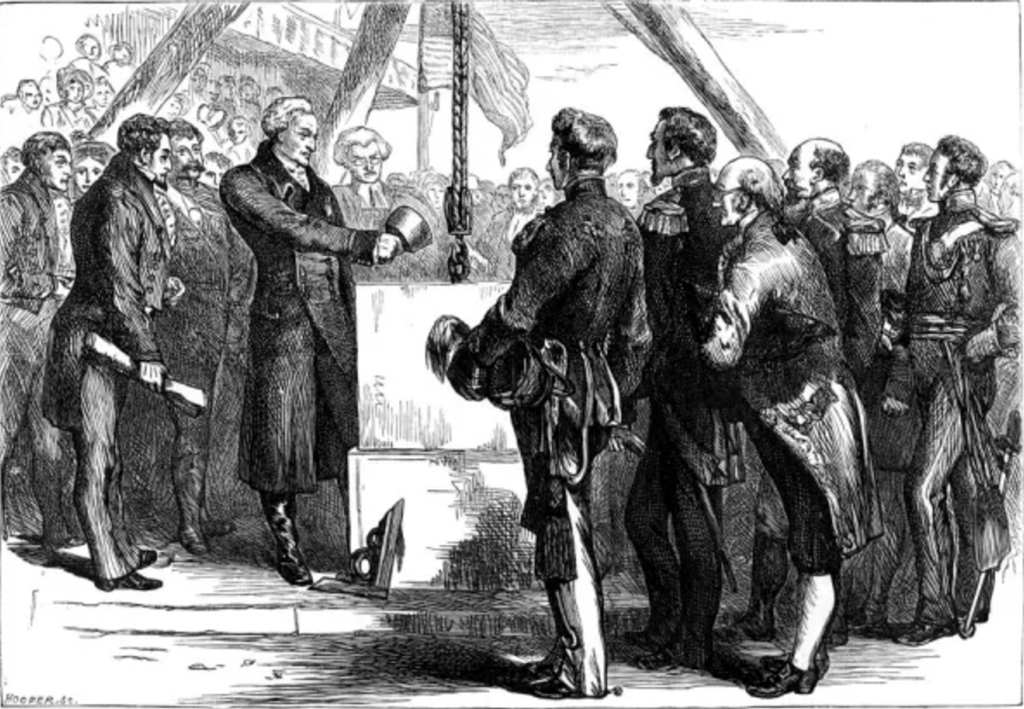
National Park Service The Marquis de Lafayette lays the cornerstone of the Bunker Hill Monument in 1825.
French culture continued to influence Cambridge in the two centuries following. Beginning in the 1870s, French Canadian immigrants brought their language, religious and cultural practices to the city as they arrived to work in the brickyards and ice houses of North Cambridge. Churches such as Notre Dame de Pitie and organizations such as Le French Club have kept these rich traditions alive, providing their members with mutual aid in a time before government safety nets and fostering the retention of French language and culture even as they helped new arrivals to integrate into American society. Beginning in the mid-20th century, famed chef Julia Child brought French cuisine to the forefront of the American culinary scene, and in the years since, Cambridge has been home to many restaurants featuring French and French-fusion cuisine.
In these and many other ways, French culture has left its mark on Cambridge, and the Grand Prix Elmendorf celebrates these contributions. History Cambridge is pleased to join the East Cambridge Business Association and Elmendorf Bakery in sharing the history of French and French Canadian immigrants and the traditions they have brought to the city over the centuries. Join us Sunday to learn more about the ways French culture has contributed to the rich and varied mosaic of Cambridge history.

About History Cambridge

History Cambridge started in 1905 as the Cambridge Historical Society. Today we have a new name and a new mission. We engage with our city to explore how the past influences the present to shape a better future. We recognize that every person in our city knows something about Cambridge’s history, and their knowledge matters. We listen to our community and we live by the ideal that history belongs to everyone. Throughout 2025, we are focusing on the history of East Cambridge. Make history with us at historycambridge.org.
History Cambridge is a nonprofit organization. Our activities rely on your financial support. If you value articles like this one, give today.
Beth Folsom is programs manager for History Cambridge.