
Summary 
Discounted extra virgin olive oil offers are prevalent in Italian supermarkets, with prices as low as €4.99 per liter due to blends sourced from imported olive oil. These discounts have raised concerns among producers and associations about the impact on the olive oil market, with similar issues also being investigated in Spain regarding potential price manipulation and collusion among market operators.
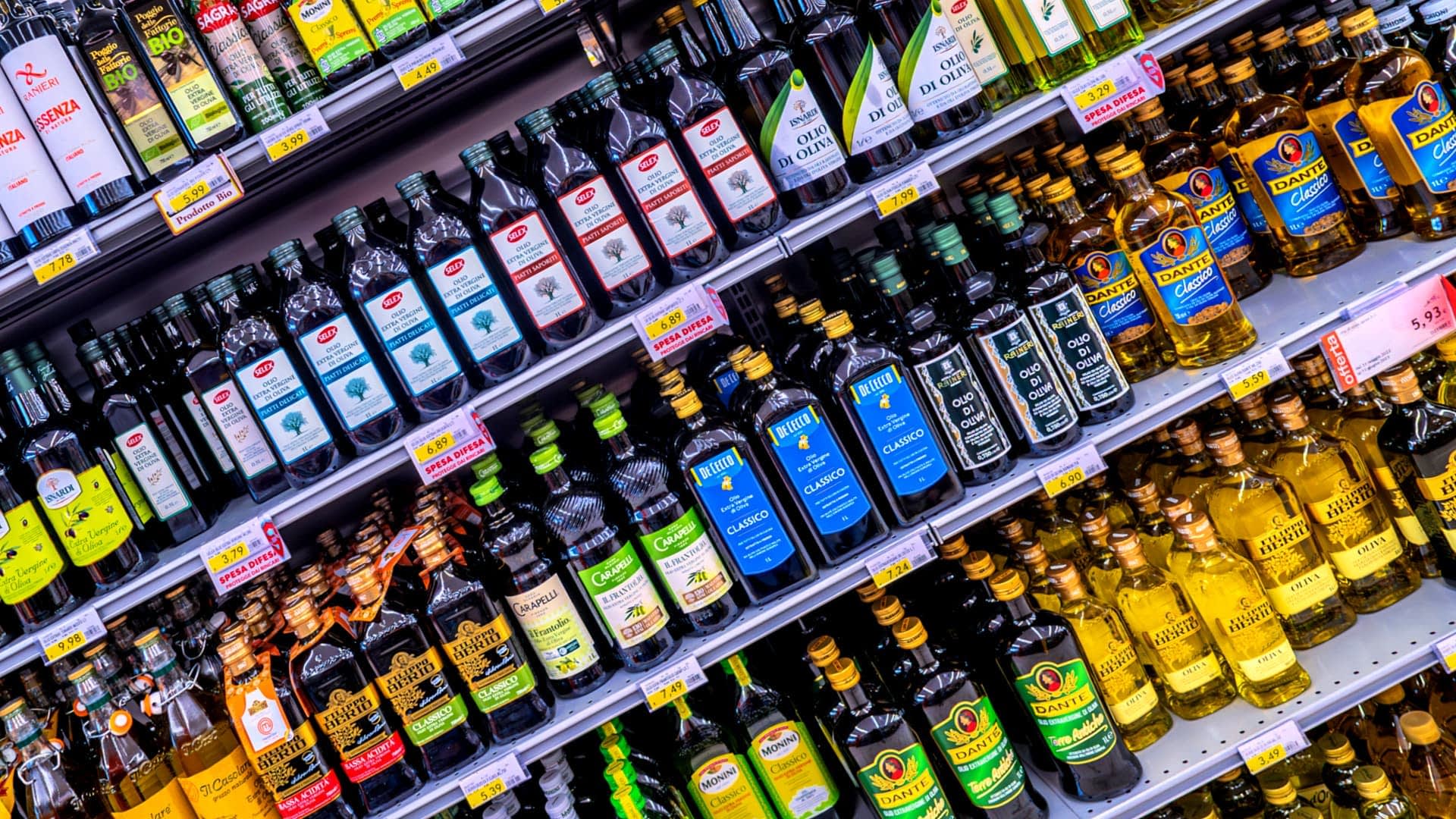
Hanging above the vinegar and olive oil aisle in a supermarket in central Italy, a large sign encourages consumers to buy extra-virgin olive oil at €4.99 per liter.
A bargain price, considering that the average price of Italian extra virgin olive oil at origin has been fluctuating at double that cost in the last few weeks.
“It is a good price,” Alessandra Rossi, a mother of two, told Olive Oil Times while examining the special discounted offer. “I wonder about quality, though,” she added while looking at the label on the bottles: it indicates that the product does not come from Italian olive trees, as it is a blend sourced from imported extra virgin olive oil.
See Also:Olive Oil Aisles Result in Superior Supermarket Sales
In a nearby supermarket, another olive oil offer is promoted for the same substantial discount: €4.99 per liter of extra virgin olive oil.
Some pallets and cartons placed in the very center of the shop ensure that all incoming customers are well aware of the ongoing discount.
Offers such as those began appearing since March across the country. Promoted as low-cost offers, such sales are considered legal only when their special-price duration is limited to a handful of days.
As Italian olive oil prices at origin remain stable on the country’s main markets, large retailers promote products from little-known or previously unheard-of brands that carry Italian names.
Still, those extra virgin olive oils are mostly blends sourced through bulk olive oil imports from the Mediterranean Basin.
Spanish, Tunisian, and Turkish olive oil, whose quotations are significantly lower on the main markets, represent the perfect source of olive oil for retailers aiming to entice consumers with super-discounted extra virgin olive oil bottles.
In a country with a substantially stagnant economy and declining olive oil production volumes, supermarkets rely on well-established strategies.
The significant distance between the Italian product’s price at origin and the discounted prices reveals the challenges Italian producers face in staying on the market.
Italian farmers’ associations and other stakeholders in the olive oil production chain, such as the many olive oil mills spread throughout the country, have protested for years against such discounts.
Italian growers and olive oil millers say they cannot compete with those prices.
“Continuous promotions, which we have criticized for a long time, have devalued the product, treating it like any commodity and impacting the entire supply chain, which is forced to operate without fair compensation, particularly in the agricultural sector,” Andrea Carrassi, general director of the national producers association Assitol, told Olive Oil Times in 2024.
Alberto Statti, president of the Calabrian branch of the farmers’ association Confagricoltura, also underlined the hidden risk of such discounted offers in a 2020 interview: “Those offers make consumers believe that extra virgin olive oil comes cheap.”
A well-known study by Maria Lisa Clodoveo warned in 2020 that such discounts could open new space on the Italian market for lower-quality olive oil blends.
“Selling off extra virgin olive oil means to condemn olive groves to extinction, because a culture that does not provide a fair income to the guardians of biodiversity, the olive growers, is a culture with no social, economic or environmental sustainability,” Clodoveo said at the time.
In neighboring Spain, the world’s largest olive oil-producing country, farmers and consumer associations are urging market authorities to investigate the current dynamics of olive oil prices.
In May, the Coordinator of Farmers and Ranchers Organizations (COAG), the national agricultural union, lodged a formal complaint with the National Commission of Markets and Competition (CNMC), Spain’s competition authority.
According to the complaint, the prices of olive oil in the market are being artificially manipulated, potentially violating Spain’s competition laws.
COAG’s complaint focuses on a significant discrepancy between the price paid to olive oil producers and the estimated fair market value.
According to COAG, a study conducted by the universities of Jaén and Córdoba, along with the Andalusian Institute of Agricultural and Fisheries Research and Training (IFAPA), shows that the average price paid to producers is approximately €3.50 per kilogram. In contrast, the fair market value is estimated at €5.55 per kilogram.
COAG noted that the €2 per kilogram gap could result in losses of up to €2.8 billion for olive growers during the current season.
According to the agricultural union, the observed price discrepancies are not justified by production data or market conditions, suggesting possible collusion among market operators to suppress prices.
Should such practices be confirmed, they would violate current competition regulations.
COAG’s initiative follows previous concerns raised by consumer rights organization FACUA-Consumers in Action.
In April, FACUA accused six major supermarket chains of engaging in a “non-aggression pact” by uniformly setting prices for their private-label extra virgin olive oil.
FACUA observed that after one of them reduced its price to €5.55 per liter, the other chains quickly matched this price, raising suspicions of coordinated pricing strategies.
Both organizations are requesting an immediate, comprehensive investigation, which they believe is crucial to protect the entire olive oil production chain.
“Not everyone knows that producing extra virgin olive oils with recognized health-promoting properties is costly, and those who buy low-cost oil should be aware that they are simply purchasing a lipid-based condiment mechanically extracted from a fruit, not a functional food capable of acting as a disease-preventing agent,” Clodoveo wrote in her research in 2020.
“In fact, the reputation of being a ‘powerful healer’ or a ‘nutritional fragrance’ currently applies to only a very small portion of the retail market, accounting for roughly ten percent of the extra virgin olive oils available,” she added.
In the meantime, the discounted olive oils pile up in Rossi’s cart as she approaches the supermarket cashier.