
Summary 
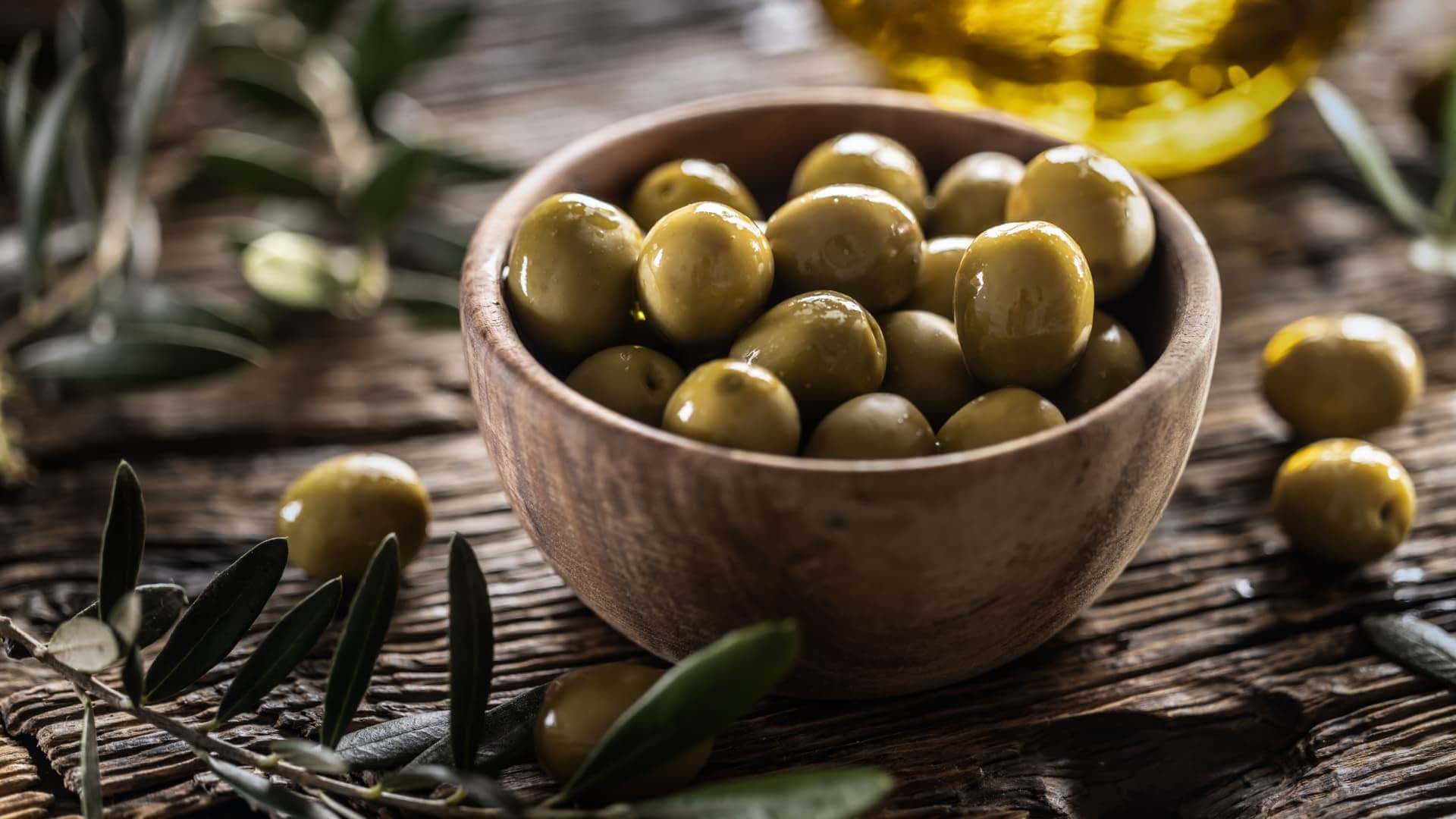
Table olives are a popular food in Italy, with the most prized variety being the Taggiasca olive in Liguria. Different regions of Italy use various olive cultivars in traditional dishes, and olives are prepared using methods such as natural brining to preserve their flavor and texture.
Table olives are among the most popular foods in Italy.
They are eaten at any time of day, from a quick snack to an appetizer, such as a pasta dish with olives, or a main course featuring fish and olives.
Every year, Italy consumes more than 120,000 metric tons of table olives, according to data from the International Olive Council (IOC). Only a few Mediterranean countries have higher consumption levels.
Taggiasca, Italy’s most prized table olive
In Liguria, in northwestern Italy, the term “Taggiasca” refers to the most popular local olive cultivar, whose trees dot the mountains and the coastlines of the region. It is also a symbol of pride and identity for the entire territory.
“Olives are the centerpiece of any aperitif or antipasto,” Fausto Scola, owner of Scola Restaurant in Savona, told Olive Oil Times. “That means Taggiasca olives, the only one that deserves to be consumed.”
See Also:Food & Cooking Stories
While many Taggiasca olives are available on the market, ready to be taken from sealed jars, most restaurants prepare their own, using their own recipe.
For his olives, Scola uses a personal brine formula. “Our brine has ten percent salt and gets changed every two months to ensure that the olives maintain their profile and sapidity,” he explained.
The Ligurian salad known as condiglione becomes a celebration of the Taggiasca olive. Tomato, bell pepper, anchovy, hard-boiled egg, red onion, oregano and the brine all come together in this traditional dish.
“The brine is essential because it adds savoriness without compromising the flavor of the olive,” Scola said.
The chef added that he seldom cooks Taggiasca olives when using them in food preparation, as this would upset the delicate balance of flavors.
“In less-than-perfect cooking conditions, the olive turns bitter and, in any case, loses its unique characteristics. You might not even realize that you are tasting a Taggiasca,” Scola said.
“It’s better to use them as a final garnish on hot dishes, if anything, to preserve their aroma and texture,” he added.
Its unconventional use, such as in savory tiramisu, demonstrates the versatility of this olive.
“The dominant flavor there is that of the Taggiasca itself, with a layer of olive pâté and an outer dusting of olive powder, between two layers of cheese,” Scola said.
The savory tiramisu, which borrows its name from the iconic Italian dessert, is often seen as a fine dining dish that blends tradition with an innovative twist. It is frequently served at buffets and is ideal for highlighting the quality of the ingredients.
The different flavors of olive cultivars
While Ligurian chefs are proud of what many consider the most celebrated table olive in the country, table olives in Italy come from a wide range of olive cultivars.
Their taste and texture vary from north to south, leading to different uses in regional cuisines.
A clear example of regional significance can be found in the Marche region with olive all’ascolana. These large green olives are stuffed with meat, breaded and fried.
The Ascolana olive is a centerpiece of festive tables and pizzerias and was granted PDO certification in 2005 as Olive Ascolane del Piceno. PDO (Protected Designation of Origin) is a European Union certification that ensures the quality and local origin of specific foods.
The recipe, found throughout the region, calls for green olives filled with a mixture of beef, pork (and sometimes chicken), Parmigiano cheese, and nutmeg. They are then breaded and deep-fried.
In Puglia, the southern region where most of Italy’s olives are grown, local chefs utilize cultivars such as Bella di Cerignola, renowned for its large size and juicy flesh, along with Sant’Agostino, Peranzana, and Santa Caterina.
See Also:The Flavors of Extra Virgin Olive Oil
There, olives are added cold to friselle, warm to focaccia and used in both hot and cold traditional dishes prepared for holidays and special occasions.
“There are over 540 olive varieties in Italy, dozens of which are suitable for table olive production,” Roberto De Andreis, table olive tasting panel leader, author and olive oil producer, told Olive Oil Times.
Each region works with its own cultivars. In Tuscany, varieties such as Frantoio, Leccino and Santa Caterina are commonly found. In the north, around Lake Iseo and Lake Garda, Sbresa and Casaliva are cultivated.
In Ligurian cuisine, olives are also used in dishes like Ligurian rabbit, where they are added at the end of cooking to preserve aroma and texture.
In Sicily, Nocellara del Belice olives appear in caponata and pane cunzato, a rustic bread dish topped with tomatoes, anchovies, and olives. They are also used in scacciata, a savory stuffed bread prepared during festive periods.
Throughout southern Italy, including regions such as Calabria and Campania, olives are often seasoned with chili, garlic and herbs, then served warm or used in dishes like focaccia and meat.
In Campania, the well-known reddish Gaeta olives are a key ingredient in traditional dishes, such as spaghetti alla puttanesca — a pasta dish featuring tomatoes, olives, anchovies and capers.
Different preparation methods
Not all table olives are the same. Beyond the cultivar, the key differences lie in the methods used to make them edible after harvest.
The natural brine method, or “olive in salamoia” process, is by far the most common way to treat olives in Italy.
“First, the olives are harvested, cleaned, the stems and leaves are removed, and then washed to eliminate any soil residues,” De Andreis said.
“They are then placed in a brine solution with a salt concentration of around nine to ten percent,” he explained.
This method triggers natural lactic fermentation, during which the pH of the olives drops from approximately seven to below four.
See Also:Spain Tackles the Salty Truth About Table Olives
“Once fermentation is complete, the olives are sorted to remove any that may have physical defects,” De Andreis said.
A fresh brine, lighter at around four percent salt, is then prepared for packaging. The goal is to allow consumers to open the jar and enjoy olives that are ready to eat, with no rinsing required.
“The jars are pasteurized, heated to 85 ºC for at least 15 minutes, and then quickly cooled down to prevent the olives from becoming too soft,” De Andreis explained.
“This process preserves the olives naturally, maintaining their flavor and texture while ensuring they are safe to consume,” he added.
Another method sometimes used for large olives is the Sevillian method, or Spanish method.
“In this case, the olives are first treated with a 1.5 percent caustic soda solution, followed by fermentation in brine,” De Andreis said.
On the market, it is also easy to find completely black olives.
“They come from another method known as the Californian method,” he said. “It uses air and ferrous gluconate and requires sterilization in an autoclave at 130 ºC. It is a faster approach, but it offers less nutritional value.”
After this process, the black olives all look the same. “And they lose most of their taste,” De Andreis said.
“The natural brine method is the best way we have to preserve the true character of an olive and maintain its nutritional value,” he added.
Scola sees a more personal and cultural dimension in how olives should be served.
“It may be a losing battle. Still, I keep telling people to take it with the brine. It won’t hurt you. It’s good for you,” he concluded.