

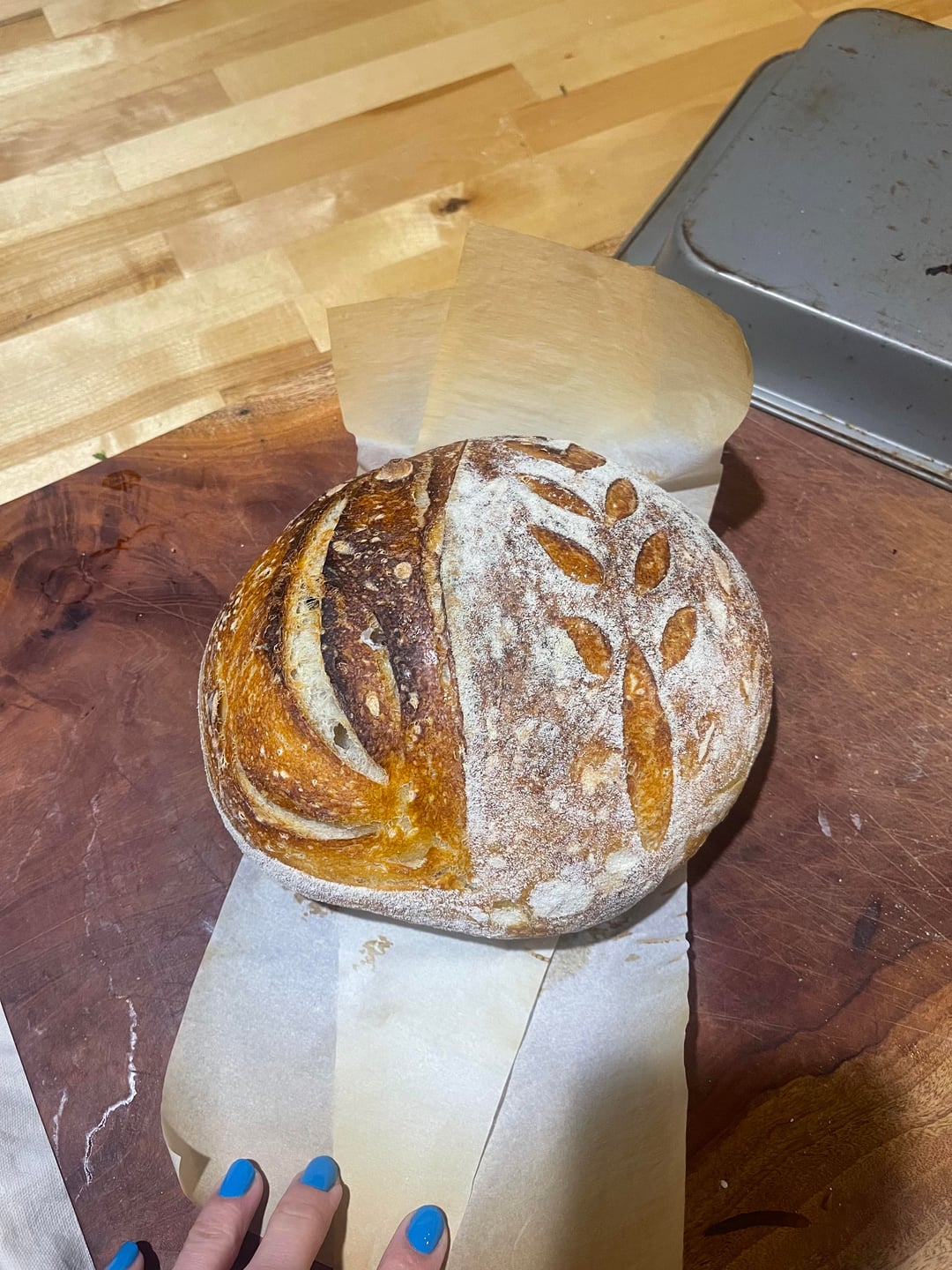


I made my starter mid August, so it’s about 40 days old. It reaches peak in 6 hours after a 1:1:1 feeding. I was so excited to finally start baking with it but I’ve had problem after problem!
First I would let the dough BF way too long because I felt like it HAD to rise 50% like other breads (which it never would, even after 18+ hours). I started doing the aliquot method and only let my 80F dough ferment until it rose the recommended 30%. It looked good on the outside but was gummy and dense. You guys recommended baking longer, so I started baking until internal temp was 210F. It was still very dense… not gummy, but very heavy instead of airy/squishy. Plus, no ear. I’ve tried higher hydration, kneading with a stand mixer, cooling the bread overnight before slicing… but my loaves are still so. freaking. dense.
Could my starter still not be strong enough? In order to make it peak in 6 hours I keep it in the oven with the light off. Does it need to be able to peak faster, or at room temp? The other thing is (don’t kill me) I have only been doing a 1 hour cold proof because I don’t like super sour bread. The flavor of my bread is still slightly sour and tastes great to me, but could not cold proofing be the reason it’s dense?
Recipe: 500g KA bread flour + 350g spring water autolyse 30 min), add 100g starter and 10g salt. Coil folds x4, 30 min apart. BF until it’s risen 30% according to aliquot (my dough is always 78-80F) which is like 7-8 hours. Bake at 475F, lid on, with steam for 25 min, then remove lid and steam tray and bake longer until internal temp is 210F. Cool at least 2 hours before slicing.
by courtneyrel
27 Comments
**Hello courtneyrel,**
Thank you for posting. **[Here is the posting prompt](https://imgur.com/a/De6AKiQ)** if you need to read it again. **[RULES LINK](https://www.reddit.com/r/Sourdough/wiki/sourdoughrules/)** :-). This comment appears on **all posts**.
**[Modmail us :-)](https://www.reddit.com/message/compose?to=/r/Sourdough)** with questions.
# **[READING CRUMB GUIDE ](https://www.reddit.com/r/Sourdough/wiki/reading_crumb/)**
# [Wiki index](https://www.reddit.com/r/Sourdough/wiki/index/), &
# [FAQ Beginner starter guide](https://www.reddit.com/r/Sourdough/s/gnqFg7osBO)
*I am a bot, and this action was performed automatically. Please [contact the moderators of this subreddit](/message/compose/?to=/r/Sourdough) if you have any questions or concerns.*
The crumb honestly looks okay to me. Even the rise itself doesn’t look too bad, though I see what you mean with there being no ear. I wonder if you need to cut the ear deeper? I think sometimes the gases have trouble escaping when its not cut deep enough; its worth playing around with it.
When you say you cook it with steam, how do you achieve this? Spritz of water or ice cubes? I have found ice cubes tend to work better than a spritz of water, personally, so try that if you haven’t already.
Congratulations on making beautiful bread! Try not to get caught up in comparing your delicious loaves to others!
Why, exactly, do you think the crumb is dense? I would disagree with that assessment based on your photos. If you are looking for a more open crumb, you may want to consider a higher hydration, but as for me I’d stick to doing what your doing because your bread looks excellent.
i love a dense loaf ha! but I totally get that it can be frustrating. I’ve been working on sourdough since February and then still messing it up sometimes.
Sandwich lovers would consider that close to the ideal crumb. If you make those Lacey high hydration loaves you can’t do much with them but tear them and dip them in olive oil.
That looks like a great sandwich slice. And just the right amount of holes… not to little and no massive ones where you feel like you’re just biting air. I think the ear is over rated as well. Looks delicious.
What are your ratios?
I would try adding a few ice cubes in your Dutch oven while lid is on, and scoring deeper I do half inch score or do a score then second score after it’s been in for 6 min.
Comparison is the thief of joy. This is a perfect crumb, and only your comparison makes it bad. If you want larger holes, add more water.
Multiple issues, but primarily you are underproofing. The final proof is not just for sour flavour, the dough continues to gain gas which makes it airy. If you dont want tang just do the final proof on the counter for a few hours until the dough is puffy and passes the poke test
Your starter also sounds quite weak so id recommend strengthening with peak to peak feedings on the counter
Looks great, and I think you’re on the right track. I’d eat it. I’d only say to keep tweaking it until you get what you’re happy with.
5 loaves is very few still, in the beginning I would recommend just baking continuously, documenting any slight variations in the process as well as the results. My 5th loaf didn’t look this good, and it’s likely that you’ve already heard most of these tips but anyway.
1. Yes, your starter is still relatively young. I know people tend to say that a few weeks is enough to bake, but honestly it heavily depends on your starter. Nowadays my starter grows over 4x in volume, and while that doesn’t equal more microbial activity, it does tell something about the combination of activity, how well your flour handles the acidity as well as the expansion of the gases.
You say your bread becomes too sour if you leave it in the fridge, so maybe the acidity levels of your starter are still high which can result in the acidity “eating through” the gluten in your dough, making it harder for it to contain any larger pockets of gas (alveoli).
You should keep feeding your starter and that should help with any potential issues with the starter. Also, do you feed KA bread flour to it or something else? What ratio? If I had to pick any single “problem”, I’d bet it’s the starter. You can try a different ratio or a different temperature (hotter is not always better).
2. Judging from the crumb, it is not obvious to me that there would be any issues with the fermentation. When all the other variables are in check, most starters can handle a wide variety of different fermentation times/volumes. You’re on relatively low hydration, which you can try to increase a little, but again I doubt that will make a giant difference, could be done improvement still.
3. The outside of your loaf looks maybe slightly dryish? What kind of dutch oven do you use? There is no mention of additional steam either via spritzing or ice cubes, this is something you can try to make it easier for the bread to expand in the oven. You can also try taking the lid off a little earlier, maybe at 15 minutes. It could be that there is some collapsing already occurring before the crust gets to form, making it slightly smaller in volume as a result, but I doubt this is the biggest factor here.
4. Scoring? The lack of ear is usually the result of one of three things: (in)activity of the starter, lack of steam or failed scoring. Out of these again I would say the starter plays the biggest role, the other two more often than not just result in cracks and tearing.
In summary, my best guess is that you can still improve the performance of your starter. Once the starter is really strong, it’s much easier to start experimenting with other things and also any other potential issues will be easier to resolve. That is then also the time you really get to focus on the fermentation and try to nail that for perfect results 👌🏼
Mine always look like that now, and I get what you mean about dense. The slices have a heaviness to them, that many bakery sourdough don’t have. That said I’ve been very happy with the flavor and eating experience and I just accept it.
I was going to ask about the temp of your kitchen but your starter is popping off!
How long do you ferment and what is your shaping process? It certainly COULD be that you’ve developed too much tension in shaping and there’s nowhere for the dough to expand.
I would expect some venting cracks if that were the case but it’s still possible.
Try adding a tablespoon of olive oil to the dough, or enrich it in some other way.
It’s possible the sourdough you’ve tried and enjoyed was enriched and wasn’t the standard water/flour/starter recipe.
If you’re getting a loaf that *looks* this nice there isn’t anything wrong with the process. I’ve never had short cold proofs affect the texture of my bread.
I never see anyone recommend this, but I would suggest switching to all purpose flour if you want a little more airy-ness. It’s still not going to be like normal yeasted bread, but I have found the texture a lot more “edible”, like you said.
These are awesome loaves. Mine look like this too.
You aren’t folding enough, your crumb is dense because your not folding enough air into it. Likely your starter is weak too. I always make my own with some pineapple juice and whole grain, feed it for a few weeks and then presto. If you buy starter you are getting something that isn’t from the environment you are in. The result is meh. Yeast is fungus, and there are a lot of variations of fungus. Why not use the fungus that already lives and thrives in your environment? You will have a better end product. Good luck, baking bread can be cathartic and is always rewarding.
try using a hybrid of commercial yeast and your wild sour yeast. I find that lightens the bread while still giving you the open crumb.
I can’t fix mine either. So dense and sometimes gummy
I think it will get better with more loaves, I started in Feb and this is how they were initially, but now they are coming out great! I don’t know what exactly changed it but here’s all the things I did:
1. Maintaining a stiff whole wheat starter, 1:10:5
2. Scoring differently for round loaves (like a cross) and then going under the tear and cutting parallel to the loaf for the ear (I guess this is for aesthetic purposes but it looks soo good)
3. No icecubes and extra steam: I think that was making the temps low in my oven. Just going with the loafs hydration and Dutch oven was enough steam.
4. The initial few stretch and folds – changed it to slap and fold.
5. I am using the bassinage method to incorporate water. This way you can add more water to the gluten network without it becoming a slop.
https://preview.redd.it/mtbxzgykt4rf1.jpeg?width=1200&format=pjpg&auto=webp&s=6b64e05cddd94146a2e3bf1c540d968e886cd26c
Are you saying it’s kinda gummy? Like if you squeeze it it sorta just turns back into dough? I swear my breads had/have this problem as well. It’s just the nature of the bread. I found that moving down to all purpose flour helped a lot with that chewy gummyish texture. The higher gluten content of bread flour makes the bread chewier.
Those all look… just fine.
tbh, i think your bread looks great! personally, i BF overnight and pre shape, rest 30 mins, shape, then straight into the oven. that’s what works for me.
no need to cold proof 1hr, as the internal temp will not cool in that time. you can proof 1hr or so on the counter and do the poke method. the very first sourdough video i watched didn’t even mention cold proofing. i think you BF a little longer when not cold proofing 🤷🏻♀️
Your crumb pattern looks fine, especially for this level of hydration, which suggests that your technique overall is good! BUT! From your description I’d say your starter is definitely too weak. The general rule of thumb (at least from the books I use) is that your levain (the amount of starter you are taking out and feeding 1:1:1) should double in 4 hours. Then, if it’s only rising 30% in 7-8 hours, that’s also really slow at those temperatures. For comparison, my levain will double in 4 hours and then raise my dough 40-50% in another 4-5 hours at 23-24C, which is cooler than you are using.
Lastly, the 30% rise is usually paired with the overnight (12hr) proof in the fridge and it’s assumed that the dough will keep rising for a length of time in the fridge as it slowly cools down. After my overnight proof, I see another noticeable rise from when I put the bannetons in. In other words, the reason for the 30% rise ending bulk fermentation is that the dough can overproof after 12 hrs in the fridge if we don’t end BF early. So, if you’re only doing an hour in the fridge, that’s not really cooling the dough down much, and you’re just adding 1 more hour to your BF. At 78-80F, your dough should be blowing up after 9 hours! Mine would be focaccia spilling over the bowl! 😀
I agree with the other poster that you should focus on continuing to strengthen your starter. Do you use any rye or other whole grain flour? That makes a big difference for me. Good luck!
Crumb is great, you may want it different, and achieve that through work and experiments, but it’s absolutely not flawed.
I am convinced that if the crumb is cooked properly, not gummy, not wet, the whole process went well. It’s really hard to properly cook an under-proofed loaf. But I’m no baker so my opinion does need to be right.