
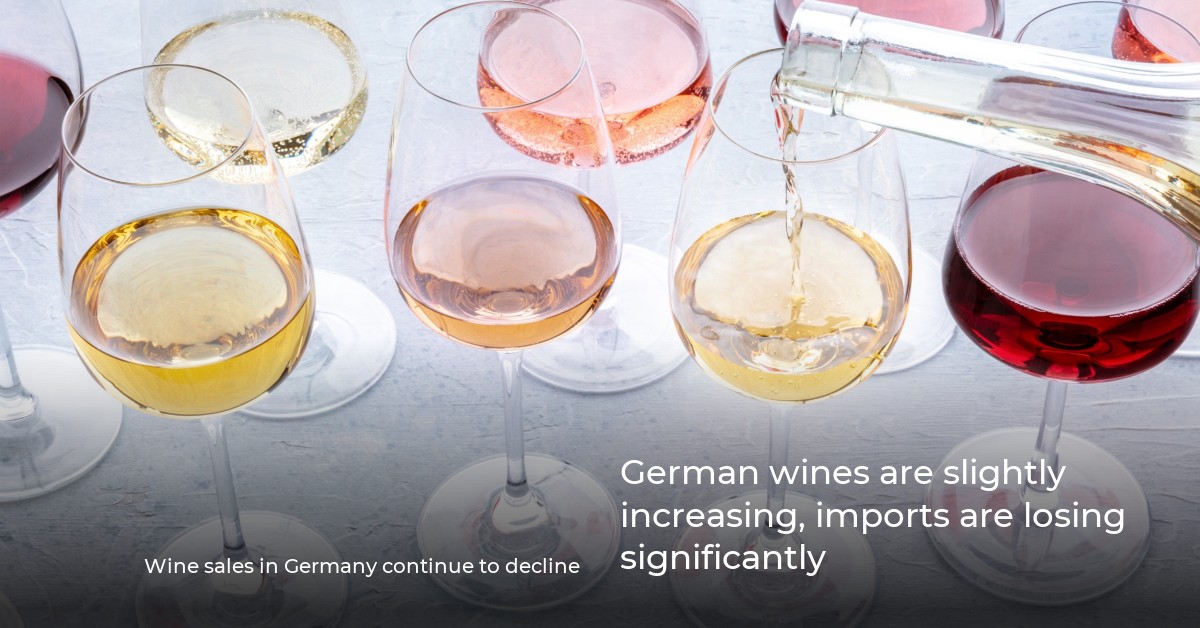
German households spent less money on wine again in the first half of 2025. According to current data from the NielsenIQ household panel, the purchasing volume decreased by 3.3 percent compared to the same period last year. The purchasing value decreased even more sharply by 7.2 percent. This was announced by the German Wine Institute (DWI).
While the demand for German wines only decreased by 1.4 percent in volume, the decline for foreign wines was significantly stronger at 6.3 percent. The purchasing value shows a similar picture: minus 4.7 percent for German and minus 9.3 percent for foreign wines. The buyer reach – that is, the number of households purchasing wine – slightly increased by 0.4 percent in the second quarter, with German wines increasing by even one percent.
Thus, consumers are not only spending less money but are also, regardless of origin, opting for increasingly cheaper wines. Nevertheless, according to the DWI, the assumption that German wine is losing market shares to cheaper imports cannot be statistically confirmed.
When looking at origin regions, Germany is gaining market shares: The share of total wine purchases increased by 0.8 percentage points, while Italy (–0.9 %), Spain (–1.2 %), and France (–1.4 %) lost shares. In detail, a differentiated picture emerges: For white wines, Germany loses slightly (–1.1 %), while Spain (+0.9 %) and other origins (+4.1 %) gain. In the red wine category, Germany gains (+1.5 %), while Spain loses (–3.7 %). Consumers are also increasingly opting for wines from Germany for rosé wine (+2.9 %), and less for rosés from France (–2.3 %).
Germany also saw an increase in sales. Market shares rose by 1.5 percentage points across all categories – red wine (+0.9 %), white wine (+1.1 %), and rosé wine (+2.8 %). France lost in all areas, Italy could only gain in red wine, and Spain only in white wine.
Increases in sales and revenue were also recorded for the so-called “other origins,” which include blends from the European Community. They belong to the low-price segment of supermarkets and discounters. This trend continues to push the overall declining average price per bottle in the German wine trade further down.
(ru)
More on the topic
Wine consumption in Germany decreases by four percent
German sparkling wine with slight sales increase domestically
Rosé and non-alcoholic wines becoming increasingly popular in Germany
Dining and Cooking