
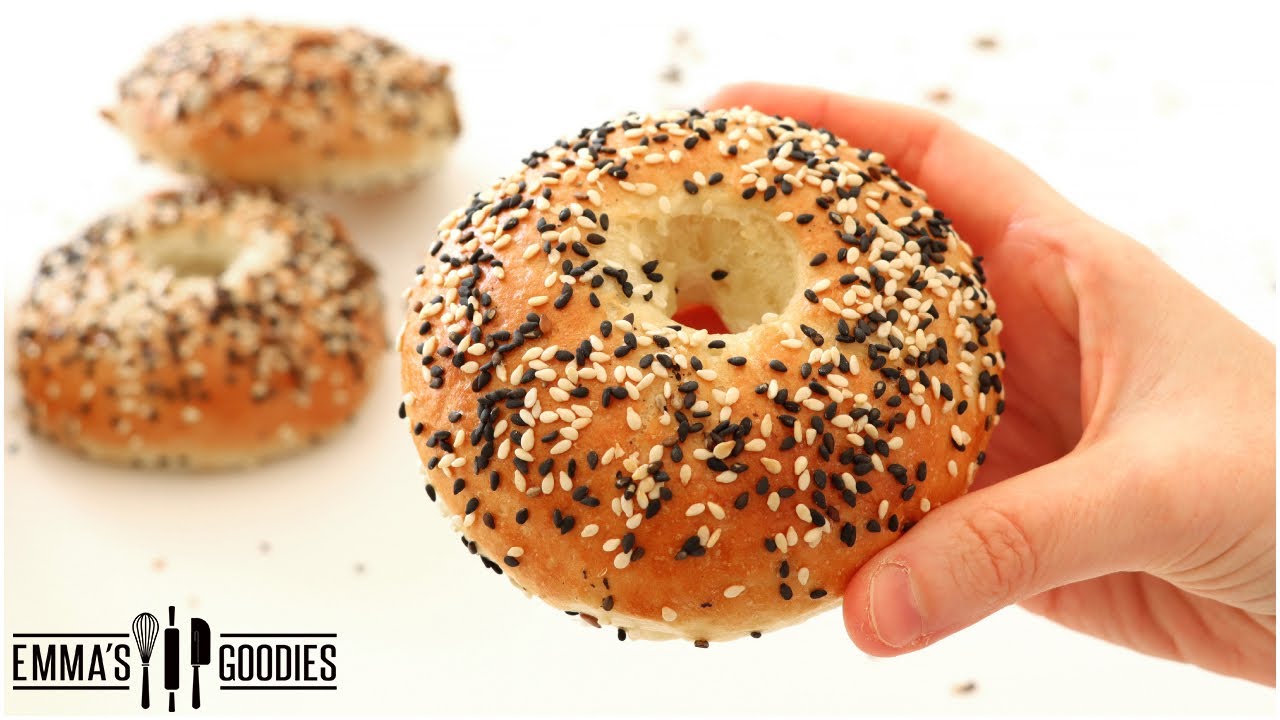
Easy No Knead Homemade Bagel Recipe – The Easiest Bagels Recipe!
This video is sponsored by Made In. Use my link to check out the Carbon Steel Collection and my other favorite cookware from Made In – https://madein.cc/1025-emma
ORDER MY COOKBOOK ❤ : https://www.emmafontanella.com/cookbook
Detailed Easy No Knead Bagel Recipe: https://www.emmafontanella.com/homemade-no-knead-bagels
Easy Bagel Recipe:
2 cups (480g) Warm Water
3 tablespoons Sugar
2 tsp Salt
2 tsp Yeast
2 tablespoons Oil
5 1/4 cups (750g All Purpose Flour)
Enjoy!
♥
Copyright © 2025 Emma Fontanella. All rights reserved.
No part of this video (including thumbnail images or written recipe) may be reproduced or transmitted in any form or by any means, electronic or mechanical, without the written permission of the copyright holder.
Chapters:
00:00 Intro
00:57 Make the Bagel Dough
02:00 Perform the Stretches and Folds
03:54 Shape the Bagels
05:36 Boil the Bagels
06:50 Bake the Bagels
Let’s make the best no knead bagels you’ll ever
have. These ones are extra soft and chewy with that signature golden shiny crust. They’re
so easy to make. And once you’ve tried these, you might never go back to store bought bagels.
There’s nothing like homemade bagels. They are delicious. Make a big batch. Store these in the
freezer. They make the best breakfast sandwiches. All you need to make these bagels is a big
mixing bowl, a tray, and a pan. The pan I’m using today is made by today’s sponsor, Made In.
These fantastic pans are used in thousands of top rated restaurants across America with over 100,000
five-star reviews. They’re also used in two three Michelin star restaurants, Alinia in Chicago and
Le Bernardin in New York. If these pans are good enough for their food, I promise you they’re good
enough for anyone. I’ll tell you more about why this pan is so useful later, but for now, let’s
get on to making the bagel dough. To a large bowl, add the warm water, sugar, salt, oil, and yeast.
We’re going to give these ingredients a good whisk and add the flour in one go. You want to mix
everything together with a fork. If your dough seems dry, don’t be afraid to add an extra 1 to
2 tablespoon of water. Even if you’re using the same flour as I am, every flour absorbs liquids
differently, so you might need a little extra water. Now, eventually you’ll have to switch to
using your hand or your fork will bend. You want to wet your hand with water and continue mixing,
making sure there’s no dry patches of flour and dough. Using a wet hand really allows you to
hydrate any dry patches of dough. Now, this recipe is a no- needed variant of the bagel recipe in
my cookbook, Simple Pleasures. I’ll leave a link below. The water amount is different for this
recipe. However, if you do want to use a stand mixer, use the ratios in my cookbook. Cover the
dough and let it rest for 30 minutes to allow the flour to properly hydrate. After 30 minutes, we’re
going to do what we do with no need bread making, a round of stretches and folds. You mostly see
this for high hydration doughs, but did you know you can use the same method for lower hydration
doughs? We just do it a little bit differently. Weigh your hand and perform your first series
of stretches and folds, turning the bowl as we go. Take one side of the dough, stretch, and fold
the dough onto the opposite side. Do about four to five folds. Then take your wet hand and push
the dough under itself, creating a rounded ball. This method along with the stretches and folds
allows you to start to develop gluten network. As you can see, we went from a shaggy dough to a nice
plump dough. Cover the no need dough and set aside for 30 minutes to allow the gluten to relax. Then
come back and do a second series of stretches and folds. You want to do about four to five folds per
every session. You’ll know when to stop because the dough won’t be elastic anymore. You’ll try to
stretch it and it will feel tense. At that point, using a wet hand, you’re going to again ball up
the dough as we did before and come back in 30 minutes and perform your third series of stretches
and folds. You want to repeat this process another two times. So, you’ve done four rounds of
stretches and folds in total. After every series, you do want to ball up the dough, pushing
the dough under itself and creating a smooth, plump dough. After the last series of stretches
and folds, cover the dough and allow to rise for about 30 minutes to an hour, depending on what
time of the year you’re making bagels. We want the dough to double in size. Transfer your dough
onto your clean work surface, and we’re going to make bagels. You’re going to divide the dough in
12 equal portions. Each portion should be about 100 g. I like to weigh the dough, but it’s not
necessary. Just try to make the bagels as even as possible. We want these to bake evenly, of course.
Now, normally what you do is you roll out each portion of dough into a bowl. And usually using
your fingers, you punch out a hole through the middle. I personally use a different method, which
is much faster in my opinion, and also gives you a more precise bagel as you’ll see. This is how I do
it. Roll the doughs into balls, but don’t puncture the hole just yet. Set the balls of dough onto
some parchment paper. Cover and set aside for 40 minutes. In the meantime, bring a large saucepan
of water to a simmer. This step is what gives the bagels that characteristic chewy texture. There
is no going around this step. Now, as mentioned, there are different ways to shape bagels, but I’m
going to show you the easiest way to get a great result. Fast forward 40 minutes later, just
before dipping each bagel into the hot water, we now punch a hole out. You can use a small
cookie cutter, anything that’s small and sharp. I like to use the back of a piping tip. The reason
I like to cut the hole now instead of earlier, is so the bagel maintains the hole. If you
were to make the hole in the beginning, as the bagels rise, they will lose their hole.
Lower each bagel with its parchment paper into the hot water bath for about 30 seconds to a minute.
The bagel should float. If they do not float, that means the dough hasn’t risen enough. Now, how
does putting the bagels into hot water make the interior so deliciously dense and chewy? Well,
it’s all about starch. When we put the bagels in very hot water that’s above 180° F, starch
granules at the surface of the dough burst, releasing starch molecules that then link together
to make a wrinkly skin around the bagel. The skin is tough enough to stop the bagels expanding as
they bake. And because the bagels can’t expand, the interior is kept deliciously chewy. This
step is what really makes a bagel a bagel. I call this the prune stage. If you’ve never made
bagels before, you might think you ruined them, but fear not. I hope you can now see that
it’s exactly what we want. As they bake, the skin on the bagels smooths out and loses its
wrinkles. If only this method of wrinkle removal worked for skin care. Place the bagels on your
lined baking sheets using a slotted spoon. And you want to leave enough space between each bagel.
Brush each bagel with a beaten egg white and add your toppings. Everything bagel seasoning is
a classic, but even just a mixture of sesame seeds or poppy seeds or even pumpkin seeds, it is
fall after all, is delicious. Bake the bagels in a preheated oven at 430° F, that’s 220° C, for about
16 to 20 minutes or until golden. You’re going to allow the bagels to sit for 5 minutes on the
pan and then place them on a rack to cool. Now, homemade bagels are delicious as they are. They’re
so good. There’s no need to toast these. However, this bagel recipe does make a big batch. And if
you’re not going to eat your bagels super fresh, toasting them is the way to go. Of course, I’m
using this maiden carbon steel pan to toast them. Now look, I know many people use non-stick pans
for everything, but I want to encourage you to think about using the right pan for the right
application. In this case, when you want to get your pan super hot, please do not use a non-stick
pan. High heat will eventually ruin the coating on the non-stick pan. But with carbon steel, there’s
no problem. It’s the perfect cross between a cast iron pan and a stainless steel frying pan. It
heats up quickly. It’s light enough to handle and gives you incredible heat control. As you
use and season your carbon steel pan, it will develop a naturally non-stick surface. These pans
can really handle high heat and go from stove top to oven to even an open fire up to 1,200°.
You can check out the carbon steel collection and my other favorite cookware from Maiden by
using the link in the description box below.
20 Comments
Detailed written recipe for the Bagels here: https://www.emmafontanella.com/homemade-no-knead-bagels 🥯
Check out the Carbon Steel Collection and my other favorite cookware from Made In by using my link –
https://madein.cc/1025-emma
ah I have to try this. I miss bagels!
That's Wow Emma thank you so much stay bless with your family nd a bless weekend
Yum!💛💛💛💛💛💛💛💛
Missed you Emma !
YUM 🤤💗
Great recipe! But i have a question if I want those for breakfast which part of the recipe i should be doing at evening. And how? Like should i just storage the dough in the fridge before dividing it to 12
Good to see you again Emma. I love my carbon steel pan that I use when I backpack camp. I'll get a Made In for the home.
Emaaaaaaaaa girl where have you been 😭😭😭😭😭 these are happy tears ❤❤❤❤❤
Hi Emma!!!! I made your hot chocolate recipe for my son the other day! He absolutely loved it 😍
Thanks for a great recipe.. can you pls bake torcetti cookies it's so delicious
Hi Emma. I always enjoy your videos. I tried these today and my husband and I loved them. They came out a little cake like in the crumb and I also need to use a bigger cutter for the holes. Just my first attempt at making bagels ever and I’ll keep making these until they look like yours. But even though they weren’t perfect they were delicious! Thank you again for the recipe. Everyone should try to make these they were easy and so much fun to make on a rainy autumn day. Thanks again from Lancaster County PA
Missed you! Lots of love from Trinidad! 🇹🇹
Will you do one for Asiago cheese bagels? thx
Great presentation
Thank you ❤
So excited to have you back! 🎉 Every time i use one of your recipes it is a big hit! I love all your videos sooooo much! Thanx so much! ❤🎉🎉😊
Thank you Emma ❤
yum . can we airfy it like you did on donuts?
Hello Emma, please provide the correct quantities for your donuts recipe. I tried it with the measurements you have listen in description box and they came out hard. Some subscribers mentioned that it's only 1 cup and 2 table spoon of flour but you listed 2 cups and 2 or 4 table spoons. Don't know if the quantities listed for the rest of ingredients are also incorrect.
Could you please let me know?
Thanks