
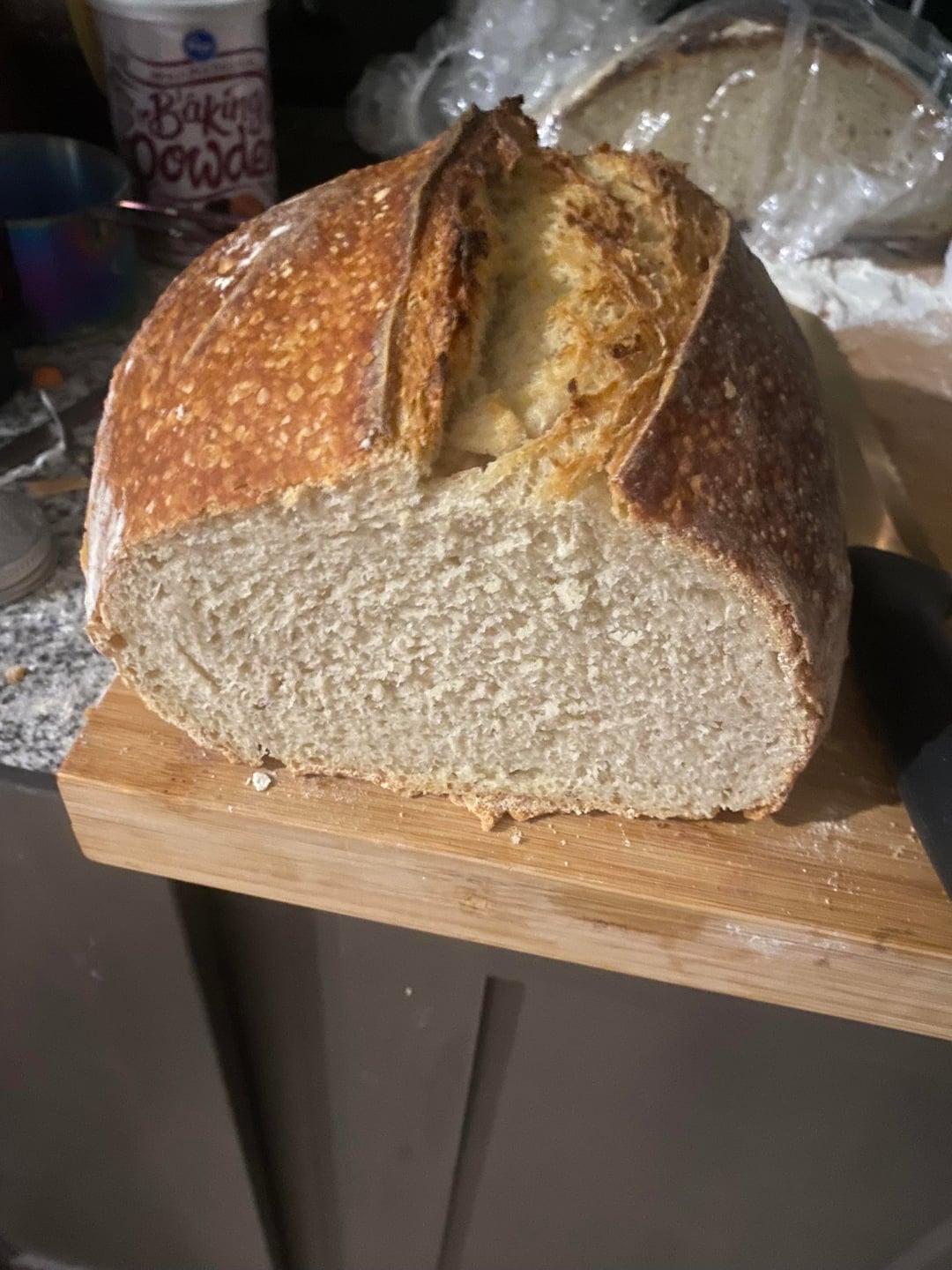
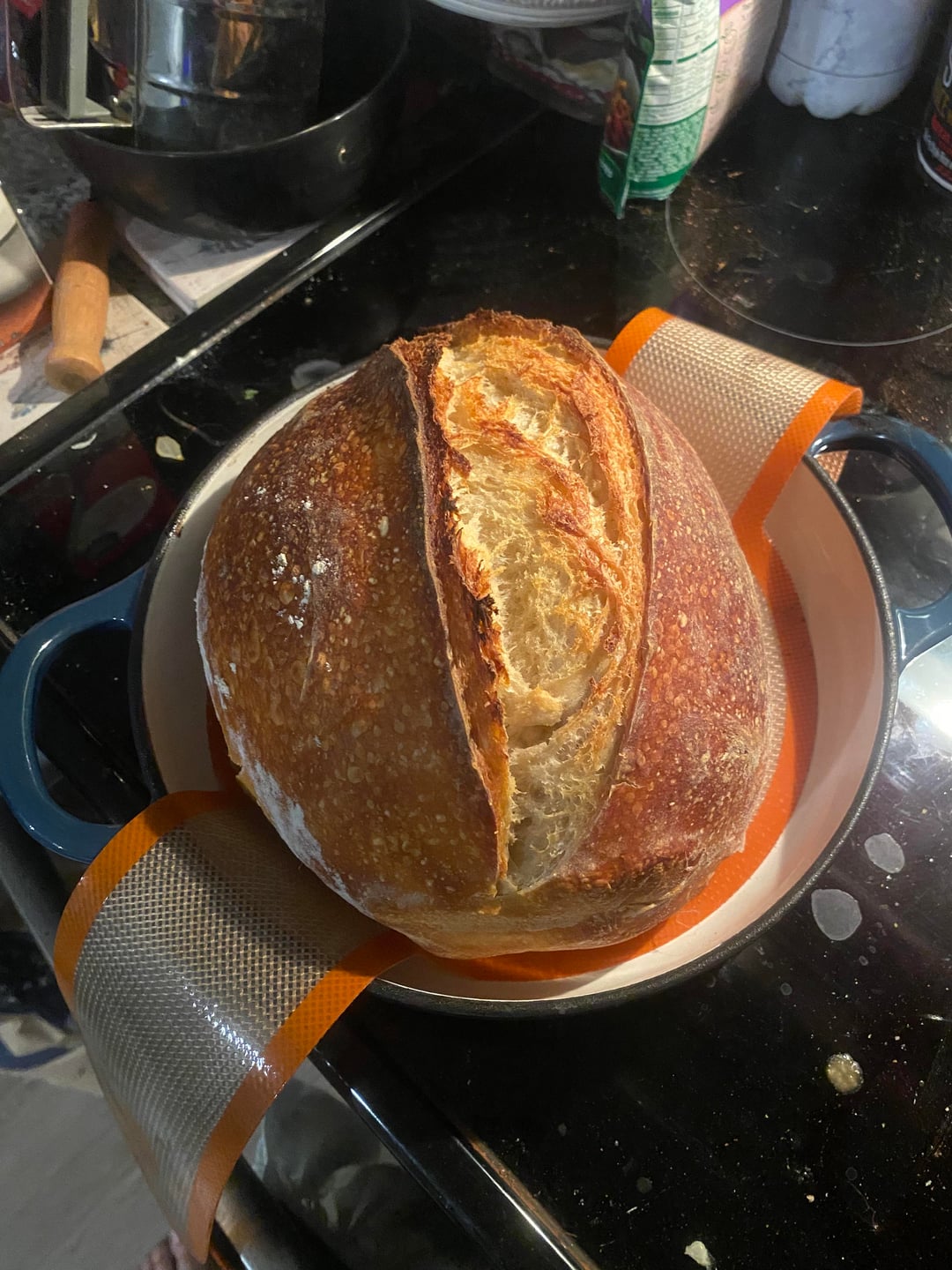
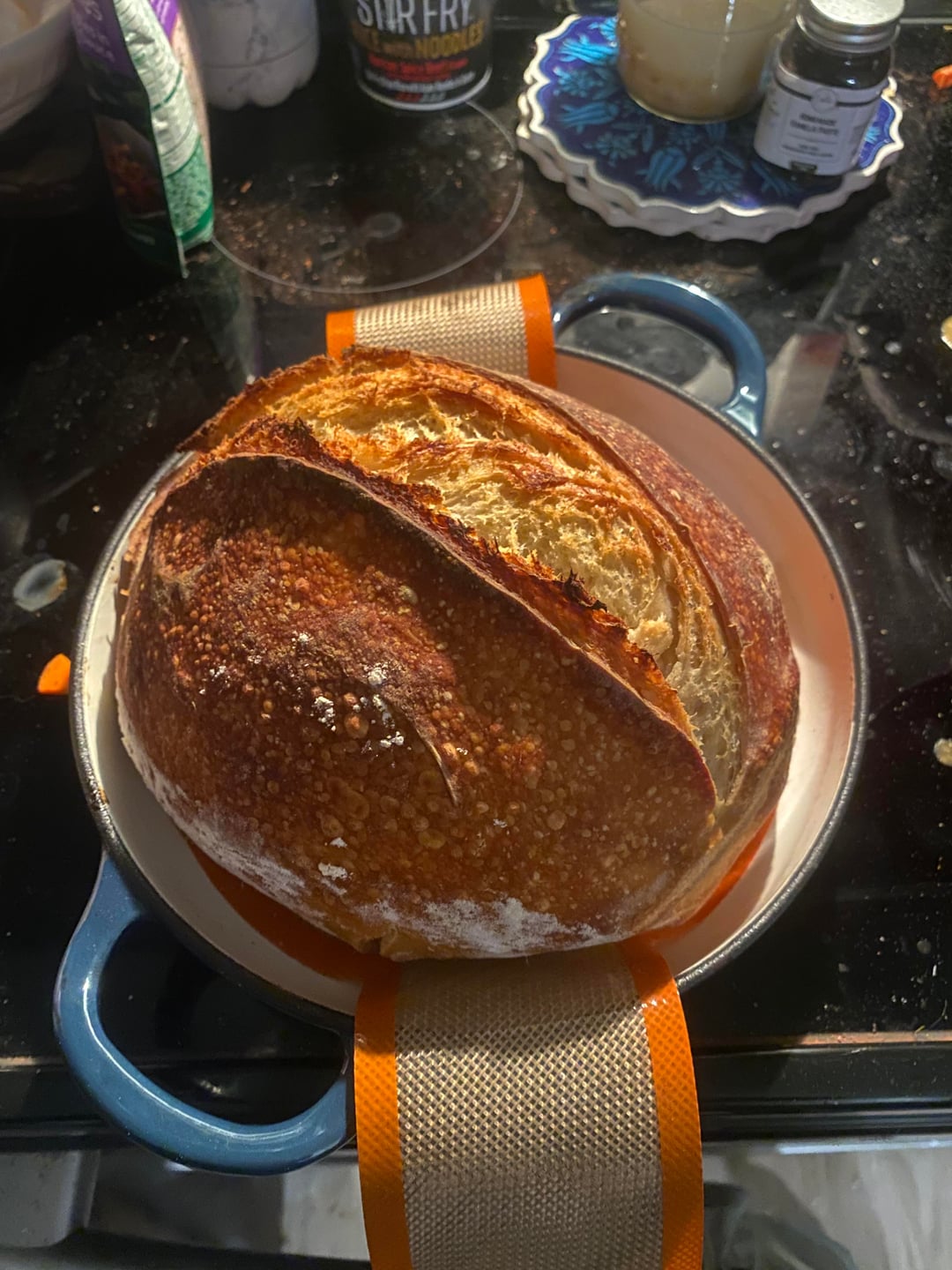
Hi everyone! I’ve been making sourdough for about 2-3 weeks now and I’ve gotten pretty good at baking it I think. I just can’t get a good crumb? It always comes out solid, I get a good rise in both proofs and a tasty loaf but no holes! What am I doing wrong? My starter is lively bubbly and doubles easily.
I used: 120g Starter (1:1:1), 4 cups bread flour, 2 teaspoon salt (10g) and 1 1/2 cups of water. I proof for about 6/8 hours or until it doubles (my place is colder)then shape and do it again. I do the poke test. I bake at 475 in a Dutch oven 30min with lid, 20min lid off.
I want that beautiful crumb that sourdough is known for but I can’t seem to get it though my overall bake improves every time I bake.
Suggestions?
by ThickPastryWitch
18 Comments
**Hello ThickPastryWitch,**
Thank you for posting. **[Here is the posting prompt](https://imgur.com/a/De6AKiQ)** if you need to read it again. **[RULES LINK](https://www.reddit.com/r/Sourdough/wiki/sourdoughrules/)** :-). This comment appears on **all posts**.
**[Modmail us :-)](https://www.reddit.com/message/compose?to=/r/Sourdough)** with questions.
# **[READING CRUMB GUIDE ](https://www.reddit.com/r/Sourdough/wiki/reading_crumb/)**
# [Wiki index](https://www.reddit.com/r/Sourdough/wiki/index/), &
# [FAQ Beginner starter guide](https://www.reddit.com/r/Sourdough/s/gnqFg7osBO)
*I am a bot, and this action was performed automatically. Please [contact the moderators of this subreddit](/message/compose/?to=/r/Sourdough) if you have any questions or concerns.*
That looks pretty good to me! For me it’s all about the proofing to get the good crumb. The cold rise is the most important step for a good crumb. Gotta get the right amount of spring/bounce back when I do the push in test. Slow bounce back means it’s proofed properly otherwise it’s too flat and underproofed
Tighter crumb = lower hydration percentage. More hole-y crumb = higher hydration percentage, aka higher water to flour ratio. I only use metrics so sorry not sure what your measurements are but my ratio of 525g flour, 10g salt, 390g of water, and 125g starter always gives me the “classic” sourdough look.
Just do a diff recipe. I do Alexandra’s the first one that comes up when you google easy sourdough recipe
Also stop using volume…1 cup doesn’t mean anything when different substances are different densities. Use weights only to measure
As someone else mentioned, weighing with metrics is what most people around here do. Not all but lots and for a reason. There’s a [calculator](https://sourdoughcalculator.info) you can use to figure out your hydration rate. Mine is 78% I get perfect loaves every time. I also use [this recipe](https://alexandracooks.com/2017/10/24/artisan-sourdough-made-simple-sourdough-bread-demystified-a-beginners-guide-to-sourdough-baking/) and it works every time!
OMG, is that a Silpat loaf hoist?!?!
That would have saved more than one burn for me.
did you do any stretch and folds during the bulk rise?
There are two properties of the gluten network that matter: elasticity (snap back, strength) and extensibility (stretchiness.) The flour you use and the extent to which you develop the gluten contribute elasticity; the hydration and the extent to which you develop the gluten contribute elasticity.
Really nice open crumbs require hydration above 70%, calculated as weight of water divided by weight of flour. You’re measuring those ingredients by volume; a back of the envelope conversion suggests your % is about 73%. Your starter is a little stiffer than that – 50%, and accounts for probably 10% of the overall, so you’re hitting about 70% on the nose.
So you’re not far off. But I’d suggest adding a little more water. And giving some attention to gluten development. Your recipe, at least as you typed it here, has no stretch and folds, no coil folds, no kneading, no rubauds, no late bassinage, no nothing; if you don’t develop the gluten, your crumb isn’t going to be very nice.
Here’s a pic of the loaf that resulted when I first managed to incorporate an aggresive early whisk mix; proper stretch and folds; rubauds; and late bassinage. Not bad for 15% oily whole wheat, and the entire loaf Rouge de Bordeaux, a heritage wheat with decidedly non-modern gluten. I’m rather proud of it. Didn’t last long – the aroma summoned the whole family 🙂
https://preview.redd.it/muub40649ewf1.jpeg?width=768&format=pjpg&auto=webp&s=a5f69249bc18326b1bdeab6e261203b49c386fd2
If you keep getting push back on writing cups, just do a separate post and write grams, and ask the question again. Then you’ll get better answers. Sometimes people are not so nice when they think you aren’t “correct” in your methods.
And, I think your loaf is beautiful, and people also come here to ask how they can get your loaf’s result! It takes all kinds, even the rude ones, because it’s Reddit. The mods here are pretty good at keeping it civil, but sometimes it creeps in.
Try asking again, and be a little more detailed in your description of your methods, because we really want to help.
Higher hydration and longer fridge retard.
Optimal hydration is tied to the flours you’re using. For example …78% hydration is fine if I’m using AP flour but if I’m using bread flour or certain whole grains I need my dough to be 85 -90%. So practice and get a hood feel for how thirsty your flour is.
I actually like 80% hydration
I was just reading the replies and believe there’s no satisfactory answer here yet, cause I want to find out why too.
I don’t think hydration is an issue, i’ve seen 60% sourdough have the “look” that OP is searching for.
OP, when you say “shape and do it again”, do you shape then wait for it to double again in 6/8 hours? Additionally, do you happen to know exactly the temperature of your dough/environment? That’s one big thing that’s left out of recipes usually.
More water
Add more water. I use Baker’s yeast too. Just 0.3% (from flour weight)
My recipe is as follows: 75g whole grain flour, 225 g flour 00 type, 1 g Baker’s yeast, 6 g salt, 230 g water, 30 g starter
I recommend people download an app called “sourdough”. It’s a calculator where you can save notes on your recipes and calculate your hydration based on the recipe and ratio of the starter.
Try to aim for 70% hydration as a good starting point. Then if you want the crumb to be even more open and soft, you can push hydration 5 to 10%, and try to handle the dough less during and after shaping.
strong flour, moderately high hydration, minimal handling after dough is formed (no folds after the first 2 hours, work on gentle shaping).
The water in dough starts by weight fine…The actual water needed for the dough is based on feel of the dough…The dough will have enough water when it’s soft to the touch but not too slack it’s a fine line but it comes with experience. Also you must develop Enough gluten during mixing or kneading usually 10 min in the dough hook in a mixer on speed 1 or 2👊🏽