
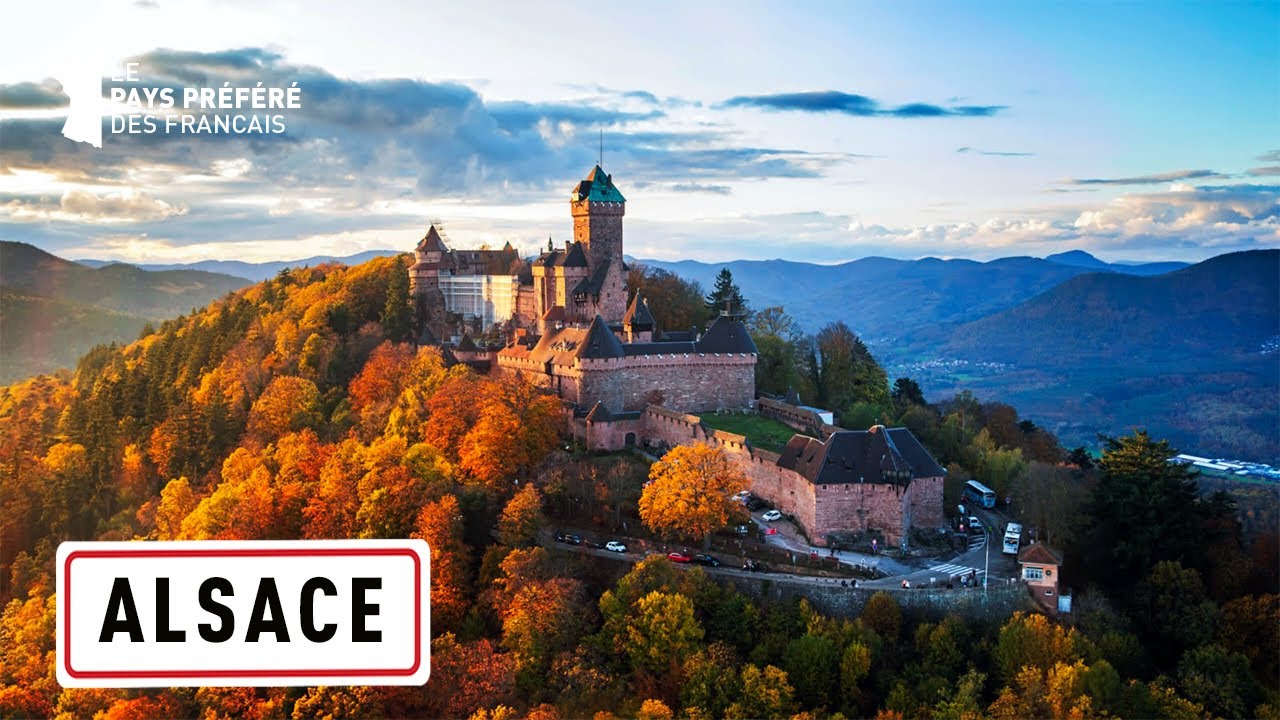
L’Alsace, ses maisons à colombages, ses géraniums aux fenêtres des petites maisons colorées mais aussi ses musées d’exception, sa fameuse Route des Vins au pied du Massif des Vosges… 🏡🌷
Pour découvrir les merveilles des plus belles régions de France, c’est ici – Abonnez-vous 👉 http://bit.ly/3zjR2Vj 🙏
Frontalière de l’Allemagne, l’Alsace, plus petite région de France métropolitaine, possède de nombreux atouts : des bourgs pittoresques surplombés par les vestiges de châteaux seigneuriaux, des vignobles au pied des Vosges ou encore des églises de grès rose aux beffrois sonores. A Strasbourg comme à Colmar, les quartiers historiques sont bordés de canaux. La région, longtemps convoitée par l’Allemagne et la France, possède également une riche histoire militaire, qui permet encore aujourd’hui de plonger dans les tranchées de la Grande Guerre ou de s’enfoncer dans les entrailles de la ligne Maginot.
Réalisé par Emmanuel Descombes
© MORGANE PRODUCTION
Do you like France? Do you like to explore it,
discover it, and meet it? Sometimes you even
feel like you know her well. We all have a small beach,
a small cove, a clearing, a hamlet or a path that belongs
only to us, far from the beaten track and that we only want to share with
those we love. This is the France we want
you to discover, through 100 places that you absolutely must see in your lifetime.
Today, we invite you to cross a magnificent border region
that two countries, France and Germany, have never ceased to covet. And to stand up to these two contenders,
Alsace has equipped itself with magnificent finery. These are picturesque towns, almost
majestically overlooked by the remains of stately castles
and also mysterious rocks with magnetic properties. We’re going to fill up on energy, then.
Here we go. Here we go. Alsace offers superb districts
lined with canals and sandstone cathedrals with resonant belfries. While its military history allows you
to dive into the trenches of the Great War and delve
into the bowels of the Maginot Line. It’s still impressive,
these corridor tiles. Alsace is the land of storks and
schpitzlé, the traditional pasta. It’s all there. Yeah, you have a bit of a memory of Alsace,
a bit of everything, it’s true. On the plate. It is also surprising men and landscapes
where the forest can even take on the air of the Amazon. It’s hard to believe we
‘re 5 km from Strasbourg here. It’s truly a beautiful place
where I can recharge my batteries. I understand you well. Our journey through Alsace begins
in the city that constitutes its heart: Strasbourg. The capital of Alsace is a splendor
listed as a UNESCO World Heritage Site. These bridges, squares,
houses and canals bear witness to a rich historical past. This is the hometown of Adeline Beck,
in an astonishing building, this young woman directs the Strasbourg Voodoo Museum
, dedicated to the arts and beliefs from Africa. I have traveled a lot. I lived in Limea,
I discovered Africa, Latin America, but my heart remained
in Strasbourg, my city, because I am known to have tradition,
heritage and modernity. We are also a European capital and we
have a very dynamic cultural life. First of all, Adeline wants to
show us the cathedral. The architectural jewel of Strasbourg. With its spire reaching 142 metres,
it was, until the 19th century, the tallest religious building in Europe. Victor Hugo said that she was a prodigy of the gigantic and the delicate. It’s no wonder
so many tourists come to pay their respects or simply relax on the square and
admire its pink sandstone facade. This Gothic cathedral welcomes
more than 8 million tourists from all over the world every year. Adeline has arranged to meet
André Veuglet, a bell maker. Tell me, you know the bells we hear there
, I think? Absolutely, absolutely. My family has been
involved in the maintenance and repair of these bells for a very long time. And I even made some
for the cathedral. I’d love to go see the belfry.
Can we go? Let’s go. Located above the Gallery of the Apostles,
between the two towers of the facade, the belfry houses 10 of the 16
bells of the cathedral. Visiting the belfry is
a privilege rarely granted. It is the only treasure of the cathedral
that is still inaccessible to the public. So here we are, entering the belfry.
You see? It is this enormous oak beam structure
that allows the bells to be suspended and to contain the thrusts
developed by the swinging of the bells. Ah, that’s monumental.
Yes. A remarkable work
that we are going to see from the inside. So we have an old lady that was
founded in 1427, which weighs around nine tons. The other bells are instruments
that were built to be tuned to this famous bourdon. And when do we hear
these bells? So, the bell rings on very big
holidays: Easter, Christmas, major national events. Here we have the 10:00 bell. It is a rather unusual bell
dating from the beginning of the 19th century, which is a curfew bell,
which is used to announce the closing of the city gates. It is a tradition that was maintained
until the 19th century and which still rings today. Afterwards, we no longer have a door in Strasbourg,
but the bell rings every evening at 10:00 o’clock. And then we have bells that date
from different periods, including the last one that arrived. This is the one I cast
in collaboration with a Benedictine monk, which dates from 2006. So there, you see, we arrive
at the summit part of the belfry. We see the upper level of the bells,
their fixing, their suspension. It’s impressive.
How was it set up at the time? So, in the cathedrals,
there were two-person lifting installations which were used by the
stonemason, the carpenter, etc. And here we opened this
hatch in the Oculus. A rope was passed,
a goat above, which allowed the piece to be raised
from the bottom of the cathedral to this level. It’s titanic. So. Stay here, I’ll give you a surprise. With the magic of electricity,
André Veuglet sets this drone in motion, which formerly required the strength
of four bell ringers attached to the bell arms. The cathedral’s bell resonates
with all its power in the sky of the Alsatian capital, which
has become the European capital. Now, Adeline will immerse us
in the medieval roots of Strasbourg. It takes us to the beautiful district
of Petite-France, where the island, this tributary of the Rhine,
divides into two main canals to enclose the historic heart of the city. She sails with
Marie-Christine Perrillon, a Strasbourg historian. Marie-Christine, are we
entering the heart of Petite-France? Absolutely. Right now we are
crossing the covered bridges. Covered bridges with large
towers mark the fortifications. And we arrive in this old district of
the Meuniers des Taneurs, which is that of Petite-France. And what about the history
of this neighborhood? It has a history connected to the miller,
because the driving force of water was used to turn the mills. It also has a history linked to tanners.
For what ? Well, because the tanners
washed their skins in this canal, which at the time was still as
pretty as it is today, but it did n’t smell quite the same. In this neighborhood, we have half-
timbered houses with stepped roofs. Can I tell you a little more? Well yes, because that’s really what makes
this neighborhood special. When you look at the roofs,
well, you see that in the roofs, there are large skylights. It’s a characteristic of our
architecture, but here, they are particularly notched. Because
once we had tanned the pots, well, we dried them up there. There, we arrive in front of
a very large house. Can you tell me about it? Oh yes, that one is magnificent,
with its beautiful geraniums in the windows. In fact, it is a double house,
topped by a single gable, and it is really very old. We were able to see by consulting the wood
that it really dates back to the 15th century. It’s called the
Tanners’ House, and it’s truly one of our most beautiful houses. And do you know why we call
this neighborhood Petite-France? Well, I’m going to disappoint you. It’s not at all for
a patriotic reason. So let me explain,
because there was a hospital called the French Hospital. And it wasn’t just any hospital,
they treated syphilis there. This disease was introduced
into Alsace by the mercenary troops of Charles VIII, François I,
during the Italian Wars. So, at that time,
it was the Middle Ages, the end of the Middle Ages,
the Renaissance, well, we were… It was part of the Holy
Roman Empire, until 1681. So, we weren’t the ones who
introduced this disease, so we attribute it to our neighbors. The French Hospital,
being located in a then sparsely populated area, the place became by extension
the Petite-France district. Today, Petite-France attracts
visitors with its picturesque aspects. Half-timbered houses,
narrow medieval streets, small squares where restaurants
spread out their terraces. Bucolic edge of the island which can
also prove defensive. Oh, actually, you wanted to take me to
see the Vauban dam? Oh yes, that’s also
one of the things to see. So, this dam is
not just any dam, because when we became French,
in 1681, well, Louis XIV came with his
military architect, Vauban, to see if
the city’s fortifications were still in good condition. That probably didn’t convince him. So he made
some new ones for us, including this dam. And this dam
has a special feature, you know. The
iron doors under the arches can be lowered. And in this case, if the enemy shows up,
we can flood the entire southern part of the city. It’s not a scorched earth policy,
but a flooded earth policy. This dam was used during the siege
of Strasbourg in 1870, causing the flooding
of the districts located upstream. Today it is a place for walking
to admire the covered bridges and the magnificent panorama of the city. A few kilometers from Strasbourg,
a lush forest lies bordered by the Rhine and the Hautes Eaux dike. This is the
Rochelen Island Nature Reserve. Here, we protect and restore the ecosystem
of the rainforest, a floodable or partially flooded forest. Adeline navigates through this tangle
of plants and vines, accompanied by Frédéric, who triggers. The reserve’s curator watches
over this natural lung of more than 300 hectares like a doctor. Hey, it almost feels like we
‘re in the Amazon here. So yes, because rainforests,
in fact, are often compared to Amazonian forests, because they are
lush forests. We have water which is predominant and we have
this slightly particular atmosphere, with a strong humidity,
a little stifling, which has this slightly Amazonian atmosphere. Rainforests play a major role
in the natural purification of water and air. They also provide a habitat for
many plant and animal species. You have a lot Is this
a little wildlife here? So yes, the particularity of
rainforests is that, in fact, as they are quite dense,
we have a whole range of environments which fit together,
where birds can build them. And in fact, we have a whole range of birds
present, including, as we are in the forest,
the five species of woodpeckers: black woodpeckers, green woodpeckers, which are not found here. I would love to see one. So, it’s not easy to see because
since it lives in the trees already in a canoe, it’s not great. And what’s more, it’s a bird
that’s quite discreet. But maybe we can hear it.
Great. By keeping a low profile,
you can hear 146 species of birds in the reserve, which find
a favorable ecosystem here. Look, there’s a corner there
where we can easily dock. Plants also thrive here,
as in summer they can draw water and nutrients
from the water table. The combined heat and humidity
result in this plant explosion. Well, say, is your job
adventurer? Not adventurous, but when you love
good things, you have to know how to deserve them. Not wrong.
So you see, there you go. Here, we are on one of the last
wild vines, therefore vitis silvestris, which is protected at European level. And how many are there
in the vineyard reserve? So in the reserve, there are only
four left, around twenty in Alsace. So you see, nature reserves
are also biodiversity conservatories which are very useful in
this period of climate change. The heritage of this alluvial forest
is one of the most exceptional in Europe. And so there you have it. So here we are, in fact,
at the confluence between the Rhine, which you will see here, and the old Rhine,
which we traveled along by canoe. It’s impressive. So here, in fact, we have a biodiversity
that will develop with emblematic species like the river lodge,
which is a species protected at European level. We have the nesting of grebes
which are placed in the groves. So it’s really a corner that’s
a little bit special in the reserve. It’s hard to believe we
‘re 5 km from Strasbourg, right? Yes, you see, and right opposite,
you have Germany, which used to be a border zone.
So there it is completely open. There are people who go
shopping there. I think, frankly,
I prefer to stay here. It’s truly a beautiful place
where I can recharge my batteries. I understand you well. Our journey continues to the south
of Alsace, on this Wine Route which winds through the great vintages. Here, the vineyards are
the backdrop to the villages. It is also
Margot Young’s little kingdom. She was crowned queen of wines in 2018. I was lucky enough to spend my entire
youth in this ideal setting, surrounded by vineyards. So, it was a real joy. My parents and my whole
family are winegrowers. Today, I am responsible for our
tourism at a wine estate in Rivaudvilliers. And what I love about Alsace
is this diversity, this richness. It’s a joy every time
for our grandpas, for our eyes. We discover a lot of things. People are exciting.
So, I love it. Margaux would first like to
share with us her enthusiasm for her hometown, Ribouvillé. She walks there in the company of
Bernard Schwab, the memorialist of the place. Like Riquewihr
in Kaysersberg, Ribouville is one of the most beautiful towns in Alsace. These alleys lined with half-
timbered houses have retained all their medieval and Renaissance character. So what I really like
about our Alsatian villages is the mosaic of colors
that we have on all the facades. Yes, but you know that in
ancient times, there were only two colors in our villages.
Which ones? Well, blue, for Catholics,
is the color of the Virgin, and red, for Protestants,
was made from ox blood. Okay, so two colors
and today, a mosaic. A rainbow of colors. A rainbow, exactly. The city also experienced an explosion
of notes, because in the Middle Ages it was the refuge
of the Minstrels, these musicians that the Alsatians called Pfeiffer. It is said that a lord of the city
once gave a coin to a minstrel who had broken his instrument. Every musician in Alsace must
then be a member of this corporation to be protected by the family
of the lords of Riboville. The minstrels also have their house there. A splendor adorned with a
magnificent wooden oriel window. And they are even given
a party that serves as an outlet. It is called the Pfeiffertag and has its
epicentre in the town hall square. Do you recognize this fountain? Ah, this fountain, it’s magical.
This is my favorite. Well yes, it is magical because every
year, at Pfeiffertag, the water turns into wine. The first Sunday of September. Isn’t that beautiful? Oh well listen, there are
loads of people coming to drink. And yes, but then what is
the tradition behind it? Oh this tradition goes back to the Middle Ages. When the Lord offered
bread and wine to the entire population on the day of Pifretaouille. So it’s a tradition where they
were very generous at the time. And luckily,
we kept the tradition then. Of course.
And it continues. Another important brotherhood
in Rébovillé is that of the butchers who, in the event of an attack, are responsible for defending
the town from a watchtower. Look, the Butchers’ Tower
is one of the seven towers in the city. So why was it
called the Butchers’ Tower? Because there were slaughterhouses nearby. It’s just that simple.
Quite simply. So, the Butchers’ Tower
was the symbol of the power of the lords in the city. But look up there, the real power
of the lords was in the castles. Two, three castles.
But yes. If you want, we’ll go.
Well, here we go. Here we go. Above the Ribovillé vineyards,
rise three magnificent castle ruins, like three lookouts perched
on this site occupied by man since prehistoric times. In the center,
the castle of Grand Ribaud-Pierre, better known as the Castle
of Saint-Hulrich, once controlled the strategic road
linking the plain of Alsace to Lorraine. Built in the 11th century,
it also serves as a watchtower to alert the residents of Ribouville of forest fires. Tell me, Bernard,
we’ve just done quite a trek there, is it worth going up to the castle? We climbed it 300 meters with
an impressive difference in altitude. Yes. So, these are a bit like the
emblematic castles of Ribovilliers? Yes, these were the castles of the lords
of Ribaudpierre, the most powerful lords of Alsace during the
Middle Ages, until the revolution. In the Middle Ages,
the lords of Ribaudpierre were tasked with protecting the Christian populations. To do this, they must fight
distant wars. Something characteristic here
is the Romanesque window, here, above. There is a stylized palm tree that was
reserved for lords who participated in the Crusades.
It was a privilege to have this symbol. It was written in stone. Returning from the Crusades,
the lords lead a completely different life here, much more peaceful and calm. So, Besta, look. The Knights’ Hall,
this magnificent room which could hold 200 guests
who came to celebrate here. And we have details of certain celebrations where
there were meals with 14, even 15 dishes. You must have been hungry there. Yes, you had to be hungry. So it’s a princely castle. It was a residential castle that had
nothing to do with fortress castles like Haut-Canisbourg,
where there were only 30 people. Here, it was a permanent party. It was grand. A little bit of prestige. And there, the view was
magnificent every time. Yes, so the ladies would stand at
the windows to look down at the city. Admire the beautiful view. Oh yes, it was the end of the meal. It was exceptional.
Gorgeous. Gorgeous. But one day the occupants of the castle grew
tired of contemplating the plain from their eyrie. In the 16th century,
they had a
much more comfortable seigneurial residence built in Riboville. Thus, its strength the slow decline
of the castle of the Mountain. A small garrison was established there
until the Thirty Years’ War. The castle chapel
sometimes welcomes a few pilgrims. And then nothing. Only weeds,
old stones and a few spectral presences remain. So, this castle
seems to me to be steeped in history. Do you have
any legends to tell us? Yes, the legend of the White Lady. The famous White Lady. So, this is the story of a young
noble daughter of the lord of Ribaud-Pierre, who was in love with a small local count. And unfortunately,
her father did not agree to this girl marrying this young man of despair. She commits suicide by
throwing herself into a pond. And so, every new moon,
it is said that she returns here, wandering around the castle,
and at the stroke of midnight, she reappears and
circles the castle twelve times. It’s a little bit like us,
Romeo and Juliet, Haribo-Vilay. Absolutely. Beyond the castle of Saint-Hulrich, stands the Tenschel, a peak in the Vosges mountains,
where legends and paganism merge to perpetuate the mystery. Today, Margot decided to climb this
mountain with Hugo Herbin, an experienced guide. For the moment, the climb is most
bucolic in this forest of fir and beech trees where one is lulled
by the song of the woodland birds. The Tenchel is a magnificent
place for walking. Here, the centuries have formed
real mineral sculptures. So, you see, Margaux, we are arriving here
at the level of the sandstone outcrops. That’s quite a thickness, since the Taine Choll is about 180 meters thick. That’s a lot, indeed,
just like the age of this rock which is more than 250 million years old. It was sand and it
gradually consolidated under different climates. To become these rocks, what. To become these rocks.
Okay. So this is the sandstone we
used for rib-oven constructions? Quite.
So, it is a stone that is very easy
to cut, which was used in the surrounding dwellings. And so, we are going to see the rocks
which have also been easily sculpted by erosion.
Okay, well here we go. Let’s go. The higher you go,
the more complex the shapes become and the place becomes filled with magic. The Celtic druids are said to have made it
a sanctuary, where they celebrated the worship of the sun, the wind and stones. Ah, but it’s magnificent there. Yes, it is the rock of giants. So, I guess the name
is due to the size of the rocks? The giants could very well have had
a meal, indeed, on these large rocks. Well why not? Today, on these mysterious rocks,
it is common to come across magnetizers equipped with their pendulums. But I have the impression that it’s
still quite a mystical place, with quite strong energies.
Yes, absolutely. Look, this lady is using a pendulum.
Oh yes ? To see a little bit of the
energy currents that circulate in the rock below. Okay, so there’s definitely still
a lot of energy out there for those who can feel it. The pendulum must help a lot, I imagine.
Yes, exactly. The site is known to be a
mecca of cosmo-tellurism. Great, let’s
recharge our batteries then. Here we go.
Here we go. Magnetizers claim that these
cosmo-telluric waves rise from the Earth’s core and travel up to the heavens. Magnetic fields are said to reach
record concentrations here, making Tenchel one of the
most powerful vibrational terrains in Europe. So here we are at Reptile Rock. When you look at the shape of these rocks,
you can imagine lizards straight out of the Carboniferous period. So, there is a little anecdote that
relates to this rock, since it is a wobbly stone. And I think I know her.
Yes. I think it was a test to see
if the wives were faithful to their husbands. Yes, exactly.
In the Middle Ages, what is called Ali’s gold was produced. It was God’s judgment. So women
who had committed adultery were actually made to climb onto loose stones. If the rock moved, well,
they were spared. And if the rock did not move,
they were thrown into the void. It was that the adultery was proven. Yes, that was it in the Middle Ages. But you can still try. I invite you to climb onto this rock and
find the point of imbalance. I hope we don’t fall, then. So, now we have to
find the point of imbalance. We’re going to go towards the edge, then. Do
I have the right? Yes, yes, yes. There you go, things are moving well there. So, is it moving?
Yeah, yeah. Perfect ? Yeah, I think you’re
spared punishment. We can go home peacefully,
everything is fine. So you escaped that, huh? You’ll see, it goes down
a good twenty meters. The famous precipice. That’s
it. Not much chance of getting out of this. I was lucky, I think. Yeah, in the meantime,
we have a splendid view. Yeah, it’s beautiful. And with the weather we have
today, I think we were really lucky. Yes, you were lucky. These Vosges massifs experienced
more terrible days during the First World War. At that time,
Alsace was a lost province, annexed to the German Empire. Throughout the summer of 1915,
the French Army attempted to storm the German positions. A century later,
the Col du Linge has preserved the memory of these deadly clashes. They are still very present
in Laurent Beaulieu, a military history enthusiast. He takes Margot to this place of memory,
painfully preserved, like a scar on a face. So there we are in a
rather impressive setting. I feel like I’m right in the
middle of the battlefield. Well, listen, Margot,
you’re right because there’s the German trench, you see,
which is made of solid stone. Very solid. So.
You have armor plates,
firing slots. And there, barely ten meters away,
you have the French trench. And it’s quite impressive,
this difference between the two. There, really, on the German side,
it’s very solid. On the other hand, on the French side
, we hardly see it anymore. Well yes, but that’s normal,
it’s due to French doctrine. The French are on
the offensive at all costs. You have to know that we
were on German soil. So the Germans,
they are in imperial land. They absolutely do not want
the French to move forward. They want to keep their place. And so, the French And after,
attack here in an unlikely place. There is nothing strategic. And at the same time, the doctrine of the time,
which holds the highs, holds the lows, was to descend onto the plain
of Alsace and reconquer Alsace. That’s the doctrine. Take up as much space as possible. And it is also having a vision,
first of all, of what is happening behind
the front, because the Alsatian villages and the Alsatian towns
were the towns of the front. Obviously, from above, you can see everything. So. We’re going to put ourselves in the shoes
of a German soldier. That’s exactly it. So it looks super
narrow and not very tall to me. Well yes, but that’s normal. Look, they used the stone.
Why is it narrow? This is the original stone. There, opposite, they created a masonry. And why is it very low? Because the things that were
upstairs made of wood and sandbags are gone. There was probably a log,
a sandbag, a trench shield. So, these are things, structures
that have disappeared over time. And only
stone and concrete remain. So it was much higher back then.
Yes, yes, yes. And you should also know that the ground had
probably been dug with pebbles that prevented
water from reaching your feet. There you go, that explains that.
All right. This battle of the linen was one
of the bloodiest battles between the German Empire and France. In just three months,
the clashes left more than 17,000 victims, including 10,000 on the French side. But tell me, are there really
zigzags everywhere? Yes, that’s normal because the chicanes
were made to avoid enfilade shooting, you see. Otherwise, with just one soldier, they could
kill five at once in a straight line. So at every turn,
it was really the element of surprise. We didn’t know what was going to happen to us.
Exact. It was also part
of the trench defense system. Very thoughtful. In the autumn of 1915, the front froze
and a war of position and attrition ensued until the armistice. We still have a
magnificent view here. Yeah. So, what you see, Margaux,
there, is the ridge line. This ridge line
historically corresponded to the 70-71 border. Beyond this line
was French soil. And so here we are in Germany. So, Lorànt, how
come you’re passionate about this? Listen, when you see this
Kaysersberg valley, the heights, you can only fall in love, right?
I agree. And why I’m interested
in history is that I already have a fairly
atypical history in terms of my generations. Of four generations of Alsatians,
I am the first to be born French. My great-grandfather was born in 1871.
German. My grandfather was born in 1907.
Still German. And my father, in 44, in annexed Alsace. So I am the first
Alsatian to be born French. So you see, when we speak Alsace,
are we French, are we German? It’s worth asking
as a question, right? So, the simplest thing
is to answer that we are Alsatian. And that’s exactly what
I tell them. You had a network. After the conflicts,
Alsace experienced periods of famine where it was necessary to be imaginative
to feed the members of the household. Margaux travels to the beautiful village
of Kaysersberg to meet a Meilleur Ouvrier de France (Best Worker in France). In his restaurant,
Olivier Nasty usually prepares two-star cuisine. A little wheat semolina,
how much did you make? 500 grams there? Today, he will prepare
a very simple menu especially for us, consisting of a beef broth,
the Rivoleux soup, and as a main course, spitzle accompanied
by apple compote. What was once a poor man’s meal now
requires only flour, eggs and apples. So, where did you get this recipe from? I see my wife doing this
for the kids in the evening, she’s in a hurry, she does… She comes to the soup with… The kids, they love it. She got this recipe from her mom,
her mom from her mom, you know? Oh yeah, great.
These are things. Oh yeah, great.
It’s family stuff. Well, it’s family stuff. So here we prepare the dough which we
will then put in the broth. So you have to tell me
if I’ve got the right touch. You have to…
You see? You’re going to leave your point
a little bit, you smooth it out. Like that, I move forward and it falls by itself.
It’s almost good. You lean back, you lean against the casserole dish
and you turn your dough. Do you see how it turns? The dough needs to become
elastic. And then it falls off by itself.
Okay. Come on, let’s go.
There you go, that’s it. So. Perfect.
Okay. Come on, let’s continue. It’s pretty elastic, huh?
Oh yes, yes. I’ll let you do it. I’ll take a hand there, though. She is ready to be married. So it’s really good
and it’s fun. That’s why children like it. That’s
it. You’d think
my wife made them. Now, the butter. The spitzlets are then
sautéed and browned in butter. They will be accompanied
by a little apple compote. To make the soup,
Olivier adds eggs, flour and maghi to the cooking broth. This mountain herb
gives a taste of celery. Ah, the famous soup. The famous one. It really makes me want to. So.
We’re going to taste this. It smells like maghi, it’s incredible. Ah, that’s excellent. And, we just put flour
and an egg in there, how good is that? You know, the peasant families
who worked the land, we couldn’t afford to eat
meat morning, noon and night, especially after the war and all that. So, that made meals. That was a whole meal.
A good broth. Here, look. They don’t look
bad though, huh. Oh yeah, they’re magnificent,
and they’ve… They’ve taken on some beautiful colors there. Come on, go. They’ll be all crispy. So, the sweet and salty marriage
is really good. They are magnificent.
There’s everything there. Yeah, that’s the story.
It’s the story of… You have a bit of a memory of Alsace,
a bit of everything, it’s true. On the plate. Alsace has its culinary traditions,
but it also has an animal that symbolizes it on its peaks: the white stork. It had almost disappeared
from the landscape at the end of the last century. This is due to changes in
agricultural practices and droughts in Africa. These migrants left,
but never returned. Margaux goes to a boat where they are trying
to reintroduce and preserve the white stork. Anthony Chuet is the deputy director
of this park, which aims to introduce the public to
the endangered species of Alsace. Are you going up a little higher
to admire the storks? Yes, no, not to watch
the storks, but more to take a look at what we’ll have to
prune in the near future. There are a lot of willows here in the park. It’s pretty, it grows quickly, but that’s
also a disadvantage for the storks. The nests
will be buried very quickly. We won’t see them anymore. We won’t see them anymore, so we’re
still forced to cut regularly. So there, normally,
there are a lot of nests. Yes, 55. We counted 55 at the beginning of spring. But if you want, what I suggest
is that you come with me, because there’s going to be a little
feeding that’s going to happen in a moment. And so, we’ll be able to take
a closer look. It’s snack time. Come on, Margaux, you can go. Go ahead, follow me. We’re going to get a little closer to her. To repopulate the species,
200 storks were settled in an aviary. In three years, they lost their
migratory instinct, reproduced and gave birth
to a new population of storks. There you go, there are some nice flights,
let’s go home. And what do they eat? It’s meat,
a mixture of ground meat. Minced, yeah. Does n’t that hurt? We must not let
another stork come closer. You mustn’t enter
this area otherwise… No, no, no, no, no, It’s a
social sensation among storks too. Here, if they ever get a
little too close, bang, there’s a peck.
It’s the peck. Direct. Come on, storks. So in fact, you, these,
these are the last storks that remain here for us this season,
because the migration is now almost at an end.
Finished. And most of the migrants have gone on
migration. So these will
stay for the whole winter. They move more. Yes, they will stay here because
they are said to be sedentary storks, so they have
lost their migratory instinct. This was the principle, in fact,
of the reintroduction of the stork. The stork ‘s migratory instinct was removed
so that it could be reintroduced. We wanted to find this
symbol of the region. It is a strong symbol. We can’t imagine
that for the Alsatians, this bird would disappear
because it was still… It was Alsace,
it was the Alsatian people. There were no others elsewhere. There were no other populations
elsewhere, in France at least. And that is why this
reintroduction program was carried out in the hope of seeing its return. So today it’s over.
It’s over. It’s over now
because the white stork population is no longer threatened. We now have a population
of 1,000 couples, whereas at the start of the operation,
we had less than 10 couples. Awesome.
It worked well. Yeah, beautiful. Something must have been missing
, after all. That’s it.
It’s part of the landscape. We leave the Alsace plain
to end our journey in the far north, where the Hagenau forest
captures the landscape. This
border territory, now peaceful,
was the scene of a turbulent history with Germany. In Aguenau, we meet
Maryvonne Léonard. This young retiree has taught history all her
life at the high school where she was a student. What I love about this Northern Alsace
is its dual identity, its dual culture,
which can be read in its landscapes, in its architecture, in its history. And I always take great pleasure
in visiting it and, of course, in showing it off. The history teacher heads
towards one of the key locations of the Maginot Line, the system of military defenses
that crosses Alsace from north to south. Schönenburg Fort
is one of its jewels. Beneath this concrete block hidden among
the trees, an impressive
system of underground galleries stretches over more than 20 hectares. For 40 years, Marc Altaire has been reviving
the memory of the Maginot Line fighters and passionately maintaining
this fort that he helped to restore. Hey Marc, I was sure I’d find you here. Still tinkering with your fort? There is always something to do. And then, for me,
it’s a long family story. Grandfather
worked in the Maginot Line in 1930 and Dad was an
officer in the Maginot Line in 1940. I’ll show you. Today we enter
through the munitions entrance. A small electric train is used
to transport and ventilate them in the fortress. This heritage of military architecture
was decided upon and built in a few years from 1930. It was necessary to quickly secure and arm our
borders with Germany before they woke up. There, we arrive at the firing casemate
which protects the entrances. And what is a casemate? A casemate is a concrete firing unit
pierced with holes called crenellations. And through these holes
you can shoot outside. So here there are two machine guns that we
call a twin, and we can alternate with other weapons,
machine guns, etc. And that big piece right
in the middle is… What is it? This is a gun,
a 47m anti-tank gun. The special thing is,
I can remove the machine guns and put the gun in its place. Between 1939 and 1940, Schönenberg’s guns are said to have
fired nearly 17,000 shells. In return, the fort holds the record
for being the most bombarded structure on the Maginot Line without being damaged. The robustness of the structure is evident
when you access the second basement. Who can imagine that these
gigantic entrails were entirely dug out with picks and shovels? It’s still impressive this
detail, this kind of corridor, here, this kind of perspective. We don’t know where it will end. How deep are we here, Marc? So here we are
30 meters deep. And why?
Why so deep? So, for safety reasons,
at this depth, no shell or bomb of this era can
penetrate so deeply. This gallery system requires
collective discipline. 630 soldiers live here
like in a submarine. They are also called crews. Cut off from the rest of the world, everything has been
arranged for their daily life. Here, an infirmary
and its operating theatre. There, a chapel. Not forgetting a kitchen where
the most innovative appliances of the time are gathered, from the
electric oven to the potato peeler. These are the places
where the soldiers could eat. Oh, they didn’t have a dining hall? There was no general dining hall. They ate in the corridor
of the square for 40 soldiers. And there, it’s
the best, it’s the top of the fortification,
it’s the gun turret with two 75mm guns. And to fire, you have to lift 100 tons
and raise the turret 50 cm from the ground. It must be brought out of the ground. Thanks to this increased force,
the turret can emerge from its thick concrete and steel housing. At the armistice,
this giant of Alsace with superhuman abilities ceased fighting without ever having been defeated. The land of Alsace has always been the subject of all desires and sometimes even in the etymological sense of the term. Around the village of Souffleneheim, the
land contains a precious commodity: clay. Maryvonne wants to stop
in the personal reserve of Jean-Louis Ernevain As, a potter from the town. Here is the gold of Souffleneheim,
from our village. It is gold because in fact,
it is this clay that has made us known throughout time. It’s very malleable. The Romans made
tiles and bricks, and in Souffleneheim,
they made pottery for cooking. Afterwards, Barbarossa gave us a right
of extraction because the potters of Souffleneheim
made a nativity scene in clay. They gave him this crib and he
gave us the right to extract it from the holy forest of Aguno. And since then, you can
extract this clay for… Since then, we can
extract this clay. The manufacture of molds. So. Shall
I take you to the pottery?
My pleasure. Let’s go. Since Barbarossa,
the Emperor of the Holy Roman Empire , the potters of Souffle-Nahme have been
making all kinds of culinary objects, especially the most original
of them: the kouglof mold, a traditional pastry from Alsace. No wonder we decorate
its mold with another emblem. Jean-Louis’s pottery workshop
could resemble Gepetto’s, because like him, he starts with a material that he
works, kneads, shapes to create something else. For 30 generations,
Jean-Louis’ family has passed down its expertise from father to son. Oh yes, we can already see it taking shape. You have magic fingers. So, fingers are very important
because pottery is very tactile. You need to know how thick you are
so as not to tear it. Ah, I always have… And then it’s the rotation that gives
the regularity of the shape. Absolutely. And that’s why we can shoot,
we can train. At will.
At will. We can do whatever we want with it. So we cut. So this is the base of the mold. This is the base of the kuglof, it is straight. Then we’ll put a mold here
to put the grooves in. All right. You need to take a support that is
already partially solidified. Yes, to put the streaks, yes. So, we start like this. We can already see the ribs coming. Oh, you do it with your finger? Absolutely. Yes, following the ribs of the back. It must be well printed so that
inside, we can see the ridges of the kouglofs. We can already see the cake appearing.
Yes, yes, yes. We have to get it down. So. So now we see here inside
the kouglof, which is really, really well printed. When you see the mold like that,
you start to get hungry. Exactly. We can already smell… The scent of the cake coming out of the mold. We already want to take it,
to cut it up. And eat it. And eat it. We in Alsace are
a bit of a gourmet. A bit greedy, it’s true. Kouglof has long been a favorite
cake for holidays and Sundays. Legend has it that the cake owes
its shape to the turban of the Three Wise Men. THANKS. Before continuing on her way,
Maryvonne tastes it at a renowned pastry chef in the region, Sophie Logel. Ah, that’s excellent. This egg kouble is a pleasure,
and it’s a pleasure to be Alsatian, just to be able to taste this egg kouble. We have a very beautiful gastronomy,
full of specialties in Alsace, and indeed, you can be proud. And here is one last source of pride in
Alsace’s heritage. Maryvonne’s favorite
is Fleckenstein Castle, which emerges like a ghost ship in the
middle of the lush Vosges forest. This 12th century castle was long
considered an impregnable citadel. Marivonne makes the ascent in the company of
Suzanne Goumon-Karcher, guide at the castle. As you may have noticed,
we’ve been climbing for a while. And yes. So, it is indeed
a mountain castle. And what is typical of
mountain castles is that not only are they located high up, but also as
many materials as possible have been used on site. So here we can see the sandstone very well. Vosges sandstone, which is found everywhere. Exactly. Which also gives the whole thing
this largely dominant pink color. So. Carving this castle out of the
rock was a feat. It was the gift given by Emperor
Barbarossa to Baron Fleckenstein to reward them for their loyalty. We’re here in the lower
courtyard of the castle, right? Yes, it’s the farmyard
with the big animals, so pigs, chickens, horses, everything you need. But what do these gutters and
grooves that we see all over the facade correspond to? Oh yes, it’s absolutely fascinating. All this rock tells us is about
pipes. The theme of and
water supply is absolutely fabulous. When you live at the top,
how do you get water? So there are two solutions. Le Puy is about searching for
water deep down. There is one in a tower. But in addition to that,
there is a rainwater recovery system that fell on the roofs,
which we no longer see. And then you could even drive it
into the gardens. So, nothing was lost. An architectural challenge like this castle
requires many other arrangements to make the habitat practical. A drum winch is used to lift
water and other loads to the upper floors. The stairs dug into the rock
provide access to some rather unexpected rooms. So, we go up to the cellar? Absolutely, since the dwellings
were even higher just above the rock. So, so the cellar
was really high up. Yes, to have easier access
from the top where we lived to the food supply.
Exactly. Behind these walls,
these towers and these curtains, the barons of Fleckenstein lived
for five centuries. Dominating the Vosges,
they are the sentinels of the Holy Roman Empire. Why was this castle destroyed? It was destroyed in 1680 by the troops
of Louis XIV, like all the imperial castles which were a threat to him
during his conquest of Alsace. Today, Fleckenstein has become,
after Haut Königsbourg, the most visited castle in Alsace. Thank you Suzanne for all
these explanations. I have to admit,
I feel like I’m on the prow of a ship here, but also on a bridge
between France and Germany. This concludes our journey through Alsace. While rivalries may be a thing of the past,
its beauty and mysteries continue to attract attention and delight
all those who wish to explore it.
7 Comments
Merci! 🙂 <3
I am going to l'Alsace 🎉🎉
Merci pour le reportage 👍
La plus belle région de France ! ❤
Une très belle région à visiter et revisiter.Merci pour ce reportage 🙂
macron interdit de visiter notre pays _______________
❤❤❤❤❤