
“Chef, can you make the turbot without the leeks?”
“Yes,” says Metnick, head down, working the line.
Five minutes later: “Chef, can I have the agnolotti without dairy?”
“I can do it without butter, but not without dairy. They’re made with ricotta.”
“Chef, I have a five-year-old with my party.”
The chef sighs just perceptibly and reaches for a box of De Cecco linguine on which is written “Pasta 4 Baby.”
To whatever extent Masson has kept his chefs in their traditional place, he has also restored waiters to theirs. “Just carrying food to the table, that’s not a career,” he says. “That’s a messenger.” Dishes like frog’s legs, which are cut into three-inch segments, soaked in milk, and then sautéed in fresh butter and garlic, get a final, theatrical deglazing in the dining room. (They would make perfect Super Bowl food, especially if followed, as they are at table, with a gleaming silver finger bowl.) The waiters must also be able to expertly dismantle a roast chicken grand-mère, fillet a sole using only a fish fork and a flat sauce spoon, slice kidneys for rognons de veau moutardier into uniform strips, like meaty little mushrooms, and then flambé them with Cognac and mustard in a whoosh of old-school flame.
As dinner service reaches its peak around 8:00 p.m., the activity backstage intensifies. Handwritten orders flow in, dishes flow out. One table of five orders five soles grillées; there will apparently be no passing of plates in that group. Out beneath the flowers in the dining room, the murmur of Champagne-enhanced conversation slowly rises in volume. Masson patrols the perimeter with the slightest skip in his step. It is obvious there is no place on earth he’d rather be—even France.
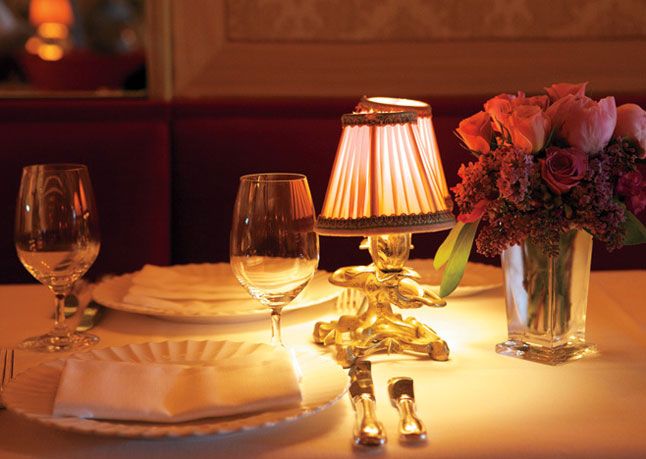
Tabletop perfection
It’s clear at these moments that La Grenouille is not a museum to a dead culture, but a living restaurant, one that reminds us of all the other things a restaurant can be besides a temple of innovative food: a place to watch your date’s eyes grow wide, a place to take your mom on her birthday, a place to sit at the bar with a friend who’s down in the dumps, splitting a roast chicken and a bottle of red wine and hashing it out, a clubhouse, a canteen, a fantasy, a vacation from all the less well tended corners of the world.
As for the trends it continues to buck, Masson remains unperturbed.
“I read a statistic recently that the average restaurant’s life span is four years,” he says, with just the hint of a smile. “What does that tell you?”
Dining and Cooking