
Welcome to “Smart Kitchen 86″!
You are watching video: Just Look At These Points To Pick Fresh, Juicy Watermelons!
I hope you enjoy watching my video!
🏠 SUBSCRIBE to Smart Kitchen 86: https://www.youtube.com/@UCjfWQ2pNDobcKG3kiqDr9dA
© Copyright Smart Kitchen 86 ☞ Do not Reup”
#smartkitchentips #pickwatermelons #smartkitchen86
Have you ever spent $10 or more on a watermelon
only to be disappointed when you cut it open and find it bland, dry, and tasteless? This happens
more often than you think, and it’s truly a waste. But don’t worry. Today, I’ll share with you some
simple signs that will help you pick a watermelon that is sweet, crisp, and juicy right at the stall
in just a few seconds. Not only will it make your meals more delicious, but watermelon is also made
up of 90% water, rich in vitamin C and lycopine, very good for health, especially for older people
who often drink less water. So, let’s dive right into five accurate tips for choosing watermelon,
so that next time you go to the market, you’ll never pick the wrong one again. First,
when choosing a watermelon, flip it over and look at the yellow patch at the bottom. This is the
spot where the watermelon sat on the ground while growing, like a natural stamp showing whether
the fruit has ripened or not. If this patch is creamy yellow, leaning toward a buttery shade,
and the surface looks matte instead of shiny, then it’s almost certain the fruit ripened
naturally in the field. Watermelons like these are usually very sweet, crisp, and full of juice. On
the other hand, if you see the field spot is pale white or almost absent, it means the watermelon
didn’t spend enough time in the sun to ripen. And when you cut it open, the flesh is usually bland,
dry, and not tasty. A small tip to make it easy to remember. Creamy yellow. Take it home. Pale
white. Leave it behind. That’s all. Just a quick glance at the bottom of the watermelon and you’ll
know whether to pick it or not. Also, make sure to tell the difference between a true field spot
and sunburn marks or scratches. A true field spot will be evenly creamy yellow with a matte surface,
looking very natural. Defects, on the other hand, often look patchy, dark orange from sunburn, or
even show soft spots and mold. In those cases, it’s best to leave that fruit aside. With just
a few seconds of checking the yellow field spot, you can already eliminate more than half the
risk of buying a bland watermelon. Quick, easy, and extremely effective. After checking the field
spot, the next step is very simple. Pick up the watermelon and feel its weight. A good watermelon
will always feel heavier than it looks. Why is that? Because inside, it’s filled with natural
sweet juice. The flesh is firm and dense, and when you bite into it, the juice bursts right out. On
the contrary, if you pick up a watermelon and it feels unusually light for its size, there’s a high
chance that the flesh inside is spongy with little water, bland in taste, and dry. That’s exactly why
so many people end up disappointed after cutting open a big, beautiful looking watermelon.
When you’re at the market, you can quickly compare two watermelons of similar size. The one
that feels heavier will usually be sweeter and juicier. This is a small but extremely effective
tip. You just need to lift it to know right away. A heavy watermelon also means it contains a lot
of water inside. Eating it not only refreshes but also helps replenish natural hydration for the
body, especially on hot days when we often forget to drink enough water. So remember this clearly.
Feels heavy in your hand. Sweet and firm. Feels too light. Put it down. Just one small action
can help you pick the right delicious watermelon. After checking the field spot and the weight, the
next step is to carefully look at the rind of the watermelon. On the surface, you’ll see stripes
running lengthwise from the stem down to the bottom, alternating with the green background of
the rind. These are the natural patterns of the watermelon, and they reveal quite a lot about its
ripeness. A naturally ripened watermelon usually has bold, clear, and continuous stripes. The lines
look as if they were drawn with ink, stretching straight down, with dark green alternating with
light green, creating a very distinct contrast. When you cut open such a watermelon, the flesh
inside is usually bright red, juicy, and sweet. On the other hand, if you pick up a
watermelon and notice the stripes are faint, blending into the background, or even broken and
incomplete, that’s a sign the fruit hasn’t fully ripened. Such watermelons often have pale flesh,
weak flavor, and sometimes a grainy texture. So, don’t let a shiny exterior fool you. Always pay
attention to the clarity of the stripes. A quick tip to remember, the bolder and clearer
the stripes, the sweeter the watermelon. And did you know choosing a watermelon
with clear stripes not only guarantees better taste but also brings more health
benefits? Watermelon contains lycopine, a natural antioxidant that helps protect
the heart, reduce oxidative stress, and support healthy skin. On top of that,
its juicy red flesh provides vitamin C, boosting the immune system, especially helpful
during hot weather or seasonal changes. So, when picking a watermelon, don’t forget to take a
close look at the rind. A fruit with sharp, bold, continuous patterns almost certainly promises
the sweetest flavor and the freshest juiciness. After checking the field spot, the weight, and
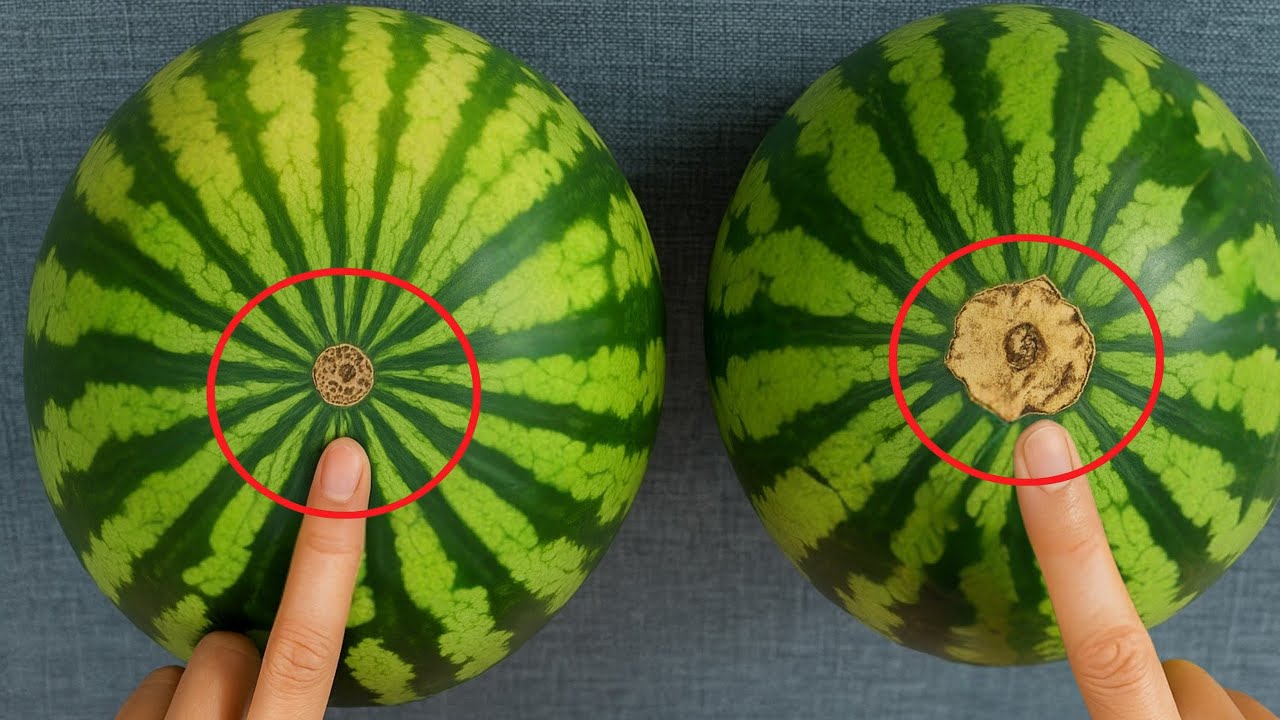
the rind patterns, let’s pay attention to another detail at the bottom of the fruit, the watermelon
navl. This is the small round mark at the very base of the watermelon where the flower originally
fell off before the fruit started growing. Tiny as it may seem, it’s a trace that tells you how the
fruit developed. Take a closer look. If the navl is small, tight, and closed with no spreading
marks, this indicates the watermelon had enough time to grow naturally in the field and ripen
fully. These watermelons usually have bright red flesh, plenty of juice, and a crisp sweet
taste. On the contrary, if the navl is large, wide, or even slightly sunken, that’s a sign the
fruit was harvested too early before it had time to mature. When you cut it open, the flesh is
often bland, less juicy, and dry. Here’s an easy tip to remember. Small navel, sweet watermelon,
big navel, leave it behind. Just by checking the bottom, you can quickly rule out many underripe
fruits right from the start. So, next time you’re at the market, don’t forget to check the
watermelon’s navl. The smaller and tighter it is, the more confident you can be that you’re picking
a truly delicious one. Finally, after checking the field spot, the weight, the rind patterns, and
the navl, you should look at the overall color of the rind. This is the final step to make sure
you’re holding a naturally ripened watermelon. A good watermelon will have a deep, rich green
color. The rind should look thick and sturdy. When held under light, that green shouldn’t be overly
glossy. It should appear slightly matte and solid. This is a sign the fruit has fully matured and
the flesh inside will be sweet and juicy. On the other hand, if you see a watermelon with a lighter
green rind that looks too bright or overly shiny, it’s often a sign the fruit hasn’t fully ripened.
Such watermelons tend to have thick rind, pale flesh, and weak sweetness. Many people get
tricked by this polished look, but once cut open, it’s disappointing. Another quick check is
to notice the contrast of the colors. Ripe watermelons usually have a dark green base with
bold black stripes. Unripe ones, however, have a pale green background with faint, weak stripes
that lack vitality. Beyond taste, choosing a fully ripened watermelon with a dark green rind also
means you’re getting more nutrients. Watermelon is about 90% water, making it an excellent way
to rehydrate, especially on hot summer days. It also contains vitamins’s A and C along with
lycopine which supports heart health, helps keep skin radiant and boosts immunity. So just by
looking at the rind color, dark green with sharp stripes, you can be confident that your watermelon
will be sweet, crisp, juicy, and packed with nutrients. So with just five simple signs, you can
already pick a ripe, sweet, and juicy watermelon. Now I’m going to cut open the watermelon I just
selected, which has all five of those signs. I place the watermelon on the cutting board, hold
it firmly, and slice it in half lengthwise. The watermelon is so fresh and full of juice that as
soon as the knife touches it, the rind feels tight and the fruit splits open. You see, the watermelon
is truly delicious, juicy. With a thin rind, it’s just wonderful. Sometimes simply choosing a
good watermelon can already bring such joy, don’t you think? Next, I will show you two super simple
ways to cut watermelon to serve your guests. First, I’ll take a quarter of the watermelon
to demonstrate this method. Place the piece of watermelon face down on the cutting board with the
green rind at the bottom and the red flesh on top. Next, trim off both pointed ends of the piece so
it becomes a neat block with two straight edges. Once the ends are trimmed, keep the watermelon
firmly placed right side down on the board. Now, imagine the green rind at the bottom
divided into three parallel strips, one in the center and two along the sides. Use
a knife to cut along the two imaginary lines, slicing off the outer strips of rind while
leaving only the middle strip attached. This way, instead of the rind wrapping all the way around,
you’re left with just one narrow strip of rind right in the center at the base of the piece.
This strip of rind acts as a natural handle, letting you hold the watermelon piece without
juice dripping down your hand. It works exactly like the wooden stick of an ice cream bar.
When making these cuts, go gently and slice cleanly so the removed rind comes off neatly,
leaving the piece looking tidy and presentable. After creating the handle, rotate the piece,
keep it steady on the board, and cut lengthwise from top to bottom into sticks about two to three
cm wide. Each stick will now have the sweet red flesh on top and a small strip of green rind at
the bottom for holding. When served on a plate, these pieces look just like refreshing
popsicles, easy to hold and mess-free. This method is especially great for kids or when you’re
serving guests, it’s both attractive and hygienic. So, with just a few simple steps, you’ve
turned an ordinary watermelon slice into fun, refreshing popsicle sticks that
both kids and adults will love. First, take a portion of the watermelon
and place it on the cutting board. Use a knife to carefully separate the green rind
from the red flesh, leaving behind a large, clean triangular piece of watermelon
flesh. This is the part we’ll be cutting. Place the rindfree watermelon piece flat on
the board with the large flat side facing up. Starting from the left edge, measure about 2
to 3 cm. Position your knife perpendicular to the surface and slice straight down. Then move
the knife another 2 to 3 cm to the right and repeat. Continue until you’ve cut the entire
piece into even vertical slices. Next, hold the watermelon steady and move to the right edge.
Once again, cut slices parallel to the first set, each spaced about 2 to 3 cm apart. At this point,
the piece of watermelon will have vertical cuts from both sides, creating long strips, ready for
the final step. Now, rotate the watermelon so that the cut slits are facing horizontally in front of
you. Place the knife perpendicular to the previous cuts and slice down at 2 to 3 cm intervals. When
finished, the intersecting vertical and horizontal cuts will form evenly sized cubes of watermelon.
At this point, you can easily pick up the cubes with a small skewer or fork, neat and clean. If
you want to make a salad, simply scoop the cubes into a bowl and mix with other fruits. The special
thing about this method is that it’s both quick and versatile, perfect for eating directly or
for preparing desserts. When arranged on a plate, the neat watermelon cubes look elegant and tidy,
making family meals or parties more appealing. So, today we’ve learned together how to pick a
sweet, juicy watermelon with five simple signs along with two easy and attractive ways to cut
it. From now on, you can walk into the market with confidence. Choose the right watermelon
that’s crisp, sweet, and full of juice. Then, turn it into neat, refreshing slices
that your whole family will love. Watermelon isn’t just delicious and refreshing in
the summer. It also provides a wealth of vitamins and natural antioxidants that support heart
health, strengthen immunity, and keep the skin healthy and radiant. That’s why you should make
the most of this fruit and enjoy it regularly in your daily meals. And what about you? How do
you usually cut your watermelon? Share your way in the comments so I and everyone else can learn
from it, too. If you found this video helpful, don’t forget to hit the like button, share it with
your friends, and subscribe to the channel so you won’t miss the next Smart Kitchen Tips. Thank
you for watching and see you in the next video.
3 Comments
Steamed Ginger: The Longevity Secret of a 97-Year-Old Grandma! https://youtu.be/y1uCTV7KLnI
"The colors and layout you chose are so harmonious—it’s instantly appealing!"
This was super clear—thanks for busting a few myths and giving simple checks I can actually use at the store. Your “field spot + weight + stripes + small navel” combo is gold. One extra thing I look at that wasn’t in the video: the little curly tendril closest to the stem. If it’s fully dried and brown (not green), that usually means the melon finished ripening on the vine. I also avoid oddly lopsided fruit and go for a symmetrical “heavy-for-its-size” one. Since using these cues together, my miss rate is almost zero. Great job!