
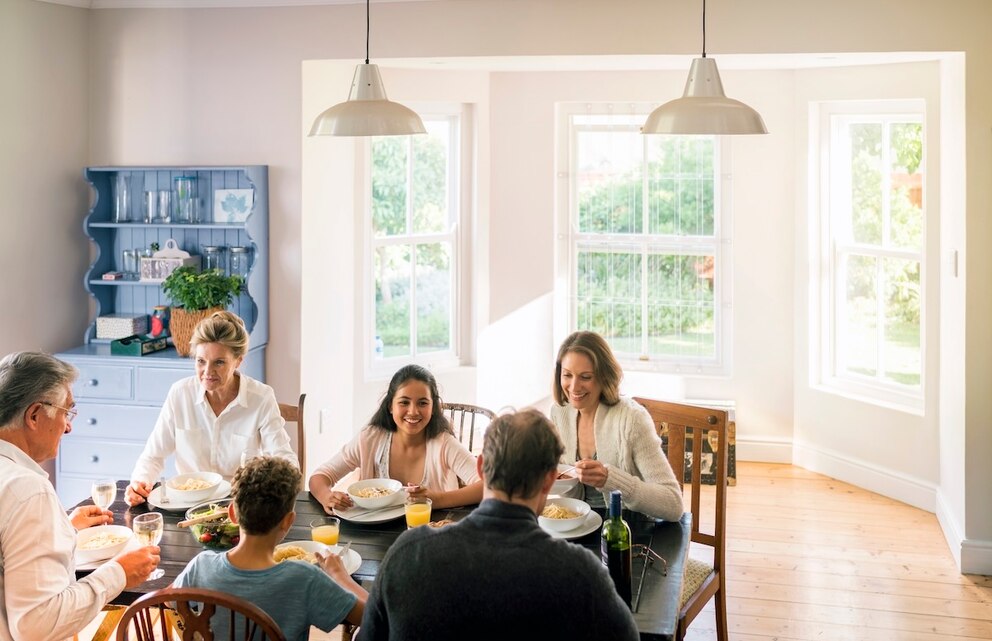
The dining room was once the heart of the home. A space with a large table, over which a pendant light hovered, where the family gathered on Sundays and guests took their seats. For decades, the dining room symbolized togetherness, hospitality, and structure in everyday life. But today? The dining room is increasingly disappearing from many homes, and especially in new constructions, it is often hard to find. myHOMEBOOK interior expert Mareike Schmidt explains why the classic dining room is vanishing in modern apartments and what new living forms are taking its place.
Follow myHOMEBOOK on WhatsApp now
The Room That Needs Too Much Space
One of the main reasons for the disappearance of the dining room is simply a lack of space. Living space has become significantly more expensive in recent years, especially in cities, where every square foot must be carefully considered. Rooms today need to be flexible and serve multiple functions. A separate room used for only a few meals a week seems to many like an outdated luxury from times past.
Instead, living, working, and eating are increasingly merging. The dining table is no longer in its own room but becomes part of an open living area. It serves as a workspace in the morning, a craft area for children in the afternoon, and a gathering spot for friends in the evening. This multifunctionality reflects a new living culture where efficiency and practicality are more important than formal representation. The dining table becomes the center of daily life and less a venue for polished etiquette, but rather a place of lived community.
Also interesting: Not just for small spaces! Why round dining tables are trending
The Shift in Our Lifestyles
The traditional family model, where fixed meals are shared at the dining table, is no longer a given. Classic meal times–breakfast, lunch, and dinner–are losing their unifying function because many people’s daily lives are more fragmented today. Flexible working hours, shift work, and remote work make it harder to maintain shared routines. Additionally, a pronounced to-go culture means meals are increasingly consumed on the go or in between, whether on the train, on the way to work, or during a walk in the park. Even dinner, once a symbol of family togetherness, is often replaced today by individual schedules, food delivery apps, and streaming dinners on the couch.
The new reality is both pragmatic and individual: We eat wherever we are–at the kitchen counter, on the balcony, in front of the laptop, or even in bed. Eating becomes an activity that adapts to life, not the other way around. The dining room as a ritual gathering place is losing its significance. It is replaced by spontaneous encounters in the kitchen or casual conversations over the laptop. This also shifts the symbolism of eating, away from a shared ritual to an expression of a flexible, mobile, and digitalized lifestyle.
Open Living Instead of Formal Dining
In the interior world, a clear trend has emerged over the past two decades: open floor plans. Kitchen, dining, and living areas merge into a seamless unit. Instead of clear room boundaries, transitions, sightlines, and functional zones define the design. The social center of the house or apartment has noticeably shifted–often to the kitchen. Here, it’s not just about cooking anymore, but living: chatting, working, eating together, and welcoming friends–all in one place. The classic dining room, separated from the action, no longer fits this lifestyle of openness, spontaneity, and community.
Nostalgia Meets Redefinition
The dining room hasn’t completely disappeared; it has rather reinvented itself. In some larger homes, it remains as a “dining space” or “social room,” serving as a deliberate counterpoint to the hectic everyday life. Here, dining is not just eating but celebrating: The room is carefully designed, often with designer chairs, striking lights, and selected art on the walls. The decor reflects the residents’ individual style and their desire to give special moments a pleasant setting. It is usually a staging: a place for special occasions, not for every day.
What Remains: The Table as a Symbol
Even if the room disappears, its centerpiece–the table–remains. It is the piece of furniture where our lives converge: working, playing, eating, discussing, celebrating. Perhaps this is the true evolution of the dining room: It lives on, not as a room, but as an idea.
The dining room, as we knew it, is a relic of a time with clear roles, fixed routines, and Sunday rituals. But in its place comes something more vibrant, more flexible–spaces that adapt to us, rather than the other way around. In a world where everything is in motion, living spaces can flow too, and perhaps that is the real progress.
The post Why the Dining Room Is Disappearing from More Households appeared first on myHOMEBOOK.
Dining and Cooking