
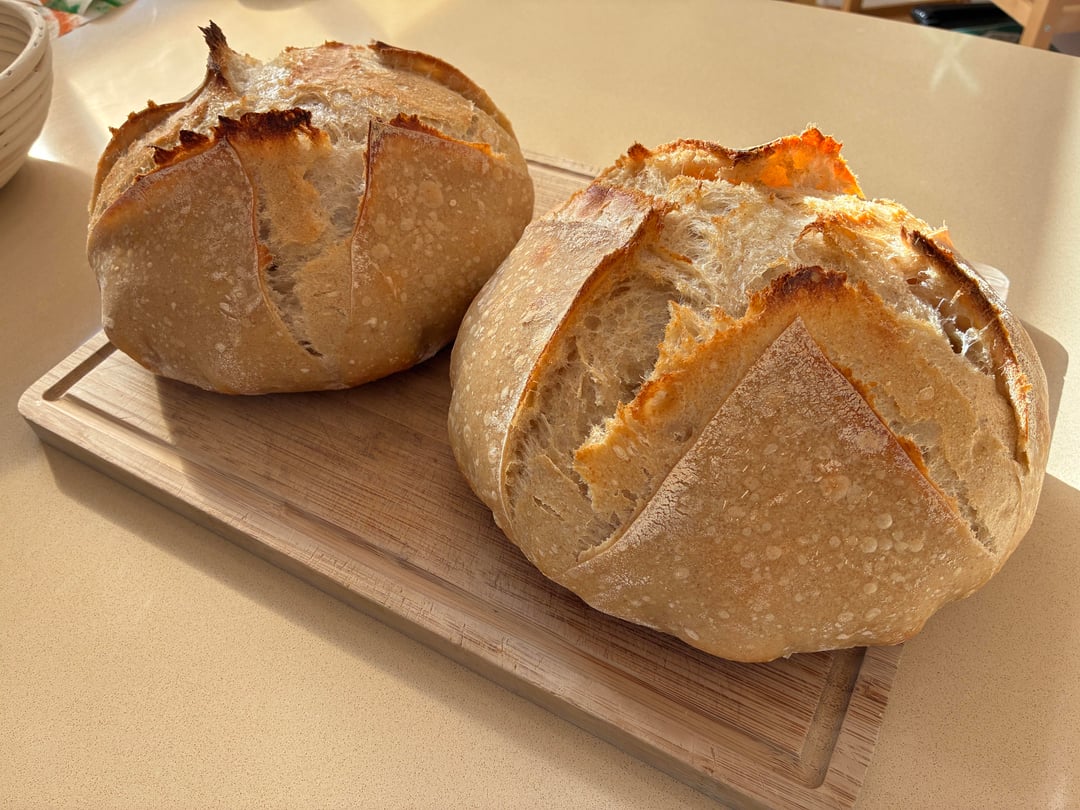
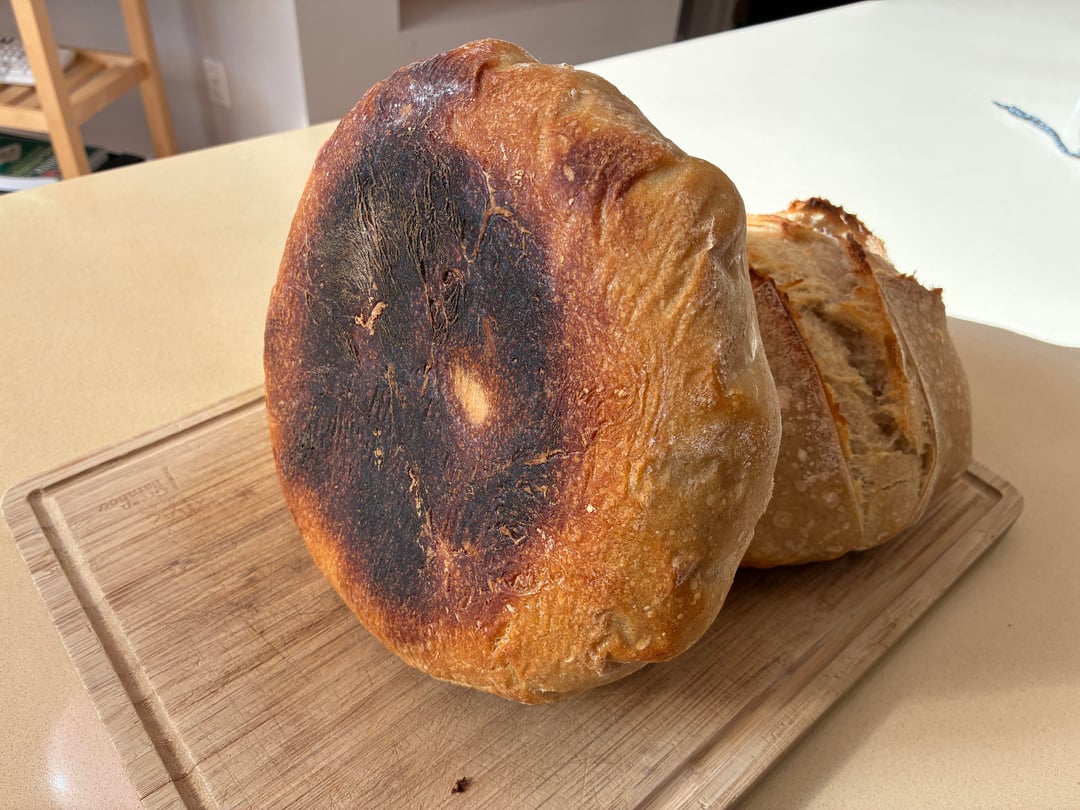
I've been making sourdough bread for many many years now and I'd like to see if I can experiment a less hard crust. All around but in particular the bottom (2nd pic).
They're big loaves (1.4 kg each) so cooking time is 50 minutes at 450. I bake them in a Dutch oven (which is preheated with the oven).
Is the Dutch oven the cause of this? I'm not sure what to try next. Everything else with the bread is great, including the crumb. But it can be a challenge to eat slices, especially as a sandwich.
Thanks in advance for any guidance!
by chillysurfer
23 Comments
Put a pan as a heat guard on the bottom rack
Do you have the option to disable the bottom part of the oven? I cook the bottom for about 20mins and 20 mins the top. Maybe try to leave a bit more space between the Dutch oven and the bottom part of the oven
Try putting a baking sheet on the rack below your Dutch oven to shield some of that bottom heat. Also maybe drop your temp to 425 after the first 20 minutes with the lid off – that crazy hot Dutch oven bottom is probably what’s giving you that thick crust
You could also try putting some parchment under the loaf or even a thin layer of semolina/cornmeal to create a buffer
Maybe there are recipes of enriched sourdough. I make my own enriched sourdough recipe and it’s delicious, but it features considerable amounts of sunflower oil and sugar. The sugar helps it brown.
Here’s the ingredient list:
~950-1000g white flour, including the old dough.
~1.5 tablespoons iodized salt (~23g).
7 or 8 tablespoons sunflower oil.
2 large eggs.
7 tablespoons of sugar.
I can share the full recipe if you’re interested. I don’t have it written down yet.
Two things I found helped a lot — put raw rice in the bottom of the Dutch oven (but only if you’re using parchment paper under the bread) and place a baking sheet on the bottom oven rack, which will shield the bottom from dome of the direct heat.
I didn’t like that the bottom of my bread was always so hard and those two things fixed that issue completely.
The trick is to use a lighter coloured pan, and also use some parchment paper. I had this problem all the time until I got new pans. Those pans are ONLY for bread so that I can keep the bread nice.
I use parchment paper in my Dutch oven and have had the same issue. Now I bake in loaf pans, and there lighter coloured pans make a difference. I put parchment in a loaf pan, pop the dough in, and when it’s time to put the loaves in the oven, I slip an ice cube or two between the parchment and pan. Invert another loaf pan on top. Voila, a steamy environment, a traditional loaf shape for toasting, and no burned bottoms!
If you have a pizza stone stick it under the Dutch oven. I recommend launching onto a pizza stone and sticking a light aluminum pan/bowl on top. Ceramic conducts heat slower then cast iron less heat transfer less burn.
I find ceramic yields the best bread bottoms in my oven and given that my oven burns bottoms probably your oven.
I have the exact same desire (not too crusty of a bottom) and have been experimenting for a few years. A few things I found:
– most American home ovens heat from the bottom only. So to avoid extra thick/browned/burnt bottom, you need to give your Dutch oven the highest possible rack position without touching the oven broiler
– I also add a half sheet pan right below the Dutch oven to diffuse the heat transfer and make it not as direct. The sheet pan goes into the oven cold on a rack underneath the Dutch oven, after the bread is loaded into the oven.
– I’ve experimented with convection setting (leaving fan on), and decided that fan off is a better crust
– I bake with my Dutch oven lid on the whole time, instead of taking it off half way. Because I don’t want that extra crusty top either. Once the moisture inside the Dutch oven burns off enough, the bread would be crusty regardless
– I bake with a slightly lower oven temp of 425 (but preheat with 500), so that the bottom doesn’t cook too fast upon contact
That’s been my current summary. I’m quite happy with the result so far. I think a lot of it is that to hypothesize what your dough is actually experiencing, and tweak that experience with your settings to match the desired outcome
Half way through baking (when I take my dutch oven lid off to brown the crust) I put the dutch oven on a room temp cookie sheet and put that back in the oven. I find this slows down the heat transfer enough to stop getting a hard bottom crust. Also as other people have said, darker coloured bakeware leads to darker bakes.
When you take the top off the Dutch oven, put it under the pan instead of taking it out of the oven during the second half of baking
I bake mine on a preheated steel, so I’ve had this problem. I solve it by moving the loaf onto a rack after ten minutes of bake time, then continuing to cook. This also gives me the opportunity to rotate 180 degrees for a more even bake.
Just want to say thank you for asking this, I’ve consistently had this issue but just assumed it was my crummy oven and nothing I can do about it! Now I have lots of new things I can try.
Are you using a silicon lowering mat underneath? If not, get one! Silicon provides some insulation from the bottom, and makes it easier to lift the loaf out of the pot, because these mats have handles.
Silicon is biocompatible and inert, so it’s safe to cook on, but I still try to find stuff that doesn’t have too much colour die on it.
A pan underneath can also help, but haven’t tried that myself.
I do 475, 20 minutes lid on, 20 minutes lid off for my 1Kg boules, and they come out perfect with a silicon mat.
Dutch oven liner that’s shorter than the oven itself. Of course we can’t post pics here, but what I did was get aluminum liners that were around 1″ shorter than the oven but still the same outside rim diameter. They “float” above the bottom of the oven. It gives you less room for your loaf to rise, so you’ll have to keep that in consideration. For baking bread on a campfire, that’s what I do and just make a smaller loaf, and it turns out perfect.
I do something similar at home: What I do is slit the liner vertically down the sides so it’ll slide into the oven and put the dough on a silicone baking mat. The liner stays just barely above the bottom of the oven, and the mat helps manage the heat. You’ll still have to be careful about burning the bottom, but it provides a little “insulation.” I just make regular-size loaves with this method.
I have a 10-inch oven, so I got these:
[https://a.co/d/bwFDBPw](https://a.co/d/bwFDBPw)
I had this issue forever. Finally switched to a pizza stone, + inverted Dutch oven! Not only do you get a *much* nicer bottom crust – you also get to use a peel to launch the bread into the oven, which means a bit more fine control over its final shaping, and a much easier setup for scoring! Plus no parchment paper creases, on the sides 😁.
Cast iron is a *huuuge* thermal mass. That’s what makes it so great as an outer material for your baking vessel – but it also makes it ***terrible*** for any part that’s actually in contact with the crust. It just keeps on transferring heat to the crust, throughout the entire baking time, making it tough and overcooked. You *want* it to keep transferring heat to the air *around* the loaf – this allows for a super even, consistent bake. But you don’t want it actually touching the loaf anywhere. The solution? A $30 pizza stone, and the same Dutch oven turned upside down! Ceramic is actually what they use in commercial bread ovens as well, since it really is the perfect material.
Just be careful, and use oven mitts when flipping the oven over on your loaf! I like the silicone coated ones, since they have a higher heat resistance, and they allow you to ‘grip’ the pan, when flipping it.
I had better success getting rid of the Dutch oven. I bake mine on a pizza steel and put a pan of water in the bottom of the oven. I also open the oven and mist the loaf every 10min or so while baking.
This is also the same process I use for baguettes.
I keep a spare pizza stone on the bottom rack as a heat soak and guard. It’s basically always in there these days. It does affect cook times a bit but I’ve found almost everything I bake ends up a little more evenly cooked. Including sourdough.
I use tinfoil underneath my parchment paper in my Dutch oven. I fold the tinfoil into a little square so it’s not touching the pan
I make a ring with thick tin foil. After I take the lid off, I set my bread on the ring in the bottom of the Dutch oven so the bottom of the bread is not touching the pan. I’ve never had a burnt bottom crust since doing this
The best answer here is pie beads
I had this problem. I add 1/4 cup water right before I put the loaf in the pot. Water cools down bottom, but sides and lid are still hot. As an added bonus you get steam for a better crust.
Move your Dutch oven up a rack if you can. Looks like you’re baking too close to the heat. I don’t do anything to temper the heat. The bottom only gets that dark if I bake on the lowest level.
How long are you baking with the lid on? Your tops look pale, which moving up will also help, but you probably need to uncover sooner. This will also help with the crust thickness.