
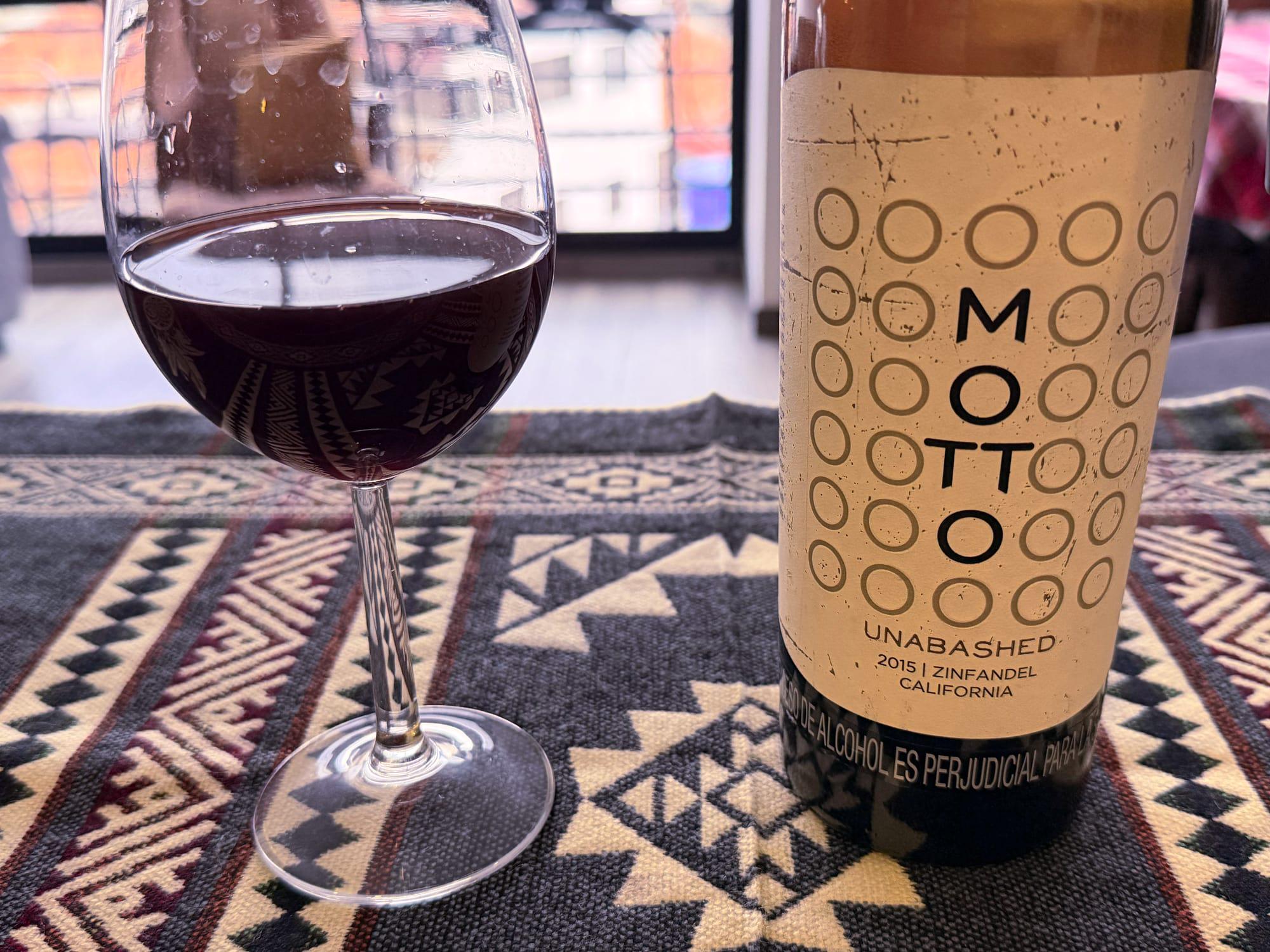
So I picked up this 10-year-old, no-name Zinfandel here in Colombia for about $9 — which, for context, is very cheap by local standards. My guess is it was some close-out backstock deal that a grocery chain grabbed, because wine here is usually pretty pricey. They probably paid $2–$3 a bottle.
What really surprised me is how well this bottle has held up. It’s on the older side, it’s a lower-tier wine, and Zinfandel isn’t exactly known for graceful aging… yet it’s still full of pepper and fruit, it’s got lively acidity, and it’s actually quite enjoyable. Not amazing or complex, but solid. Importantly, it doesn’t taste fake, pumped-up, or overly sweet. In the glass it even looks its age — more brown than purple, and there’s definitely some silt settled at the bottom.
And that got me thinking.
This bottle clocks in at 13.5% ABV, which is pretty low for modern California Zin, especially the bottom-shelf stuff that usually sits around 15%+, sometimes even higher. The flavor profile is also totally different. It’s not a fruit bomb. It’s not trying to be. It’s simple, but there’s nuance, and it feels like the grape is actually being allowed to speak for itself.
Compare that to what I’ve tasted recently from the U.S.: even cheap reds feel heavily manipulated — you can see it in the glass, smell it on the nose, and taste it on the palate. There’s this hyper-ripe, sweet, polished style that seems engineered rather than grown.
Drinking this older bottle really made me feel like something fundamental has shifted in California winemaking over the past decade, especially at the lower end of the market. Styles, alcohol levels, extraction, sweetness, oak alternatives… it all feels very different now than it did even 10 years ago.
When I go to lower priced producers in other countries that I see on the shelf stocks of the world. Be it Barton & Guestier; Pasqua or even Beronia; they don't seem to be that heavily manipulated. They may not be great wines (although in some cases they can be); but they don't try to do much more than represent the grapes in their terroir. I feel that if California were to go back to the basics, their bottom-shelf wines would be a lot more serviceable.
Curious if anyone else has noticed this, or if I’m just getting lucky with this random old bottle.
by diebrdie
7 Comments
As a fairly old guy, I can promise you there was some real junk on the shelves 30 years ago. However, it was usually from a known ultra-big grocery wine maker (e.g., Gallo). The mid market ($20-50) heavily manipulated stuff is definitely a newer phenomenon.
I blame Sideways. So many people got told they needed to like Pinot, but actually wanted a sweet, concentrated wine. That drove a lot of makers to start manipulating stuff. Before long, it spread.
Prior to that, a $15 cali cab nigh or might not be any good, but it was usually “honest.”
At least that’s how I remember it.
You mention cheap reds being manipulated, I’d argue cheaper wines are more often manipulated to make them sweet/ palatable and higher ABV. Sure you have caymus and the loke but typically those willing to spend on wine want an actual expression
I’m pretty sure you just got lucky with a random bottle.
The rise of Barefoot was like, 40 years ago, Meiomi nearly 20 years ago. You can read old articles with snobby old-world guys complaining that the Californians “make wine to a formula they learned in school” – Well, UC Davis has been teaching winemaking since 1935.
Now something to consider is that California is pretty unique in the fact that their winemaking industry underwent a boom in the last 20 years, up until the last two three years.
Here’s an interesting article in the San Francisco Chronicle this morning: [There are too many wineries in California](https://www.sfchronicle.com/food/wine/article/wine-winery-vineyard-california-21143358.php)
Since 2010, the number of wineries in California went up 47%. This is quite unlike other regions, like say, Bordeaux or Langudoc, where the industry has been shrinking over the past few decades, quite significantly (up until 2001, Langudoc produced more wine than the US as a whole!)
Something to consider is this – as a very, very rough heuristic, when the industry grows, you will see wine being made from grapes grown on really young vines on farmland previously people thought was unsuitable for grapes – demand is up and the industry is slowly expanding to meet it. When the industry is shrinking the opposite happens, the worst producers go out of business and the worst vineyards get torn out first.
So odds are, the bottom shelf California wine got a bit worse, while the bottom shelf French wine from Langudoc probably got quite a bit better. After all, the previously bottom shelf producer tore out their vines and now the previous “middle shelf” guy is now the bottom shelf guy.
Try the wines of Las Jaras. Fun people and wines. All natural. Creative combinations of varietals. Passion over pretension. Good value.
US wine isn’t a monolith at all. I don’t know anything about this product/producer but in general there is lots of good wine out there, some of which is reasonably priced, but you’re just not gonna find it at the grocery store. And in somewhere like Colombia, you probably won’t find it at all. Smaller quality producers are unlikely to be exporting much.
You should try some older ridge zin, they age incredibly well. California has been blessed with extremely good weather since 2012 barring fires, most winemakers are getting superb fruit to work with. There hasn’t been many bad years that truly test winemaking skills.
This wine was discontinued by the winery (SMWE) 6 years ago. This was probably free.