
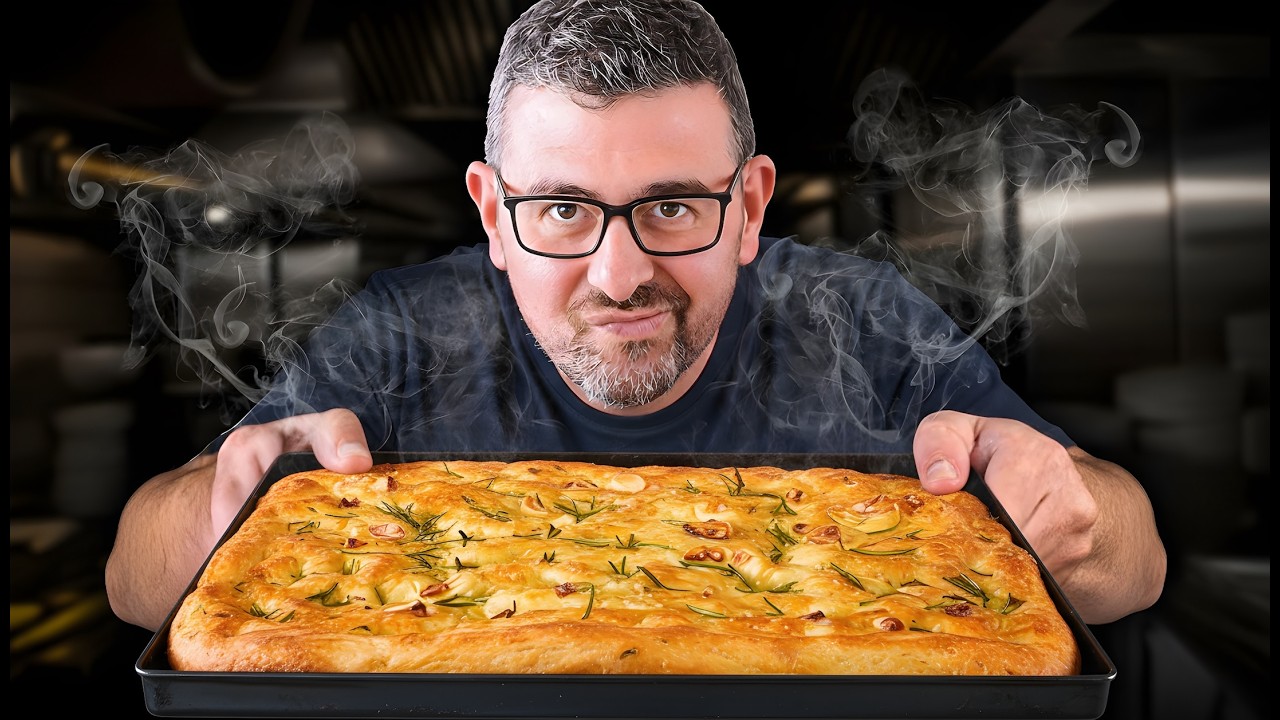
Learn how to make authentic Focaccia alla Genovese in your own kitchen. This easy recipe uses a flavorful biga pre-ferment and baking staples to give you Italian focaccia with a crisp, golden crust, a tender crumb, and mouthwatering oil-soaked dimples. Top it with rosemary and garlic or customize it with your favorite flavors.
→ Recipe: PRINT THIS RECIPE: https://www.billyparisi.com/focaccia-alla-genovese/
MY EQUIPMENT:
LLOYD PAN: https://amzn.to/48mi5lO
CUTTING BOARD: https://amzn.to/46uq1OR
HALF SHEET PAN: https://amzn.to/3AbGnjr
SHEET PAN RACK: https://amzn.to/3YvSeCR
PARCHMENT PAPER: https://amzn.to/3Yuu8bA
CARBON STEEL PAN: https://amzn.to/4cevScr
NON-STICK PAN: https://amzn.to/3ysy2XX
STAINLESS PAN: https://amzn.to/3WO1dho
CHEF KNIFE: https://amzn.to/3SydDHG
DIGITAL SCALE: https://amzn.to/3YOCUld
MANDOLIN SLICER: https://amzn.to/4d8AW3k
CHINOIS: https://amzn.to/49CmoaY
INSTANT READ THERMOMETER: https://www.thermoworks.com/?tw=chefbillyparisi
*These are affiliate links that allow me to earn from qualifying purchases*
→ Ingredients
For the Biga:
• 2 ¼ cups bread flour
• 2/3 cup + 1 teaspoon filtered lukewarm water
• 1/3 teaspoon active dry yeast
For the Dough:
• 2 ¼ cups bread flour
• 1 1/3 cup + 1 teaspoon filtered lukewarm water
• 1 teaspoon active dry yeast
• 2 teaspoons coarse salt + ½ teaspoon
• 6 tablespoons olive oil
• Fresh rosemary leaves from 3 sprigs
• 2 thinly sliced garlic cloves
Watch more recipe videos:
Brioche: https://youtu.be/MK_EdZ7VTVo
Sourdough: https://youtu.be/yTTynk20KCI
→ Follow Me On:
• My Website: https://billyparisi.com
• Instagram: https://www.instagram.com/chefbillyparisi
• Facebook: https://www.facebook.com/chefbillyparisi
• Pinterest: https://www.pinterest.com/chefbillyparisi
• LinkedIn: https://www.linkedin.com/in/billyparisi
Classical culinary expertise meets home cooking!
I’m Billy Parisi, a classically trained culinary school graduate from Scottsdale Culinary Institute with over 15 years in the restaurant industry and over 25 years of cooking experience.
Join me as I teach essential cooking techniques and provide easy-to-follow recipes, empowering you to create restaurant quality meals right in your own kitchen. From classic dishes to innovative creations, I’ll show you how to make anything from scratch, ensuring that every meal is a masterpiece.
Food is the common language that bridges diverse backgrounds and stories, bringing people together around the same table. For me, cooking isn’t just a skill; it’s a source of pure happiness and fulfillment.
Tune in every Friday for a new recipe, and subscribe now to discover why homemade food always tastes better. Let’s cook up some magic together!
Bkaca has to be one of the most delicious, recognizable breads in the world. The dimples on top, the golden brown crust, the light airy crumb. It just takes you right to your Nona’s house or your favorite restaurant, which is why it’s on my menu at Paresi’s. But I’m going to cut through the internet noise and show you exactly how it’s done to make a traditional unforgettable faukatcha that everyone you serve it to will want more of. Let’s first start off with one of the most important aspects of the dough. Sound good? Let’s bake. We are going to make a bea. And I’ll explain exactly what that is in a minute. But first, I’m going to add 335 g of bread flour to a large bowl. Now, for all my US friends, yes, I measured in cups as well, and it comes out to exactly 2 and 1/4 cups. But seriously, just buy a scale. It’s so much easier to use when making bread. And it’s precise. There’s no guesswork. And honestly, it’s 10 bucks. That’s it. If you’re serious about bread making, you need to get it. Take care of it. It’ll last you forever. Okay. In that bowl, I’m going to add in 1 g or 1/3 teaspoon of active yeast. And yes, instant yeast is totally fine to use here. Then pour in 165 g or 2/3 cup plus 1 teaspoon of filtered lukewarm water. Now, using your hands, you want to gently mix and fold everything together until it’s combined, which should take you roughly 3 to 4 minutes. And the technique of making a bea goes all the way back to the Renaissance period between the 14th and 17th century in Italy, especially in the Laguaria region. And it was used for things like pizza, chabatada, and of course, faukatcha. Throughout making the bea, the dough will start to become really shaggy, but that’s because it’s only hydrated at 50% and tends to be stiffer, which is totally typical. And because it’s a preferment, it’s going to help the small amount of yeast that we added to it to get a head start in the bread making process to help improve the strength and the gluten in that dough. And you know once it’s done because it’ll be fully hydrated and there won’t be any parts of the dough that have any flour on it. And this bea will represent 50% of the total weight of our finished faukatcha. And at this stage I like to bring the shaggy dough a bit more together to form sort of a loose ball. Then I transfer it over to a camro because I always like to get a clear view of what’s happening in there as the yeast starts to work. But of course you can just leave it on the bowl and cover it with a lid or plastic wrap. Let’s place on the lid and let it sit at room temperature for 8 to 24 hours. And probably one of my favorite benefits of using AGA is going to be the amazing aromomas and flavors that come from it. Yeah, does it take a little extra time? Sure. But think of the people that you’re serving. They are going to know the love that you put into this and that that just makes it all worthwhile. And once it’s time to start bread baking, let’s pull out the bea. And as you can see, well, not too much has really changed. You should see a few little bubbles in there, but the first thing you should do is smell it and start to understand the aromomas at each stage. It is so good. And you’ll also notice that it really won’t rise all that much, if at all. And you should see some air pockets, though, if you turn it over. See those? Perfect. The bea at this stage definitely will have come together to resemble more of a finished dough with a bit of stretch to it. And maybe you’ve seen some of those Italian pizza dough videos. They add a huge piece of what looks like finished dough to a mixer before adding in a bunch of water and more flour. Yeah, that’s a bea and it’s almost time to use it. But first, in a large bowl, I’ve got the remaining 335 g or 2 and 1/4 cups of bread flour. And in it, I’m going to pour in 255 grams or exactly one cup of filtered lukewarm water. Then, using your hands, mix it together to combine everything by squeezing and folding everything over repeatedly. And then, you’re going to let it sit for 30 minutes and up to 4 hours at room temperature. This process is known as auto lease and it’s very common in all bread baking. And what it does is it allows the dough to be hydrated completely and also more importantly it turns the complex carbohydrates in the starch into simple sugars. And ask yourself what does yeast like to feed on? Sugar. This is a good process. Once the flour and water are combined, which takes around 3 to 4 minutes, it’ll be pretty sticky and wet, which is all good. And I usually use a dough card to help scrape off as much as possible from my hands. Every little bit helps. Now, at this stage, I simply cover it with a kitchen towel. And for me, I’ll let it sit in ottoly for about 30 minutes. Plenty of time. Then, after that amount of time, let’s come back and you’ll see the dough is a little less sticky, but it’s still really, really soft. In that same bowl and final dough stage, I’m going to add in 85 g or 1/3 cup plus 1 teaspoon of filtered lukewarm water along with 3 g or 1 teaspoon of active dry yeast. And again, just get a scale. Your bread baking life will be happier. Okay. And then 2 g or 1 and 3/4 teaspoon of coarse salt. I know the salt’s probably not going to kill your yeast, but it does inhibit your yeast and for good reason. If you don’t do it, it will eat everything in there. It’ll rise too quickly. It’ll be sticky. It won’t be good to work with. But what it does do, and the huge benefit, it adds awesome flavor. It strengthens the gluten and it will help make that beautiful brown crust, which everybody wants in bread baking. Now, let’s grab our big old bea and add it right to the bowl. Now, the first thing I do is I sort of make these fingerping motions to sort of press everything in the bowl together. And I do a combination of squeezing, pincing, and folding. And this just helps to get everything completely merged and incorporated. And yes, you’re going to get a workout from this. And this part is hands down the most important procedure in this entire faukatcha recipe. What you’re doing here is making sure all the ingredients are incorporated, the beas in with that ottoly flour. And of course, you’re strengthening that dough to get that beautiful open airy crumb that makes fkaca so special. The final dough will be 50% bea and have a hydration of 75% which is right where you want to be when making faukatcha. Now, if you’re wondering if there’s a simpler process to this, like in a mixer, yeah, there is, and I’ll show you how to do it in just a minute. But first, get a load of that stretch. Told you the beagle will help with the extensibility. Okay, now to keep stretching the gluten to make sure this rises and is beautifully light and fluffy. I’m going to transfer from the bowl over to the board and using a dough card to help scrape everything out of there and to help bring it together by scraping it up around the sides. Now, with this wet dough, we’re going to do a series of slap and folds by picking up the dough in the center, slapping it down, and folding it forward. This is known as the Berttonet method made famous by the worldrenowned baker Richard Burtonet. It’s kind of an intense way rougher coil fold if you will. Now I personally love getting my hands in the mix and working with dough. I just love it. And this process is so important. And over the 8 to 10 minutes we’ll do it. You’ll start to notice it will become less sticky as the dough begins to strengthen and form. And we’re just about to wrap this up before we let it rest for an hour. But first, let me just say this. Sticky dough is good dough. Yeah, it’s a little hard to work with, but the benefits far outweigh sticky fingers with dough. That’s why your bread is so moist, so tender. That beautiful brown crust. All the things you want in delicious bread. We’re going to have it by doing this. Now, every time it gets a little too sticky, I grab the dough card and scrape it up around into a tighter ball and repeat the process. And also, as a little tip, don’t add more flour to the dough. That isn’t part of the recipe. Instead, try just gently wetting your hands with a little bit of water before kneading. I promise it works. You won’t believe it. All right, a few more folds. And it really has great elasticity at this point. So, now I’m going to make it as taut as possible because it’s time to get this proofing resting on our baking tray. And for fkaca, I like to use a 16×12 Lloyd pan. It’s non-stick and it’s kind of the traditional pan to use when making this. However, a regular 13×18 half sheet tray will work. Just make sure it’s really oiled up or even just a plain 13×9 non-stick metal casserole pan. This is great, especially for those of you who like super thick extra mountain high non-traditional fkaca. It’s all good. So, for the pan, I’m just going to drizzle on about 2 tablespoons of olive oil. Using a pastry brush or just clean hands, rub it in, covering the pan in its entirety. This will help so the dough doesn’t stick at all. Now, let’s grab the dough ball and add it right to the center of the pan. Then, cover it with a kitchen towel and let it proof for 60 to 90 minutes at room temp, or at least until it’s double in size. So, for the folks out there who are like, “Yeah, way too much work. I’m not interested in getting carpal tunnel.” Well, in a stand mixer with the hook attachment, add in the 335 g of flour with the 255 g of water and mix it on low to medium speed until it’s combined. Let it autoise for 30 minutes. Then add in the bea, the 10 g of salt, then the 3 g of active yeast, and finally the 85 g of water. Mix it together on low speed, just until it’s combined, which takes around 3 minutes or so. And then crank it up to high and mix it until the dough is formed. and it should completely clean the bowl. And this takes right around 5 minutes or so. And just like my hand needed version, it’s got great elasticity. Then from there, it goes on an oiled pan covered up and proof. And speaking of proofing, let’s go have a look. And as you can see, the dough has doubled in size and it’s a bit more slack. But that’s totally fine because at this point, using your clean hands, we are going to press our fingertips down, making dimples into the dough while simultaneously stretching it. You want to fit it to all corners of the pan. Now, for some reason you find your fingertips are sticking, just add a bit of olive oil to your hands and continue pressing down. Add a little extra fat. Eh, never hurt anybody. Now, at this stage, we’re going to cover it and let it proof for an additional 60 to 90 minutes. And with about 30 minutes or so left in that proofing process, now this is when I like to start preheating the oven. And I’m going to 425° F or 218° C, fan on. And we’re so close to baking. But first, let’s go have a look at the dough. And it’s exactly where I want it. Beautiful. Now, to add a good amount of fat, evenly drizzle on about 3 to 4 tablespoons of good olive oil. Then, using your fingers, create more dimples into the dough. I start on the outsides of the pan and work my way to the center. You’ll notice there are air pockets and bubbles that have developed from that proofing process. It’s great for me. The more the better. Who doesn’t like fluffier fkaca anyways, right? The famous dimples are for controlling how and where the bread rises while allowing the pooling of that olive oil. It’s like we’re frying bread in olive oil. Delicious. And at this stage, I’m going to give it a gentle season of coarse salt. Maybe just a/ teaspoon or so. Then I’m going to evenly sprinkle on fresh rosemary leaves from about two to three sprigs. And this right here will get you the classic bokatcha ala genovves. But let’s take it a step further and either you can thinly slice or grab a mandolin and shave and shoot two garlic cloves all over the dough. So dang good and well worth it. Grab the pan and we’re going on a middle rack in the oven baking at that 425° F fan on for exactly 19 minutes. I’ve tested this adnauseium and it comes out perfect every time. And if you’re baking in that deeper casserole dish, add five to six more minutes. And let’s just bring this out because seriously, I don’t know how heaven could smell any better than this homemade faukatcha. Absolutely gorgeous. Let’s have a listen. And of course, a scrape. Right on. The smells are they’re just I don’t even know what to say. They’re incredible in here. Just takes me right back to those old school Italian restaurants and why faukatcha is just so good. But hey, hey, looks can be deceiving. Let’s slice into it and see what we’re working with. Grab a serrated knife. And yep, airy, fluffy, crispy, brown, and ridiculously delicious. And I like to hit it with a bit more olive oil because, well, why not? So, hey, real quick. A lot of folks ask me, “How can I support your channel?” So, I recently launched channel memberships. All you have to do is click the join button next to the subscribe button and follow all the prompts. There you’ll get more insider info, history, tips, side dishes, early access to videos, and a whole lot more. And honestly, in the end, no matter if you subscribe or not, I’m just super appreciative that you all are here. I cannot do this without you, and this channel would not be what it is today. So, a huge thanks to you all. Oh, it’s got that chew. Oh, salt, garlic, rosemary. Dude, so good.
43 Comments
last
Focaccia?
Gotcha.
This is the perfect bread for a turkey pesto and sun dried tomato sammie.
last
I guess that instead of biga it is much better to use real sourdough made only from flour (or course rye) and water. It will take more time to get it but the smell and most importantly taste is far superior.
❤❤❤
That’s a lot of work.
Baking often requires measurements by weight for greater accuracy, as opposed to volume, due to the need for precision in its chemical processes. Baking generally demands more precision than many other types of cooking because of the delicate balance of chemistry involved.
Thanks for the vid! I'm always excited to learn everyone's baking techniques.
What other gluten free flour could be Used 🤫🤫
great explanations. will try it with 00 flour.
Wetting your hands with olive oil works even better than water, and it becomes part of the recipe. You could also lightly coat the surface on which you are kneading the dough.
The recipe on the website is incorrect in its metric measurements. The US Customary measurements were "translated" not into grams but into millilitres (not weight but volume).
Excellent video, thank you!
CHEF!! You know I’m a bread man. You taught me how to make sourdough. And now Im gonna bake some Biga Focaccia. Thanks for the recipe Chef 🙂
Excellent! I've (somewhat) mastered Ciabatta and can see this adventure in my near future. Thank You!
Thanks so much Chef! I'm just getting into bread making and have been looking for this type of instruction. As usual, you continue to inspire every time I watch. I'm keeping a watch on the restaurant progress, planning to stop in on future travels!
Looks Delicious! Does it matter if I dont have a fan setting in my oven?
I’ll never regret buying my Italian spiral mixer.
Chef! Another banger!
QQ: I don't have a convection function on on my oven (Boo!). Does that change anything up in that part of the process?
Congrats again on the restaurant!
The first time I made focaccia was with sourdough and it was amazing according to all the people that ate it.
Artista!!!!! Grazieeeee!!!!
Love your channel and your recipes, but can you put gram measurements in your printed recipes please? You speak about how we should use grams in the video, but the printed recipe has all sorts of cups and pecks and bushels and stuff….. 🙂 good luck on your new venture!
so i was right in my comment under previous video, it was written FAMIGILA in your logo and now i see on your site you had it corrected 😀
even though you wrote a comment under mine saying to check better as it was right, and then you deleted it 😀
good, my best wishes for your new restaurant! but too far for me to reach (south italy) 🙂
Listen up Chef Parisi:
I been watching your channel for awhile now, and tonight, I applied everything I have ever learned, and then some.
It was the most epic dinner.
Thank you, most sincerely for sharing your gift 🤙
So you're saying you are making this on another planet in this video or is there a person named no one?
Billy do you need to use high protein bread flour or will a good all purpose flour suffice?
0:52 every time I use a scale to measure, the consistency is always wrong. That can’t be a skill issue because I’m using a scale!! I will stick with the old fluff and scoop with cups measuring system. I have never had bad results with that .
You convinced me to give your recipe and technique a try. I love the flavor the biga creates in the bread. I normally skip it for time's sake. I'll try the long preferment and autolyze method.
I wear tight-fitting nitrile gloves when I hand-work high hydration doughs. The dough comes off a little more easily. Don't try loose-fitting gloves; you'll lose them in the dough.
I never knew how much went into making Focaccia bread I get from my local Italian deli and grocery store. I would have a hard time making this, too much patience is needed. Thanks for another good video.
Awesome vid! I put the salt on the outside of the doughball during autolyse. I bake in preheated 10-inch cast iron skillets. My topping of choice is rosemary salt which has a bit of lemon zest. This is my favorite bread to bake!
This looks awesome, even if very labor intensive. I would slice the bread in half, drizzle evoo on both sides, add a good amount of mortadella, seasoned tomatoes, rucola, and buffala mozzarella on the bottom and finish with some 2-3y old balsamico. One of the best sandwiches in the world!
Is it 2-grams or 10-grams of salt? You put 10-grams in the mixer and call for 2-grams by hand. 🤷♂️
Are you related to the NYC (Mott Street )Parisi bakery people?
Biga is absolutely my favorite preferment. @ChefBillyParisi have you tried upping the ratio to 70 or 80% Biga? It's an amazing trick and super tasty.
Where is your restaurant?
When’s opening day?
Hey chef
Need you to clarify your salt amount in the focaccia recipe.
In the printed version it says 12g
When your doing the final mixing by hand you say 2g and when your doing it in the stand mixer you say 10g. Also in the printed recipe the flour and water are way different than the video.
Thanks for your help
Thanks!
5:07 – Add 2 grams of salt… but later, with a mixer at 9:19, you say 10 grams of salt. Is that a bug or did you really mean 10 grams with a mixer?
I've been cooking all my life. I'm 75 years old, and watching your channel brings me joy and teaches my something new every time 🎉❤
Yes, we do, in Albania – Kosova precisely – where there's some food called "pogaqe", which from what I understand, is another form of the same word!!! That food also cooks in the same way – at some point, you prick it with your fingers, like in a cushioned dough, just like it happens with focaccia!!! I've never cooked focaccia myself, but I've not eaten pogaqe either, but they are the same thing!!! Who got it from who, is a matter of debate, like with everything ancient in between the Latins and Albania, of which generally noone speaks, but which are there embedded in our culture – that elephant in the room, which stands unmoved, to prove our authenticity, and even more perhaps, prove us to have been the originating country……( Trojet tona, sa te lashta / sa te bukura, sa te hershme!!! ✝️ )
PS. OK, I saw your video, I've been, for some reason, also watching quite a few pogaqe videos these last days, which in more southern parts of the Albanian lands, we would call pogace – the Albanians put eggs in it, at least, I can't remember the other ingredients, because I've not been meaning to cook it, but that's it – it's the same thing, the same kind of flat bread, which in the Albanian version, they make in a round shape like a bread, but it's the same technique and the same thing: a bread with some little more ingredients added to it!!! ✝️
I bought 3 Lloyd pans. One was too big for my RV oven and I have to return but they are great and super slick! Thanks Chef!
I hate to admit I have 2 scales, now. And like 4 or 5 different thermometers and probes. Sigh. Yes, I'm obsessed.
No stand mixer in my RV, it's in storage, so thank you for a recipe without a mixer. Looking for land to build or house to remodel. Sigh. It is what it is.
Love the slap and fold I can do on a picnic table outside with a little bowl of water and dough scraper.
Thank you for your recipe and clear instructions. I made the best focaccia that I’ve ever tasted. ❤❤❤❤❤