
Summary 
The 2024/2025 season saw record-high olive oil production of 3.507 million tons, surpassing previous records and driven by global expansion of production outside the European Union. Spain leads global production, with a focus on high-density, irrigated orchards, but faces challenges including labor shortages and declining profitability in traditional groves.
After two disastrous campaigns in 2022 and 2023, the 2024/2025 season delivered the highest olive oil volumes ever recorded.
According to a new report, global olive oil production for the 2024/2025 crop year is forecast at 3.507 million tons. While still provisional, the figure already surpasses the previous record set in 2021/2022, when producers harvested 3.415 million tons.
The estimate is also well above the five-year average of 3.005 million tons and nearly 36 percent higher than the reduced output seen in the 2023/2024 campaign.
Citing European Commission data, the report published by Spain’s Agrobank in collaboration with the Olive Oil World Congress (OOWC) also confirms the steady expansion of olive oil production outside the European Union.
In 2024/2025, non-EU producers accounted for 40 percent of global output. International Olive Council data show that the share was below 33 percent as recently as 2021/2022.
The report’s authors note that 58 countries across five continents now produce olive oil, including newer entrants such as El Salvador, Ethiopia, Kuwait, Uzbekistan, Azerbaijan and North Macedonia.
While olive oil is shipped around the world, the expansion of newly planted and increasingly productive groves in emerging regions points to potential yield improvements over the medium term.
Another key trend highlighted in the report is the rise in consumption in non-producing countries, which now account for roughly 30 percent of global demand. Olive oil in these markets typically sells at higher prices and is often positioned in premium segments.
Across the Mediterranean, nearly 90 percent of olive oil sales move through large retailers, with 60 to 70 percent sold under private-label brands. Most of this volume does not belong to higher-quality categories.
The report estimates that just five percent of Mediterranean sales fall into the higher-quality segment. This share has stabilized and is growing slightly each year, forming a niche for specialist producers and a tool for retailers looking to stand out through gourmet lines.
The authors acknowledge that global olive oil consumption has recently flattened or declined. European Commission data show that, after years of steady growth beginning in 2015, demand stabilized at around 3 million tons before softening in the last few campaigns.
Both EU and non-EU markets contribute to this trend: EU consumption for 2024/2025 is projected at 1.42 million tons, while non-EU markets are expected to reach 1.64 million tons, reflecting only modest gains.
The data point to a mature global market undergoing short-term demand adjustments shaped by supply chain efficiency, food cultures and the pricing of competing commodities.
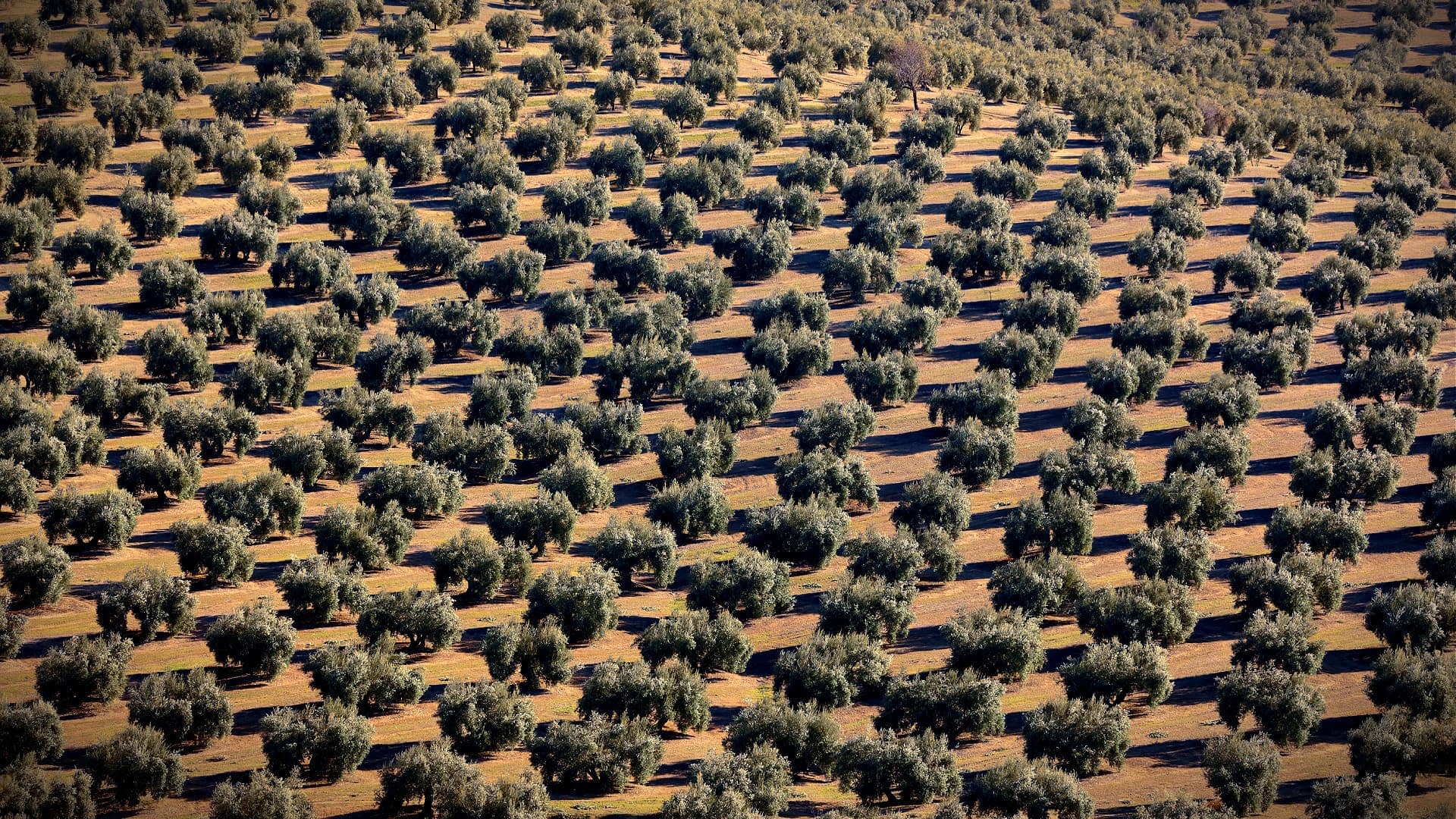
Focusing on Spain, the report confirms the country once again leads global production in 2024/2025. Spain’s olive-growing area spans 2.7 million hectares — part of the roughly 11.7 million hectares planted worldwide.
Approximately 400,000 people in Spain own olive groves, with 69 percent located in rainfed, low-yield or sloping areas.
Alongside its vast traditional groves, Spain has driven the global expansion of irrigated intensive and super-intensive systems. These orchards — concentrated in Andalusia and Extremadura — achieve mechanized harvesting rates above 90 percent and densities of 1,600 to 2,000 trees per hectare.
Such approaches are increasingly adopted worldwide, often paired with advanced farming technologies.
Water availability remains a key constraint, but in Spain, tools such as GPS-guided planting and sensor-based irrigation now cover most cultivated areas.
According to the report, Spain’s olive sector balances high productivity with structural challenges. Labor shortages and declining profitability in traditional groves continue to threaten historic landscapes and cultural heritage, the origins of some of the world’s best olive oils.
Dining and Cooking