
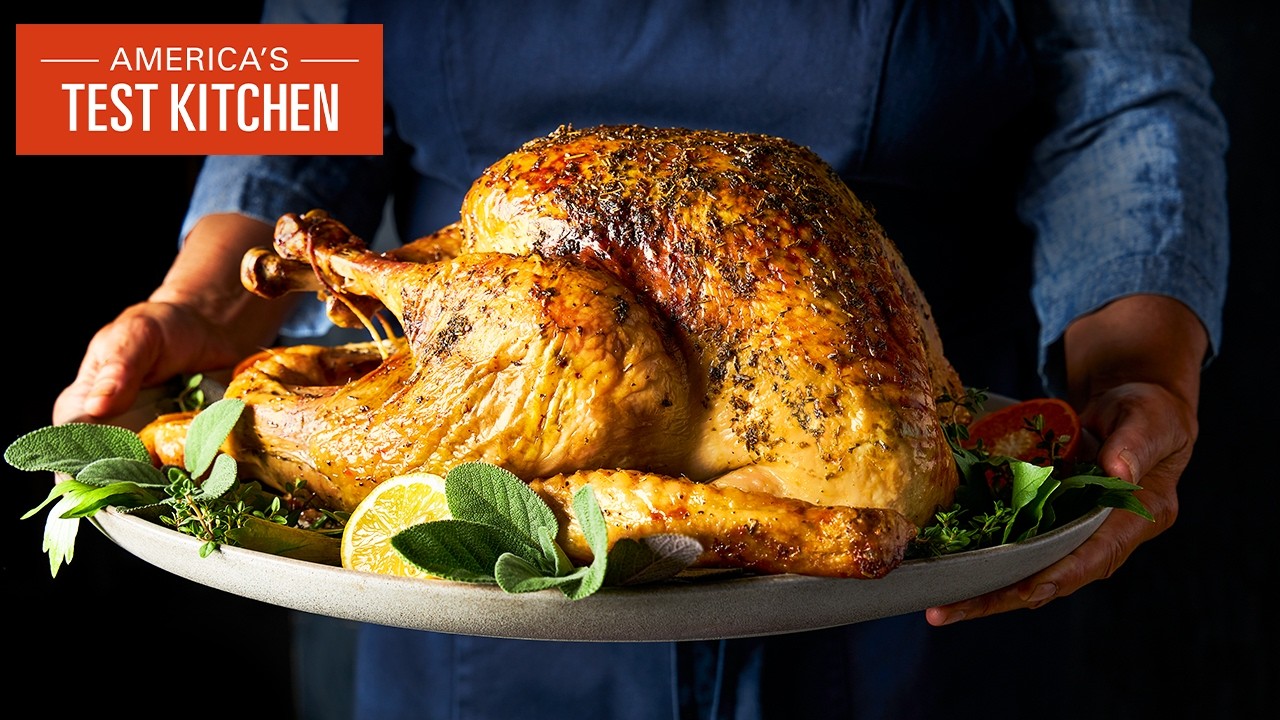
Keith Dresser shows Bridget Lancaster how to update your turkey recipe by using a paste made with fresh herbes de Provence, used both under the skin and inside the bird. Keith also offers tips on how to keep the turkey’s white meat from drying out during cooking, while keeping the skin nice and crispy. This may become your new go-to turkey recipe!
Roast Turkey and Gravy with Herbes de Provence and Lemon Recipe: https://cooks.io/4o70Vgc
Discover more recipes through the America’s Test Kitchen App: https://cooks.io/41TUSTK
Get exclusive access to every recipe, review, and more via our homepage: https://cooks.io/47Tds20
Buy The Complete America’s Test Kitchen TV Show Cookbook 2001–2026: https://cooks.io/489yjNc
Discover the latest recipes, tips, and tricks from Cook’s Insider: https://cooks.io/48abaKP
Subscribe to Cook’s Illustrated: https://cooks.io/3MeLl4E
Subscribe to America’s Test Kitchen: https://youtube.com/@AmericasTestKitchen?sub_confirmation=1
Watch full episodes of America’s Test Kitchen and Cook’s Country for free on our new YouTube channel: https://youtube.com/@ATKFullEpisodes
Watch More!
In The Test Kitchen: https://youtube.com/watch?v=eLxup9tEP0M&list=PLnbzopdwFrnZsva37L040wy1u2RTOhqiF&pp=0gcJCWMEOCosWNin
The Taste Test: https://youtube.com/watch?v=SkqhwZqnA8s&list=PLnbzopdwFrnZ3usQguuxS2qWxlwj-9aN8
Techniquely With Lan Lam: https://youtube.com/playlist?list=PLnbzopdwFrnYyvwrqTB_5AhufdOMisGnF
Most Popular: https://www.youtube.com/watch?v=2guC4Badq2s&list=PLnbzopdwFrnZcFFuiSDnaymlMCb9ANwC5
Follow America’s Test Kitchen:
Instagram: http://instagram.com/testkitchen
Pinterest: http://pinterest.com/testkitchen
TikTok: https://tiktok.com/@testkitchen?lang=en
Facebook: http://facebook.com/americastestkitchen
Twitter: http://twitter.com/testkitchen
At America’s Test Kitchen, we investigate every aspect of cooking—recipes, equipment, ingredients, and techniques—with a goal to empower and inspire home cooks. Since 1992, our team of 50+ cooks, editors, and culinary creatives ask a lot of questions—and do a lot of testing—so that you get dependable, delicious recipes, comprehensive guidance, and thorough and unbiased equipment and ingredient reviews. You can find us in the pages of Cook’s Illustrated magazine, on our television shows America’s Test Kitchen and Cook’s Country, in dozens of best-selling cookbooks, and via the 14,000+ recipes, reviews, and classes available on our website and app. Whether you’re in search of a great weeknight meal or an impressive dinner-party dish, we’ve done the testing to deliver reliable recipes and comprehensive cooking info to your home kitchen. Bring your curiosity, and we’ll make you a better cook.
#AmericasTestKitchen #CookingTutorial #FoodScience
– Around these parts, ATK
is affectionately known as “Turkey Central”. And I’m not talking about my coworkers. I’m talking about the vast
amount of turkey recipes that we have produced over the years. And we’re always coming out with more because we know that one
size does not fit all when it comes to turkey, and we also like to take a look back and see how to freshen
up our older recipes. Well, Keith is here and he’s gonna tell us how we refreshed a fan favorite. – Yeah, so Lon developed a turkey recipe six or seven years ago. Great recipe, a recipe that I use for my Thanksgiving dinner. Awesome, classic turkey and gravy. But we have people repeatedly asking us how can we add flavor
to that turkey recipe? So we went back into the
kitchen to answer that question. And that answer was an herb paste. So I’m gonna start over here, and I have three quarters
of a cup of fresh parsley. Gonna put that into our food processor. I also have a quarter cup
of dried Herbes de Provence, and that’s really the
backbone of this herb paste. Also gonna add two
tablespoons of vegetable oil, two teaspoons of lemon zest, two teaspoons of garlic powder, and a half teaspoon of black pepper. I’m just gonna buzz this for 30 seconds until everything is finely ground. (food processor whirs) Excellent. That looks great. We’re gonna use this herb paste in a couple of different ways. The first way is we’re gonna
take a quarter cup of this. – [Bridget] Ooh, I got a waft
of that. That’s really nice. – To the herb paste, I’m
gonna add some salt and sugar. We’re gonna rub this underneath
the skin of the bird, season the flesh, but also carry some of those herb flavors
into the flesh as well. So I have a quarter cup of the herb paste, quarter cup of kosher salt,
four teaspoons of sugar. Mix that together. – Nice.
– I think that is good. So, now for our turkey. I’m gonna need to separate that skin from the meat in order to
get that salt in there, so let’s do that. I have a 14 pound turkey here, and I’m just gonna start with the breast. That’s the easiest place to start. I’m just gonna work my fingers in there to break that membrane
that is between the flesh and the skin, making sure
that I leave the skin intact right here on that keel bone– – Right.
– ‘Cause if not, everything will peel back. So you wanna make sure
you have an anchor still. Okay, so that is our breast
meat. Now I’m gonna do the legs. So sometimes if you hold onto the skin and push the leg backwards like that, it’ll help separate it. Okay, that’s great. Now for our salt. I’m gonna start with
both sides of the breast. I’m gonna put two
tablespoons on either side. Now, there are many ways you can do this. You can empty the salt into your hand and try to get your hand in there. I find it easier just
to take the tablespoon and put it in there and get
it back as far as you can get. It doesn’t have to be all the way back because you can massage the salt down. – [Bridget] Right! – So as long as you get
it about halfway back, I think that’s pretty good. So I’m just gonna take that and smooth it back with my
hands, rub that salt in there. You can get your hands underneath as well. Make sure we have a nice
coating on the breasts. I’m gonna use four
teaspoons on either leg. Again, just like the breast,
once you get it on the top, you can kind of take it with your hands and massage it into that flesh to get a good, even distribution. Now I’m just gonna take the rest of this and I’m gonna put it into the cavity. People will think that,
because there’s a lot of bones in there, it doesn’t
make any sense to salt it, but we’re gonna be letting
this sit for 24 to 48 hours, so that will have plenty of
time to work through that bone. Now that’s a well-seasoned bird. So a couple more things. I’m just gonna take the wings and give the turkey a half nelson, tuck those underneath so
they’re out of the way and they won’t burn. And then, one more thing,
I’m just gonna take a piece of twine and I’m gonna
tie these legs together. Not looking to tie the legs
together too, too tight. Just wanna keep it from splaying out. – [Bridget] Gotcha. – So I’m just gonna transfer
that over to a wire rack. We’re gonna put that in the refrigerator for 24 to 48 hours, the longer the better. And we’re gonna leave it uncovered. And what we want that
skin to do is dry out, and that’s gonna mean better browning and better crispness
when we roast the turkey. So I’m just gonna wash my
hands and then I’ll transfer that over to the refrigerator. – Okay. – Our turkey is nicely dried. It’s been in the refrigerator,
uncovered, for 24 hours. Now we’re gonna get ready to roast this, but there’s a couple things we’re gonna do before we put it in the oven. First thing I wanna do
is I wanna go through and kinda blot any pockets
of moisture that I see, making sure that we have dry skin, because, as we know, moisture
is the enemy of browning. That looks great. Now, I’m gonna take a
mixture of vegetable oil, I have one and a half teaspoons
of vegetable oil in here, and I’m gonna add a
teaspoon of baking powder. Now that baking powder
is slightly alkaline, so what that’s gonna do is
it’s gonna speed up browning and also, because it’s slightly alkaline, it will break down some of the proteins and give us a crisper skin. (Bridget hums) So I’ll just stir this
into a little slurry, drizzle this over the top, just make sure we get this
on any exposed areas here. And I’ll just take a brush. – [Bridget] It really
doesn’t take a lot of that. – No, it doesn’t need that much. Okay, that looks good. One other thing we’re gonna do here is I’m gonna make a foil
shield for the white meat. And what that’s gonna do is you’re gonna protect the white meat and
just even out the cooking between the white meat and the dark meat, because we want them to finish
cooking at the same time. So I have a piece of foil here. I’m just gonna fold this over. And what we’re looking at is, well, home plate or maybe a house. – [Bridget] So you’re just
slowing down the cooking of the breast meat? – [Keith] Exactly. So, now we’re ready to roast. But I kinda have a special
roasting setup over in the oven. I wanna show you that. – [Bridget] All right. – So this is our roasting setup. What I’ve done is I’ve put a baking steel in the bottom of our oven, you
can also use a baking stone, and I’ve put the roasting pan
on top of that baking steel, and I’ve preheated the oven to 500 degrees for a half an hour. So what we wanna do is we
wanna put a lot of heat into the bottom of that
turkey, the dark meat, and that way we’ll cook the dark meat and the white meat at the same rate. – Gotcha.
– So I’m just gonna take this out of the oven, – [Bridget] Kinda super heating the pan. – Just gonna set that on a wire rack. Now I’m gonna take two
tablespoons of vegetable oil. I’m gonna pour that into our roasting pan. You can see how hot that is,
it shimmers almost immediately. – [Bridget] That’s right! – Now I’m gonna lift the turkey and put that into our roasting pan. (pan sizzles) – Ooh, that’s a good sound! – Immediate sizzle.
– Yep. – [Keith] So I’m gonna put
this back into our oven, I’m gonna reduce the oven
temperature to 425 degrees. We’re gonna cook that for 45 minutes. – [Bridget] Okay. – Okay, it’s been 45 minutes. – Ooh!
– We wanna check. So I’m gonna take the turkey out and I wanna take that foil shield off. – Okay. – But before I put this back in the oven, I’m gonna take some of that
herb paste that we made earlier, I’m gonna take one tablespoon, I’m gonna stir it into two tablespoons of melted, unsalted butter. Now I’m gonna take this herb butter, I’m gonna brush it all over the turkey. (Bridget hums) This is gonna look beautiful, but the butter is also
gonna aid with browning. So what we’re gonna do
now is we’re gonna go back to the oven, we’re gonna turn
the oven temperature down to 325 degrees, we’re gonna
let this finish roasting quite slowly. So what we’re looking for
is we want the white meat to register 160 degrees, the
dark meat will be 175 degrees. That will take anywhere from
an hour to an hour and a half. – [Bridget] All right. – [Announcer] At Cook’s
Illustrated, we’re food nerds. That’s why every recipe we
develop involves research, cooking science, and
rigorous testing by our team of expert test cooks. Only the highest rated
recipes earn a place in our award-winning magazine. Every issue features our
latest recipes and discoveries, cooking tips, and equipment
and ingredient reviews. Our step-by-step photos and
hand-drawn illustrations show you exactly how to succeed. So are you ready to become
the best cook you know? Subscribe to Cook’s Illustrated magazine at cooksillustrated.com today. – Let’s check on our turkey! – Mmm!
– Ooh, yeah, look at that golden color! – [Bridget] Gorgeous! That is beautiful. – We just wanna check the temperature, so I’m gonna go into the thigh right here. And it is 175 degrees. So you wanna check the white meat and what we’re looking for is 160 degrees. That’s great, spot on. I wanna get this outta the pan because we wanna take those
drippings to make gravy. I’ll just take a pair of tongs and put that into the
cavity like that and… – Nicely done. – So we wanna let that sit for 45 minutes and now I wanna take and
make sure that we scrape up any of these little
brown bits off the bottom of our roasting pan because, as you know, those brown bits mean flavor. So I’m just gonna take that. Now I wanna strain off
any of these solids. So I have a fine mesh
strainer set in a bowl. Now I wanna make sure we get the fat and the broth separated, so I’m just gonna pour
that into a fat separator. It’s been 10 minutes and you can see that our fat has separated
from our drippings. So I’m just gonna take this and we’re gonna pour off
a cup of these drippings. – [Bridget] That’s it. Look at that!
– And there, okay, perfect. I don’t wanna throw away this fat. We’re actually gonna take this fat and that’s what’s gonna
build the base of our gravy. So I’m gonna put three tablespoons. (Bridget hums) Three, okay, so I’m gonna heat
this over medium high heat, and we wanna get this shimmering. (fat sizzling)
Okay, that is shimmering, and I’m just gonna add the neck to that and the heart and the giblets. We’re gonna brown that
for 10 to 12 minutes, and we’re gonna get a nice,
dark brown on both sides, create some fond in that pan
to help flavor our gravy. – Okay! – It’s been 10 minutes and we have a nicely browned neck here and our other giblets. I’m gonna take those out. Now for the vegetables, I’m
gonna add one small onion that’s been finely chopped. Also gonna add one sliced carrot. – [Bridget] Okay. – I’m just gonna stir those in. I’m gonna turn down the heat to medium. I’m gonna let those cook
until the vegetables are soft and it’ll take five to seven minutes. Been five minutes, and you can see that the vegetables are softened, but, more importantly, the moisture that the vegetables give off
have kind of deglazed that pan, so all that fond is
gonna get into our gravy. I’m just gonna take five
tablespoons of all purpose flour and sprinkle that over the vegetables. I’m just gonna stir this in. Now that fat and that
flour are gonna combine to create a roux, and that is what’s
gonna thicken our gravy. So I’m gonna switch over to a whisk and take our one cup of drippings, and I’m gonna slowly add this
while whisking constantly. The reason why I’m adding this slow is we don’t want any lumps in our gravy. Okay, now for the remaining ingredients. I have three and a quarter cups of water. – [Bridget] That’s how flavorful this is. You’re not adding chicken stock? – That’s right, I’m glad you noticed that. Those drippings do have a lot of flavor and we don’t need to build more flavor with artificial stock. – [Bridget] That’s great. – Also gonna add a
quarter cup of white wine, five sprigs of fresh
parsley, and two bay leaves. Now we wanna add our browned
neck, our giblets back in there because those will add a ton of flavor. So we’re just gonna
bring this up to a simmer until it’s nice and thick. Take about 10 minutes. – [Bridget] Okay. – Gravy has been bubbling
away here for 10 minutes and it’s nicely thickened. – It is beautiful.
– It looks beautiful, doesn’t it? So I’m just gonna take the neck outta here before I strain this off. We don’t have that splashing around. Pour this into a bowl here. Now, we have a little
bit of that herb paste that we made earlier leftover, and that is going to flavor our gravy. – [Bridget] Very nice! – Yeah, I think that really makes it, and I think we are good
to go with the gravy. Now we can carve the turkey
and then we can get to eating. It’s been 45 minutes, the
turkey has fully rested, and now comes my favorite part. Actually carving the turkey is one of my favorite things to do. Okay, first thing, we wanna
get rid of this twine here to free up our legs. Set that aside. Now I start with the legs
and I just cut that skin in between the breast and the leg slowly. Now I can see the leg
joint and I take that and snap it back like that, and then cut right through there, like so. – [Bridget] Fantastic! – So now that I have my legs, I’m gonna take these and carve these before I get into the breast. So I’m just gonna separate
the leg from the thigh. So there’s a joint right there. Cut right through that
joint in one fell swoop. That goes on to our platter like that. What I like to do is I like
to take the thigh bone out. Okay, now that we have
that thigh bone out, I like to go over to a chef’s knife to slice it across the thigh like that. Our thighs and our legs are done and now we can focus on the breast meat. I start with the keel bone right here, and the bone structure of the turkey is kind of an inverted Y. So you have one bone and it
kind of splits out halfway down. So I like to kind of score
with the tip of the knife, putting my knife right up
against that keel bone, or the breast bone. Once you start to feel the rib cage, follow that rib cage down there. Now I’m gonna take this
opportunity to remove the wings and I find it easier to remove the wings once I have the breast off because it exposes the wing joint. – [Bridget] Nice. Little drumette, a little flat. – Okay, now for the breast. Now you can cut this
any thickness you want. I find if I cut the slices thicker, I can keep the skin on
a little bit better, so I would say three quarters of an inch. But again, you can cut it as
thin or thick as you want. Let’s eat this. – Absolutely!
– I am tired of waiting! – I’m crying over here. – [Keith] I’m gonna give
us a piece of white meat, piece of dark meat now. – [Bridget] Very nice. – [Keith] Gravy? – [Bridget] Hmm, yes. – [Keith] Yes! – [Bridget] There you go. – [Keith] Double the
amount of gravy for you. – I am going to first
tuck into that breast meat because that is the test,
right, of a great recipe? (hums) The meat itself is still
really, really juicy. It is like an herb explosion. – But the lemon also comes out. Just two teaspoons of lemon zest and it comes out just a little bit, just a hint at the end. Compliments those herbs nicely. – [Bridget] Beautifully
cooked, super flavorful. This gravy, spectacular. It’s silky, it’s full of flavor, really, really rich turkey flavor, but the herbs just brighten it
up right at the end as well. – [Announcer] For full episodes of your favorite cooking shows, head over to ATK’s full episodes channel on YouTube. You can stream complete seasons of “America’s Test Kitchen”,
“Cook’s Country”, and more. See you there!
15 Comments
🔥🔥🔥🔥🔥🔥🔥🔥
skip all these steps by just spatchcocking the turkey. everything will be cooked perfectly in 2-3 hours. I just dry brine for 24 hours, and season with blended olive oil, garlic, rosemary, and sage, on top and inside the skin.
Let's say i use a wet brine like kinders, can i also use this herb paste to do a dry brine for 24 hours or will it be overly salty?
A dry brine. I wet brine, spatchcock, and cook low then hot on my smoker. But the herbs de Provence is intriguing.
Repost?
Nice❤
nice😊
Good
Vrmt bien
❤❤❤
J'adore la façon de préparation. Et la cuisson, ça a l'air très, très très bon.
❤❤❤
J aime prépare du poulet je vais suivre la recette 😊
Très bon courage
C est une femme qui paie pour qu on regarde la vidéo ou on s’abonne au compte ne tombez pas dans le piège à regarder cette vidéo pas intéressante