
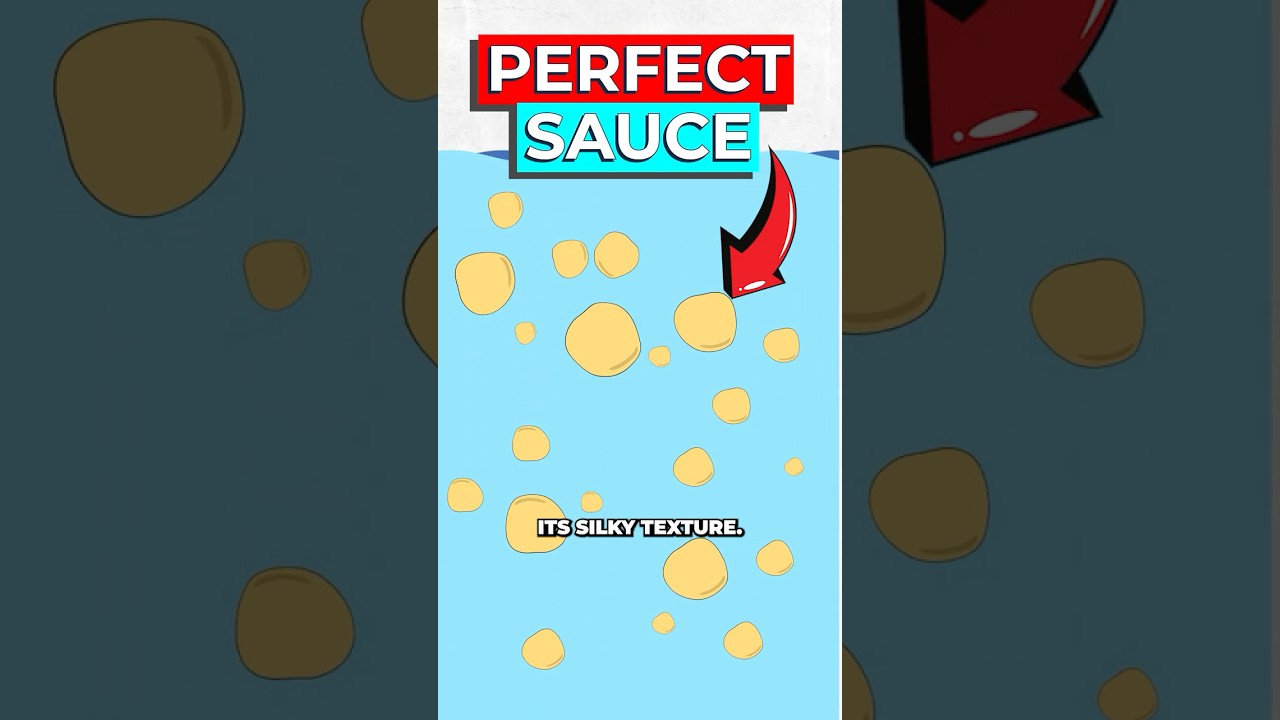
Physicists have solved the age-old problem of making creamy cacio e pepe by studying protein and starch interactions at precise temperatures. Their research reveals that maintaining starch concentrations at 2-3% relative to cheese mass creates a protective matrix that prevents cheese protein clumping, ensuring a smooth sauce.
Source Article: https://www.sciencedaily.com/releases/2025/09/250918225012.htm
#foodscience #physics #culinaryinnovation #discovery #shorts
JOIN US on Patreon 👨🔬 🚀 http://patreon.com/DrBenMiles
ROCKSTAR SCIENTIST TEEs: https://www.rockstarscientist.org/ 🤘👨🔬
If you are a scientist with a breakthrough idea apply here:
🚀 Empirical Ventures – https://empiricalventures.vc
🔗 Linktree: https://linktree.ee/drbenmiles
📸 Insta: https://www.instagram.com/drbenmiles
📲TikTok: https://www.tiktok.com/@drbenmiles
MY GEAR
📷 Sony A7III https://amzn.to/3OWrmGd
🔎 Sigma 402965 16 mm F1.4 https://amzn.to/49BNJdq
🎤 Shure SM7B https://youtu.be/lVTS_J7Xmxs
🎤 Zoom H4n Pro https://amzn.to/3OXsklB
🎤 Sennheiser AVX https://amzn.to/4geWnBi
Scientists just cracked the physics behind the perfect pasta, winning them this year’s Ignobbell Prize. Kacier Pepe is Italy’s minimalist dish. Just pecarino cheese, black pepper, and pasta. Potentially delicious, but often a disaster if the cheese sauce splits, leaving you with a greasy puddle of rubbery curds. More lab disaster than dinner. Who’s putting all this in the bin? So, physicist Frizzio from IST Austria and his colleagues turn to physics for a solution. The secret to these sources is an emulsion. Tiny droplets of fat suspended in water give the sauce its silky texture. But as oil and water don’t mix, this balance is fragile. The researchers showed that above 65° C, the casein proteins in pecorino cheese denature, their long coils unraveling and knotting together, forcing fat into clumps and the emulsion to collapse. These saucy suspensions only hold if they have emulsifiers, molecules that can interact with both polar water and non-polar fat, bridging the repulsion between the two. Traditionally, to keep the balance, chefs depend on starch that leaks out of pasta as it boils. These long carbohydrate chains are mostly water loving, but they curl into helical shapes with tiny hydrophobic pockets. These pockets help trap fat molecules, keeping them dispersed in water. The problem is, in practice, pasta water varies wildly, and the starch concentration is often too low to do the job. So, researchers turned to image analysis to build a phase diagram of how these proteins and starches interact in pasta sauce. Their suggested fix was to make a stabilizing solution from corn or potato starch, then add it to the pan alongside the pasta water. The sweet spot they found was 2 to 3% starch powder by weight of cheese. Any less and this risks the emulsion collapsing and any more it gels into a thick paste. In this narrow range, starch coats the proteins and droplets, creating a stable colloid and a source that stays creamy every time. Absolutely worthy of the egg Nobel Prize. I just hope that their next paper explains why my scrambled eggs squeak like gym shoes. What are you? An idiot sandwich. If you like science and think it should be both peer-reviewed and taste tested, follow for
25 Comments
Next up, the quantum soup 🥣 ⚛️
Just how free are our scientists. Is this where taxpayers money is going 😢
Chinese restaurant also use corn starch to thicken sauces
He said "he will run" 😅
Totally righteous video
Better way to get potato starch for pasta is to dyce the potato skin and boil it you get a very good starch
so the secret to the best minimalist dish is to add another ingredient…
And there were chefs who made it perfectly without knowing any science 🧪 They truly were real Geniuses 🫡
Yeah, SCIENCE!
Cooking is just chemistry
I think Ramsey is a bully. There's no way I would watch a show of that idiot.
I've tried his food. It's not worth the price or the hype people put behind his name.
Approved ✅
The 2 Italians taking notes
Phase diagram jumpscare 😭😭😭
Real Italian don't want you to know this trick!
No seriously, they will make fun of you, or at least the ones I know have always given me hell for using a slurry to stabilize my pepe but
I've been using a slurry to make this for years bc its what a slurry is used for and it doesn't alter the taste but they think the pasta water should be reduced and then used but they are literally the same end form just using two different starches wheat vs corn
Oh a slurry is cornstarch and water
Homophobic pasta ☃️🎄
Mmm… Nuclear pasta…
😂
This is an old common knowledge.
Asian has been put Starch to their sauce since forever.
thin rue…
most already knew…
the award goes to you!
The old adding a little bit of a slurry to the sauce as a emulsion/thickening agent.👌
Idk man was there really no science that actually improved/saved lives?
WHO ARE YOU “sadly” an idiot sandwich
So did a cook figure this out orrr a scientist
"Pahstah"