
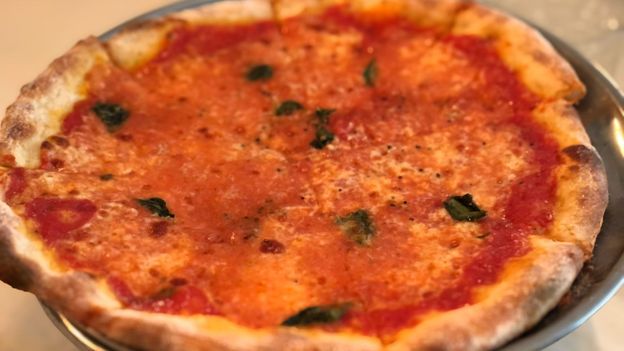
The Migliucci family left Naples in the 1890s after Joe’s great-grandfather (also named Mario) had his hand blown off by fireworks. Ashamed of his disfigurement, the couple and their children moved to Cairo, Egypt, where they opened an Italian restaurant. Their son Giuseppe married a Neapolitan woman and returned the entire family to Italy. Then in 1913, the couple moved to Manhattan with Giuseppe’s mother, Scolastica, and their 1-year-old son, named Mario after his grandfather.
You may also be interested in:
• The truth about the US’ most iconic food
• What’s left of New York’s Dutch past?
• Italy’s practically perfect food
At the turn of the 20th Century, the Belmont neighbourhood that holds Arthur Avenue was a rural hinterland that real estate developers marketed to Italian immigrants as the “Italian colonies”. And so it was here at 2342 Arthur Avenue in 1919 that the family opened G Migliucci, a pizzeria with just six tables. Scolastica and her daughter-in-law cooked simple dishes like escarole in broth and Giuseppe made pizza. After school, young Mario worked at the restaurant selling slices of pizza on the sidewalk for five cents. His friends would come by for a slice and called the restaurant “Mario’s”.
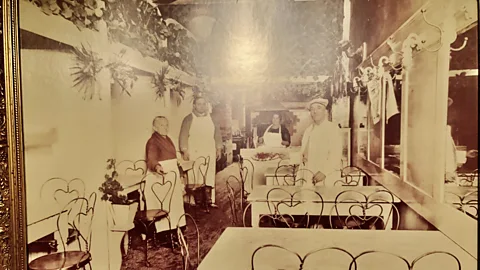 Danielle OteriWhen the Migliucci family opened the restaurant in 1919, they had just six tables and sold pizza for five cents (Credit: Danielle Oteri)

Mario and his brother Clemente took over in the 1930s, officially changed the name and transformed the pizzeria into a white-cloth, fine-dining restaurant. The restaurant soon grew into one of New York’s most celebrated, attracting mayors, governors and celebrities like Joe DiMaggio, Frank Sinatra and Elizabeth Taylor. In 1971, director Francis Ford Coppola wanted to shoot a scene from his new film The Godfather in Mario’s dining room. But when Mario heard the pitch – that Al Pacino’s character would hide a gun in the restaurant’s bathroom and then use it to kill the two men at the table – he declined, saying that it didn’t sound like a family film, so Coppola shot it at another nearby restaurant instead. And in 1976, New York Times food critic Craig Claiborne invited Mario and Clemente to cook at his home in the Hamptons with celebrated French chef Pierre Franey and published a glowing review of the restaurant.
Dining and Cooking