
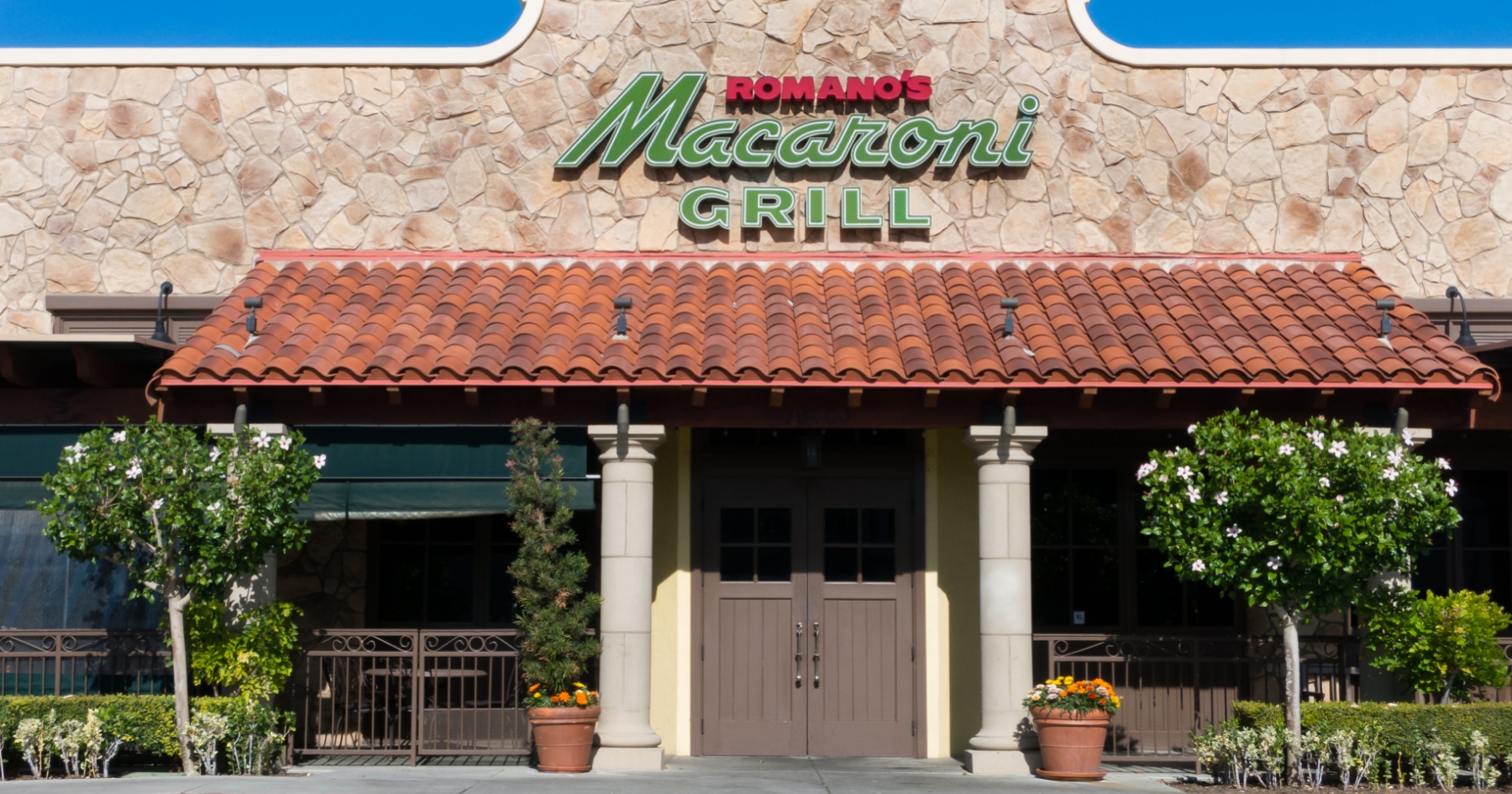
A series of owners have been unable to revive Romano’s. | Photo: Shutterstock
Romano’s Macaroni Grill has closed a dozen locations this year and is now down to just nine restaurants, a steep decline from the 85 it had in 2019.
Romano’s locations in California, Nevada, Ohio, Hawaii and Pennsylvania shut their doors in recent months, according to local media reports, though some of the stores are still listed on Romano’s website.
The Italian casual-dining chain currently has restaurants in seven states—California, Colorado, Florida, Illinois, Ohio, Texas and Utah—including two in airports. It had not responded to a request for comment as of publication time.
The closures continue the turbulent history of the Denver-based brand, which has been shrinking for nearly two decades under several different owners.
Romano’s was founded in San Antonio in 1988 by restaurateur Phil Romano, the creator of Fuddruckers. It was acquired by Chili’s owner Brinker International the following year.
Positioned as an Olive Garden competitor, Romano’s served standard Italian fare and leaned into its Italian theme: It staffed opera singers and played Italian language lessons in its restrooms.
The chain grew quickly under Brinker, peaking at 237 locations in 2006, most of them company-owned, according to data from Restaurant Business sister company Technomic.
Two years later, on the cusp of the Great Recession, Brinker sold the chain to private-equity firm Golden Gate Capital for $131.5 million, a price that was later adjusted to $88 million after the economy crashed.
The financial crisis was hard on Romano’s, as it was for most casual-dining chains, and in 2013, Golden Gate sold the brand to Ignite Restaurant Group, the owner of Joe’s Crab Shack, for $55 million. Sales continued to decline, and Ignite sold Romano’s again two years later to Red Rock Partners for just $8 million.
In 2017, the chain filed for bankruptcy and closed nearly a third of its locations, finishing the year with 91 stores, according to Technomic.
Romano’s would be sold two more times, in 2018 and then in 2023, to RMG Acquisition Co., an affiliate of Food Management Partners. Food Management has a history of buying distressed restaurant brands such as the buffet chains Old Country Buffet, Hometown Buffet, Ryans and Furr’s, all of which went defunct under its ownership.
The pandemic was devastating for Romano’s. It closed half of its locations in 2020, bringing its footprint to 43 restaurants. And unlike other casual-dining chains, it did not enjoy a post-COVID rebound: Sales have declined every year since as it continued to close locations. Last year, it dropped off of Technomic’s ranking of the top 500 largest restaurant chains in America by sales.
Full-service Italian brands have struggled recently. Average systemwide sales growth for the segment was flat last year, per Technomic, and several Italian chains have filed for bankruptcy, including Buca di Beppo, Bravo/Brio and Bertucci’s.
Despite the latest wave of shutdowns, Romano’s apparently has a plan to get back to growth. In a LinkedIn post earlier this year, CEO Jason Kemp wrote that the chain was preparing to launch a franchising program in the U.S. for the first time since 2013, and said it would soon announce a new franchisee in the Midwest.
Romano’s is also franchising internationally, Kemp wrote. And it has been working to expand its delivery-only virtual brand, Twisted Mac, via a partnership with Franklin Junction, a service that places virtual brands in other restaurants known as host kitchens.
“Sticking to the roots created by Phil Romano 35 years ago, we are still a scratch-made kitchen offering authentic Italian recipes to our guests, family and friends,” Kemp wrote.
Members help make our journalism possible. Become a Restaurant Business member today and unlock exclusive benefits, including unlimited access to all of our content. Sign up here.
Dining and Cooking