
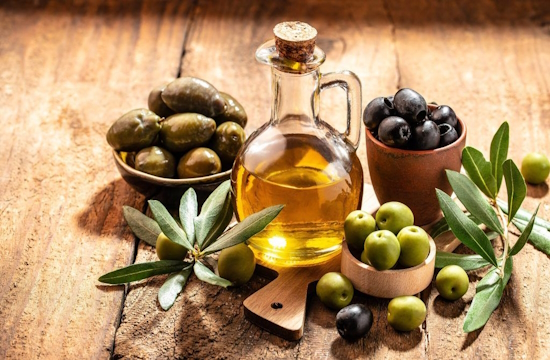
The olive oil market in Italy is shaping a new environment for Greek exports, as 2025–26 is expected to be characterized by stabilization following last year’s strong recovery. According to an information brief from the Economic and Commercial Affairs Office of the Embassy of Greece in Rome, global production is forecast to range between 3–3.1 million tons, with a slight decline due to climate pressures. Within the European framework, Italy shows an upward trend, while Greece remains stable in terms of production, strengthening its position in the international market.
Greece in the global and European rankings
Greece continues to rank among the top olive oil–producing countries, with production of around 250 thousand tons for 2024/25 — a significant increase over the previous year, with a clear quality advantage in the extra virgin olive oils of Crete and the Peloponnese.
At the same time, Greek exports of edible olive oil recorded a sharp increase in 2023, attributed to the global shortage of stocks and high prices, before declining again in 2024 with market normalization. Greece, however, remained steady in export volume, indicating the resilience of its production.
Italy remains the main destination for Greek olive oil
Italy continues to be the largest buyer of Greek olive oil. In 2024 it absorbed 497.8 million euros’ worth of Greek olive oil under category 1509 and 37.4 million euros under category 1510, despite the significant decline compared to 2023 due to changes in international prices and in Italian processors’ procurement strategies.
The volume of Greek exports to Italy fell to almost half, but the trade balance remains overwhelmingly positive: Greek exports are 50 times larger than imports of Italian olive oil into Greece, in both quantity and value. For 2024, the surplus reached 524.8 million euros.
Bulk exports and the loss of added value
Despite its strong export profile, Greek olive oil still faces a deeply rooted structural weakness: the vast majority of exports are in bulk rather than in standardized, branded form.
According to the report, Greece exports only 2–3% of its production as branded product, while Italy reaches almost 100% and Spain about 70%. As a result, Greek olive oil is blended in Italy with oils from other countries, packaged and re-exported as “Made in Italy,” often at more than double the price.
The loss for the Greek economy is estimated at 1.3 euros per kilo, or roughly 200 million euros annually in unrealized added value.
Italy “locks in” the added value of the Greek product
The Italian bottling and packaging industry remains one of the strongest in the world. It packages a total of 800,000–900,000 tons of olive oil per season, far more than its own production (250–300 thousand tons). This means it relies consistently on imports from Greece, Spain, Tunisia and Portugal, which it converts into branded Italian products with enormous added value.
In the Italian retail market, branded Greek olive oil is practically absent. “Italian” blends dominate, often containing Greek olive oil but with no reference to its origin.
Consumer trends and prices in Italy
Prices in Italy remain high, with extra virgin olive oil ranging from 7.25 euros per kilo in Apulia, to 9.65 euros per kilo in Sicily, and 13.50 euros per kilo for PDO Northern Italy oils.
The surge in prices in recent years has led part of Italian consumers to reduce consumption or shift to cheaper vegetable oils. However, for high-quality and PDO/PGI products, demand remains strong — an opportunity for Greece, provided that standardization and branding increase.
Prospects for Greece in the tourism sector
For Greek tourism and gastronomy, the conclusion is twofold: Italy remains an extremely critical market, as it absorbs the largest share of Greek olive oil exports. On the other hand, Greece has enormous potential for added value if it invests more in branded production and in linking it with the country’s tourism brand.
For Greek hotels and the gastronomic experience they offer, the promotion of branded Greek olive oils is a strategic tool for differentiation — especially in an environment where international travelers are becoming increasingly demanding regarding product origin.
Dining and Cooking