
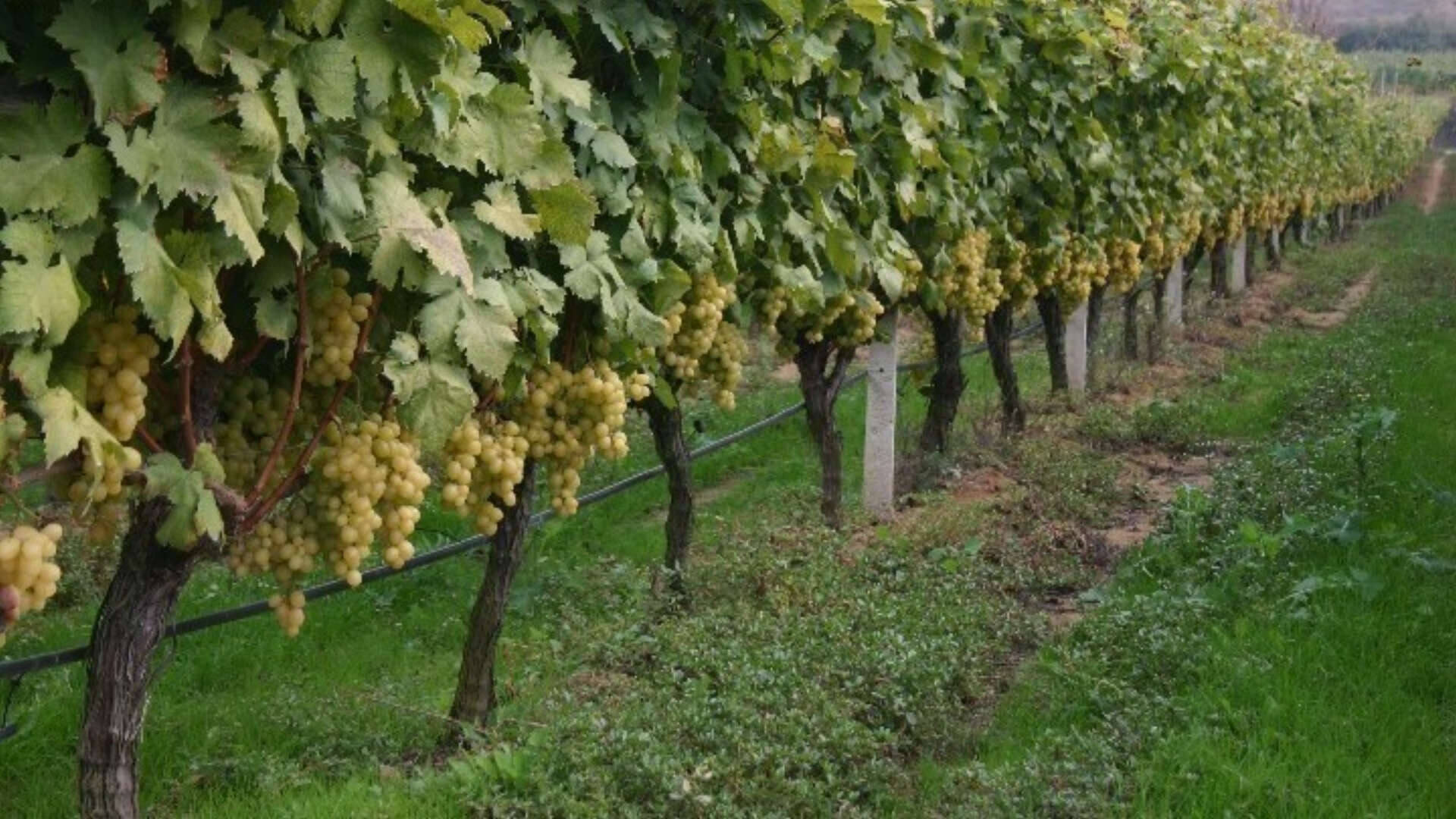
“You know there’s something special about a wine when you remember clearly when, where and with whom you first tasted it. It was August 28, 2006, a warm August afternoon in Santorini, and we were on holiday with my wife, Sue, when I tasted my first glass of Assyrtiko,” said Australian winemaker Peter Barry, describing the start of a journey that years later, in 2012, yielded the first small Assyrtiko vineyard in his country.
In 2014, those “foreign” vines yielded their first 15 litres of wine, thousands of miles away from their place of origin.
Now, production has grown and Australian wines from Assyrtiko with the “Jim Barry” label are sold in various countries, at a price range that, based on Internet research, ranges between $25-40.
While Barry’s desire to produce Assyrtiko in Oceania was the result of a chance tasting and a sudden love for the white wine that the volcanic land of Santorini produces, in other cases, the introduction of Greek vines to Europe, America, Africa and the Middle East are based on two other motivations.
The first concerns its “resistance” against the climate crisis – as Greek varieties are considered resistant to change – while the second is linked to the ever-increasing consumer trend for new wines from “exotic” varieties.
As a result, the demand for Greek grape varieties for planting in foreign soils is constantly increasing and interest is very intense, with small test vineyards having been created – among others – in Australia, Southern France, USA, South Africa, Brazil, Chile, Lebanon and Israel.
However, the road to increasing Greek grape exports is not paved with roses: capitalising on the emerging opportunity is hampered by various factors, such as incomplete genetic identification, the absence of product instruction manuals (the basic technical information that needs to accompany each variety in order for foreign agronomists to trust it), and the ambiguity as to whether Greek grape varieties should – or should not – be cultivated outside Greece.
As part of its research on the exports of Greek grape varieties, AMNA spoke with professors, masters of wine, agronomists and owners or executives of specialized nurseries.
The “exotic” Greek varieties, the evolution that “catches us off guard” and the problem with plant material
“Why do foreign winemakers seek to import Greek varieties? The general idea is that Greek varieties are resistant to the climate crisis, water scarcity and drought, but also later, which means that they resist the early harvest, which is not desirable,” said Professor of Viticulture, Stefanos Koundouras, director of the Viticulture Laboratory of the Department of Agriculture of the Aristotle University of Thessaloniki,.
The professor added that, in genetic evaluation, Greek varieties are ranked somewhere between those of Georgia and Armenia and those of Western Europe.
“They are not as delicate as the French ones, but they are more resistant,” he told AMNA, noting that the “export” of Greek varieties abroad is great advertising for Greece.
According to Professor Koundouras, in the coming years, Greek varieties will become even more interesting to foreigners, both due to the climate crisis and thanks to consumers’ desire to try new wines, at a time when French and Italian varieties have become somewhat saturated, while Greek varieties are considered special and, in a way, “exotic”.
However, the increased demand for Greek vines, he says, is “a development that has caught us off guard” due to the material in many cases not being genetically safe and phytosanitary clean.
“Serious work needs to be done with Greek varieties. Unfortunately, we were late, but fortunately we have started and wherever we gave varieties, the material was good. It will certainly take several more years for this material to exist for all varieties,” he said, adding that until now we have given more emphasis to crops that attracted subsidies.
The first Greek Master of Wine, Konstantinos Lazarakis, is also moving along the same wavelength.
“Indeed, more and more foreign producers are interested in Greek varieties and are coming to Greece to search for the most suitable ones, because they are considered to have increased resistance to heat, water scarcity and drought,” Lazarakis said.
“However, we suffer in that until recently we did not even have clones of Greek varieties and the plant material that existed was without genetic identification and unfortunately in many cases with viruses.”
The unbearable slowness of clonal selection
The difficulties and specificities of exporting grapes were described by agronomist Nikos Dalpis of Vitro Hellas SA, which was founded in 1986 and is headquartered in Niseli, Alexandria, Imathia, and is active in the production, research and distribution of high-quality plant propagation material.
Dalpis explained that the process involves ensuring the grapes are registered in the national catalogue of the country it will be cultivated in, as well as approving the phytosanitary status of the plants beforehand in order to preserve the health of domestic vineyards.
“If you are a winery abroad and you want to cultivate – for example – Assyrtiko, you will ask for two things, not at all simple: first, certification of the variety, that it is indeed Assyrtiko, and, second, certification – a blue label – that the viral load on the plant is zero or as reduced as possible,” he said.
Dalpis explained the key is clonal selection, which he defined as the set of plants originating from an original vine, which meets the requirements of phytosanitary purity and the authenticity of the variety.
Why are there different clones in the same variety? Because over the decades, vines undergo natural mutations, due to the environment in which they grow. As a result, the same variety can have many clones, each of which will “give” wines with slightly different characteristics.
The process of clonal selection of a variety is anything but easy or quick.
“It may take 15 or even 20 years to clonal select a variety. Countries such as Spain have done it, as well as Portugal, which was far behind us, but now has clones of its varieties internationally, producing experimental wines from them. All countries with international recognition in wine started this way, spreading their varieties abroad,” Dalpis said.
Vitro Hellas is currently collaborating with a company in Italy, where there are registered clones of Greek varieties, which have already been on the market for a decade.
These are seven clones of five varieties, which are available to anyone who wishes to cultivate Greek varieties abroad. Soon, probably in 2026 or even this year, it is sought to make available another six clones, of the Assyrtiko, Xinomavro and Moschomavro varieties.
“Our steps in Greece are very slow, they should have been taken 30 years ago. Serbia has more clones than Greece! I believe that soon we will start producing more, but all this requires close cooperation between all those involved and also to reach an agreement as to whether or not we want Greek varieties to be produced abroad, because many are still those who disagree.”
Opening a door in France for the benefit of Greek varieties
Agronomist Kostas Bakassietas belongs to the second generation of a family nursery business in Nemea, which is among the model grapevine propagation units in Europe.
The idea of clonal selection of vines had fascinated him since his student days and when in 2003, at the age of just 25, he found himself at a wine fair in Montpellier, France, he did not hesitate to knock on the “door” of the French Institute of Wine and Vine (IFV), to learn more about what the French did so masterfully: selecting grapevine clones, which were then cultivated all over the world.
That first discussion led, a year later, in 2004, to the beginning of his company’s collaboration with the French organization IFV, and then, in 2015, the foundations of this synergy were laid, with the creation of the “Hellenifera” consortium in Nemea.
Bakassietas noted that the collaboration led to the inclusion of the first Greek grape varieties in France’s national list in 2016.
“When a variety is included there, the whole world sees it. Essentially, it opened a door for Greek varieties to enter the international winemaking scene,” he said.
The first varieties to pass through the “door” were Agiorgitiko, Xinomavro, Assyrtiko, Roditis and Moschofilero.
Some experimental vineyards were created, and in 2021, Provence in France, famous worldwide for its rosé wines, introduced three Greek grape varieties – Agiorgitiko, Moschofilero and Xinomavro – into the PDO zone under the name “Côtes de Provence AOC”. In the next phase, Mr. Bakassietas estimates, Savvatiano and Vidiano will likely take their turn.
“The shift towards cultivating Greek varieties began in the last seven to ten years and is due to two factors,” Bakassietas said.
“On the one hand, the demand for the new and different – because Greek varieties have very interesting characteristics, which touch on various types of wines – and on the other hand, the climate crisis, as everyone is looking for varieties that grow in difficult conditions, in the lack of water and mild winters, and Greek varieties seem to be doing well in this.”
According to Bakassietas, “Hellenifera” is working with 166 Greek varieties for certification and about 35 certified.
Of these, there are 496 clones, out of a total of 2,098, that it has identified in Greek vineyards. Today, there are already 81 clones on the market, of which, unfortunately, only 24 are certified. And there is a demand for them.
Speaking on if Greece can capitalise on this potential boom, Bakassietas said:
“If we work adequately with our wine-growing zones and if we are able to provide enough information about Greek varieties and their cultivation and if we provide knowledge, if the marketing of the wine sector is strengthened in short, then a lot could be done. Unfortunately, however, we are not doing what is needed, which is why I am quite pessimistic.”
Dining and Cooking