
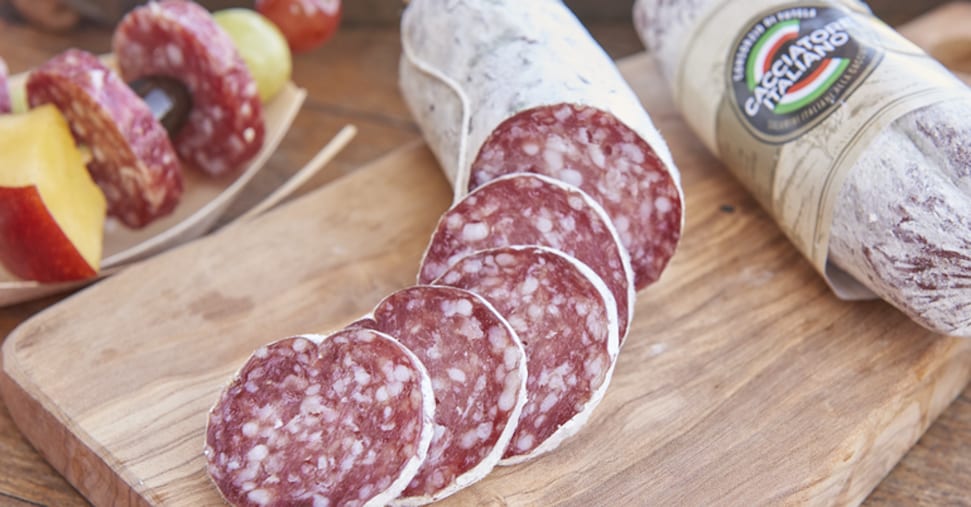
Ever smaller in ‘size’, in stick or chip form, and ever bolder in flavourings, from truffle to alkermes. The new life of salami passes through a reinterpretation of this great classic of Italian charcuterie, for which it represents the second largest market by volume (behind cooked ham) and the third largest by value in large-scale distribution (behind raw and cooked hams), with a turnover of more than one billion euros. And with growing purchases, especially for the imposed weight versions (+1.0% per unit and +0.5% in volume), which reached 494 million euros (+1.7%), according to data processed by Niq for Il Sole 24 Ore.
The snack boom
Salami enters the homes of as many as 18.2 million families (71% of the national total) and it is the snack versions that are particularly popular, which have been growing at rates of over 10% for several years, driven by an increasingly wide and appetising offer. After the morsels and sticks, the last few months have seen the arrival of Sant’Orso’s signature Salami Chips and Beretta Monetine, very thin slices of small salami sold in 70g bags that keep for up to four hours even outside the fridge. “This line stems from the desire to present historical products from the Beretta Salami range in a new format, ideal to share at the table, as a snack, in a sandwich or for a tasteful break,” says Enrico Farina, communications director of Salumificio Beretta, market leader with a 70% share and which continues to focus on this segment, ranging from salami sticks to snack kits (the latest was developed with Biraghi).
Phenomenon ‘nduja
If in the world of salami, therefore, size counts for a lot in consumers’ purchasing choices, equally important is the area of taste, the most powerful amplifier of the pleasure values that have always been linked to this food. Confirmation of this comes from the trend of ‘nduja, the soft salami with chilli pepper typical of Calabria, which in recent years has recorded significant growth in retail (+9.7% in value and +8.4% in volume), exceeding 2.3 million euros in takings in the imposed weight.
“During 2025, ‘nduja continued to grow in modern distribution (+6.4% in volume and +5.8% in value) and in southern regions (+1.9% and +2.3% respectively),” explains Elena Pezzotti, insight analyst at Niq. And it has also extended its presence as a characterising ingredient in sauces, sandwiches and spreadable creams for crostini and bruschetta.
Nduja is the trend setter in Italians’ (and in particular younger Italians’) preference for flavoured salami which, year on year, has practically tripled its sales, proposing this salami in a smarter way and in line with food fashions. Starting with the global success of pizza, which opens up new spaces for the use of salami as a topping, as proposed by Galbani, which has just launched a pre-packaged sliced spicy salami intended for the filling of daisies & C.
Dining and Cooking