
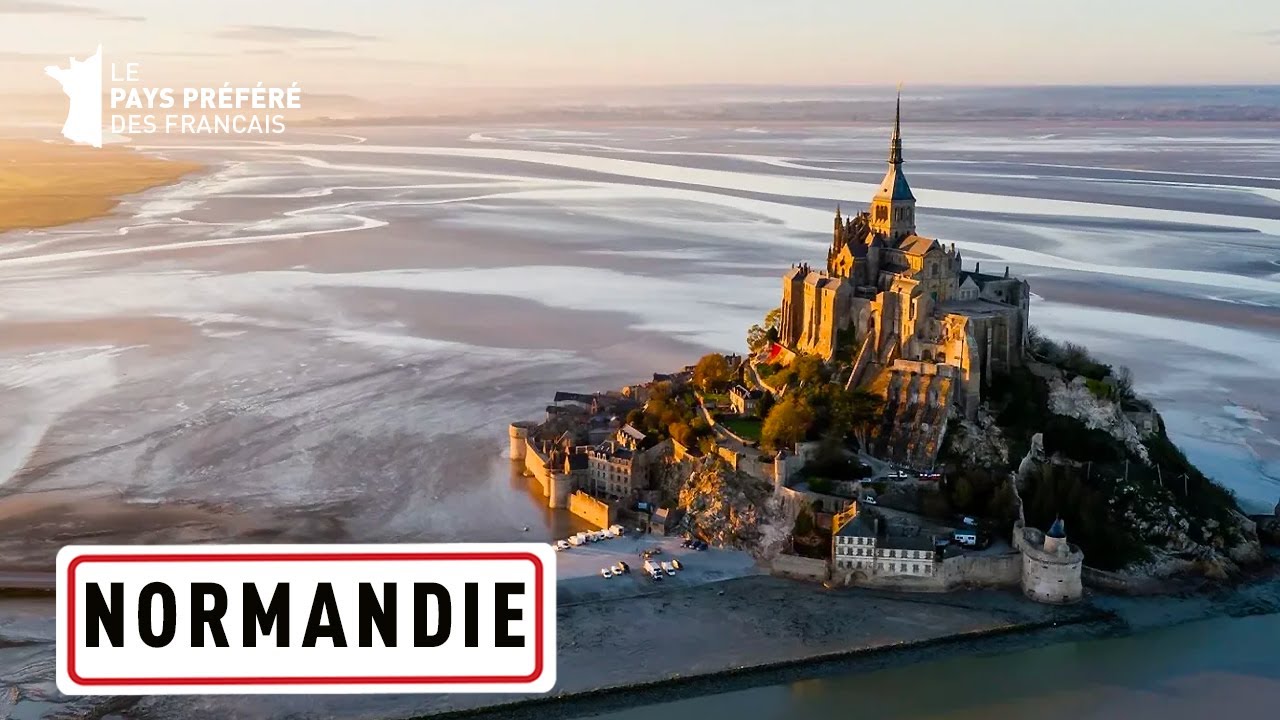
Cap sur la Normandie, de la Manche à la Côte d’Albâtre.
Pour découvrir les merveilles des plus belles régions de France, c’est ici – Abonnez-vous 👉 http://bit.ly/3zjR2Vj 🙏
À Barfleur, port de granit et départ historique de Guillaume le Conquérant, on suit le ballet des chalutiers, les ruelles serrées et les ateliers de potiers. Beuvron-en-Auge déroule ses maisons à colombages, son manoir, l’ambiance des haras et la teurgoule fumante des dimanches de fête. Dans l’Orne, Saint-Céneri-le-Gérei se dévoile au bord de la Sarthe : pont, église romane aux fresques du XIIe siècle, souvenirs d’artistes et convivialité des tavernes. Étretat offre ses falaises de craie, l’arche et l’aiguille chères à Monet, les caloges des anciens pêcheurs et l’ombre d’Arsène Lupin. Final à Varengeville-sur-Mer : cimetière marin face à la baie de Dieppe, église Saint-Valery et vitrail de Georges Braque, valeuses creusées dans la falaise, manoir d’Ango et jardins suspendus entre ciel et mer. Entre mer, bocage et ateliers d’art, un voyage au plus près d’un patrimoine vivant.
Réalisé par Élodie BOUTIT.
© MORGANE PRODUCTION
Discovering France
means wandering its cobbled streets, climbing to the top of its most beautiful towers,
tasting its specialties, climbing its trails or sailing on its rivers. It also means meeting its inhabitants,
those who, every day, maintain and strive
to bring our heritage to life. Discovering our country
means immersing yourself in the villages of our regions. In the northwest of the country,
we are in Normandy. Since 2016, this new region has united
Lower Normandy and Upper Normandy. Its capital is Rouen. A region that we will travel
from west to east, from the English Channel to Seine-Maritime,
making a detour via the Orne. Through our different stages,
you will discover all the richness of Norman heritage. From charming half-timbered houses
to sumptuous seaside villas and churches
filled with unsuspected treasures. Not to mention the dizzying scenery
offered by the banks of the Channel. From Barfleur, an
authentic and friendly fishing port. In Beuvron-en-Auge, a
picturesque town in the heart of the countryside. As far as Saint-Céneri-le-Gerais, a
town with a discreet but certain charm. Then, in the northeast of the region, we will make
an unmissable stop in Étretat. With its white chalk cliffs, the
village is famous throughout the world. Finally, in Varengeville-sur-Mer,
another so-called Norman paradise, between sky and sea. Let’s first go to the tip of the Cotentin peninsula, to discover Barfleur. This village is located 30 km from Cherbourg,
in the Manche department. In Barfleur, you will find
pleasant terraces, lively alleys, granite houses
and the coming and going of fishing boats. Barfleur is great art. I’m crazy about Barfleur. Food critic Jean-Luc Petitrenau
fell in love with this place about twenty years ago. You know that the air here has
been breathed by no one. Because as we are at the tip,
tip, tip, tip, we face the sea,
we breathe the air and we turn around and we send the air to the other
French departments behind. But it has the exclusivity of the air here.
Barfleur. Not bad, right? For our host, the location
of Barfleur is exceptional. It must be said that the village has known
some glorious times, particularly in the Middle Ages. Once the largest port in Normandy,
the city, close to the English coast, served as a strategic base
during battles. Look, roundabout,
William the Conqueror. William the Conqueror left here
with his boat to go and beat the English. He set sail from here,
you can imagine, with a boat, with oars like that. It was still
something quite formidable. Today, fishing boats
have replaced warships. Like the people of Barfleur,
you can buy freshly caught fish directly from the port. It’s coming out of the water there. Look, there, a moment ago, I…
Yes, he agrees. Good morning. Are
you doing well ? Well, is everything okay?
Was the fishing good? Do you have the nice turbo? I love the beautiful.
Oh yes, he is handsome. It is ready to put in the pan. In Barfleur,
it’s just a short walk from the port to the picturesque streets. We enter into village life. So the church is on the left and on the right,
we have this Saint-Nicolas street, which is the street parallel to the port.
It’s all very small. All these houses are gathered together. Barfleur has 600 inhabitants. These rows of fishermen’s houses,
all made of granite, contribute to the wild charm of the town. At the end of the port, there was no shortage
of the writer Jules Renard’s. He came here to seek inspiration,
as did many painters, notably Paul Signac. There is this softness
in these pastel tones. And then there is this roughness
like that of the stone. An inspiring setting that has also attracted
a new generation of artists, starting with the
village potters, Patrick and Ingrid. Approach Apollo, Caesar Apollo. And you’re talking about visits and courses
offered here all year round. Everything is done by hand. That is to say, it’s… 14 elements per party. 14 items per party. The fêtières are the ornate tiles
that adorn the tops of the roofs of Barfleur. As you walk through the alleys,
don’t forget to look up. We brought a little bit
of green because… Slightly green slates. We brought a little touch of color. I think it’s not so bad either. Over the years, the potters of Barfleur
have left their mark on almost every house in the village. End of the walk and return to the port. It’s impossible to leave Barfleurs
without making a detour to Odile’s café. Hello, I’m giving you a kiss because
you deserve it. Because here, she’s the queen mother,
she’s the one who knows best how to cook mackerel in white wine
and she’s the institution. Macros in white wine,
a local specialty whose recipe Odile jealously guards. It was a very complicated recipe. Well, I’ll explain my recipe. But it is so simple
that it does not need to be explained. Okay, that goes without saying. That’s what you call
a Norman response. The best thing to do is to
taste them on the spot. You will not be disappointed. Once you’re satisfied, you’ll be ready
to sail on to our next stop. Change of department and change of scenery. Welcome to Beuvron-en-Auge,
in Calvados. We are 30 kilometers from Lisieux. Philippe is happy to live
in this setting all year round. Beuvron is indeed one of those
villages which strives to maintain and enhance its heritage
with the help of its inhabitants. Hello Jacques, how are you?
Yes. Well, here’s the owner and the man who
redid this facade in the 70s, 72 Jacques, you redid the house. In 1970, 74, it was a block of cement.
A block of cement, yes. Like him, several Beuvrenais have worked
to give the facades that little extra charm, typically Norman. I was 20 at the time and it
gave me the village market. We have found the state,
the original state of the facades as our ancestors knew them. Today the village looks great. Its half-timbered houses,
its old-fashioned signs and its manor house will immerse you in a
warm and charming atmosphere. In Beuvron, flowers are also given
great importance. In mobile It’s for the whole village. If you have a few days free,
you can come, it’s fine. We know. We couldn’t live
without our flowers, after all. No, absolutely not. Then don’t hesitate to move away from the village to visit this stud farm located at the entrance to the village. The main activity
in Beuvron is breeding horses for racing. There are almost as many horses as there are inhabitants in the commune
of Beuvron . Residents with a way of life
a little different from ours. Can horses sleep standing up? Yes, that’s a good question. Yes, horses
can sleep standing up. For a horse, we don’t say the mouth,
but we say the mouth and we do n’t say the legs, we say the legs. Very important to know, children. You will have to remember this. A fun and educational visit
to do with the family. While you’re at it, if you’re looking for an idea
for a snack, head back to the village to try the
village specialty: teurgoule. Hello Thierry.
Good morning. How are you ? Hey, what
are you up to? The recipe for teurgoule. Round rice, sugar, raw milk. A teaspoon of cinnamon. And be careful not to confuse it
with a well-known dessert. He certainly can’t tell a Norman
that teurgoule is rice pudding because that would be frowned upon. In all baptisms, weddings,
communions, there was the teurgoule. A tradition that, over time, continues. And here is the teurghoul. Yeah, the teurghoul. Every year, it sits on the tables
during the Veuvron Cider Festival. I would like to see my Normandy again. This is the country that gave birth to me. Come on, let’s keep up the pace and head
to our next Normandy village. This one is located in Lower Normandy. There, in a mouth-watering setting,
colic hides Saint-Céneri-le-Gerais, 20 kilometers from Alençon. A few years ago, Ismérie fell
in love with Saint-Céneri. Every day, she crosses this very pretty
bridge, the ideal starting point for our visit. There, currently,
we are in the department of Sarthe and in the Pays de la Loire region. But by crossing the river that flows
just below us, well, we will find ourselves
at Saint-Céneri-le-Gérei. Keep your eyes open. There is a trick
to finding the border. She is here. In fact, it is a nail that is
planted in the middle of the bridge. There, currently, now,
I am no longer at the Moulin de Carbonnel, but I have arrived
at Saint-Céneri-le-Gérei. This time,
you’re definitely here. From the bridge, don’t miss the view
of the village’s Romanesque church. With its sandstone and pink granite facade,
it is the jewel of Saint-Céneri. And the interior is also
worth taking a closer look at. We find ourselves
in the jewel of Saint-Céneri. Yeah, listen,
I was looking at the frescoes from the 12th century, and there are
almost 200 figures. More than the number of inhabitants of the village. More than the number of inhabitants of the village. And indeed,
the artist painted inspired by the inhabitants of the village at the time. That is to say, we have here a photo that is
almost 800 years old. 8 centuries later,
you can still admire this fresco representing the ancestors of the city. So, are
our friends here? Well yes, they are
still there. The girlfriends, including Lysmérie,
are familiar with the place. They are, in a way,
the guardians of the building. Yes, in fact, they have been there for 11
centuries and they even defended this church against disrespectful looters who
entered the church on horseback. They threw themselves on the riders
and pushed them into the river. And do
these bees make honey? Listen, probably, but…
Can’t find it? We can’t find him,
we don’t know where he is. No honey, certainly,
but sweetness is still present in this peaceful village
where you will enjoy strolling. Moreover, many painters have
set up their easels in Saint-Céneri. Like Pont-Aven or Barbisan,
they used to all stay in the same place. Here, at the Auberge des Sœurs-Moisie,
a place that can be visited upon request. At the time, penniless rock artists,
most of these artists created a work that they left
with the hotelier to pay for their room. Today, to find the atmosphere and conviviality of Saint-Céneri, go to the Giroise tavern. We meet very often in the square. It’s a bit of a friendly place. We meet regularly
in the summer, during the nice weather. I think it’s a small village where
once you come, you come back. All my friends who come,
I see them again one day or another. It’s a year, five years,
ten years later, they come back. There is an atmosphere that you do
n’t have in other villages. Like this visitor,
we hope that your visit to Saint-Céneri-le-Gerais will leave a
lasting impression on you. Speaking of notable villages,
if there is one place in Normandy that leaves no one
indifferent, it is Étretat. A setting of unique beauty in the world. Étretat is located 30 km from
Le Havre, in Seine-Maritime. André is quite proud to live here,
especially when he catches the astonished looks of visitors on the seafront. Have a
nice day and thank you. You are welcome. Have a
nice stay. However, Étretat has not
always had this popularity. It was not until the 19th century
that the village’s destiny changed. First of all, the Parisians who come,
they come back, they fall under the spell of the station. So, their friends’ friends come. This is really the launch of the station. How long ago it seems,
the time when Étretat was just a modest fishing village. However, if you pay attention,
you will find some traces of it. So here you have a caloge. These are old boats that no
longer float, that can no longer go to sea, that the old ones kept. They built a small roof
to protect themselves from the rain and wind. And there they stored their
locker and all their equipment. And it’s a specialty,
really, here in Étretat. But the real specialty of the Trottas,
the one you will not fail to photograph,
are of course these impressive white chalk cliffs. The most famous being the Avall cliff,
with its arch and its famous needle. A grandiose setting that did not fail
to impress the Impressionists. Starting with Claude Monet,
who dedicated no fewer than fifty paintings to the village. Hi Isabelle, hi
Tontin Painting School. How are you doing there? I’m
fine, thank you. Are you in great shape?
Yes. There, it paints… Sacred, sacred. Sacred, sacred. What a day. What a day. When you come,
you can try your hand at painting. Several workshops offer courses
and workshops in the De-Impressionist style. We are not in the exactness of the landscape. We are in interpretation and we leave
our workshops as they did in their time.
That’s very good. So Claude Monet is here? In us.
In us? Maybe. Whether or not you have an artistic soul,
you will inevitably be touched by the charm of the alleys of Étretat. Particularly by these typical houses,
covered with flint which comes from the cliffs. When you had a little money
in Étretat, and you wanted to show your neighbor that you had a little more
than him, you used black flint in the construction of the house. A custom that must have pleased the writer
Maurice Leblanc, inseparable from Étretat. Arsène Lupin’s father had in fact
acquired this sublime Anglo-Norman style villa at the beginning of the 20th century. Moreover, in his most famous novel,
the author had the idea of digging the Étretat needle to store
Arsène Lupin’s treasures there. It had been a surprise
for Maurice Leblanc, a huge joy, the day he saw
American tourists looking for the entrance to the underground. That was in 1927. Today, his house has become a museum. A dive into the world
of the famous thief not to be missed. Before leaving the village,
take a deep breath of fresh air and go see the perisheries. You will only find this ancestor of the kayak in
Étretat. So, take the plunge. Embark on a stroll
along the cliffs. The most original and typical way
to enjoy this landscape. If you want to enjoy this
scenery even more, take an hour’s drive along the coast to reach
the village of Varengeville-sur-Mer. Less famous than Étretat,
it enjoyed an equally extraordinary setting:
between the seaside and the countryside. Ideal for a long bike ride,
Varengeville has many narrow roads with a bucolic atmosphere. Here, there are no real towns,
but houses scattered here and there in the countryside. And still, a real village life. Hello friends. Frédéric was born in Varenge,
as they say here. So let’s follow her for a first stop
at the Marin Cemetery, an emblematic place that attracts visitors from all over the world. Hold.
Ah, Alicene. How are you? How are you and what are you
doing here in the morning? I came to see the view. It’s beautiful this morning. The bay of Dieppe which is
still as magnificent as ever. A site that has nothing nautical about it
but its name and location. A marine cemetery,
not the position by the sea, because Varengeville
is not a seafaring village. There is no port, there is no
boat, there is no fisherman here. No fisherman then,
but some celebrities buried here, facing the sea, notably
the painter Georges Braque. A stone’s throw away, enter the
Saint-Valéry church, where you will discover this astonishing framework
which evokes an upturned boat. And in the nave, a unique work of art
, accessible to all. So here we are, in front of
the stained glass window by Georges Brack, Alisson. So explain to me a little. So, this is a stained glass window
that represents the tree of Jesse, the family tree of Christ. Below you have the sea,
the sea which is very blue, the cliffs which are whiter
and then you have the sky. And in the sky rises this tree, this
massive trunk, with three levels of branches. And he made the branches
like boats, like ships. All right.
So, Georges Brack, is he a painter? He was a painter who founded the
Cubist movement with Picasso, and who lived in Varengeville from 1929 until his death in 1963.
Okay. I understand better now. Like Georges Braque, many artists
have succumbed to the charm of the village. Among them, Claude Monet. These paintings of the Saint-Valéry church
contributed to the popularity of Varengeville. There are settings that painters
and walkers will only find in Varengeville. These are the Valeuses, these
narrow passages which cut into the cliff. Go, for example, to admire
the Valeuse de Vaste-Rivale. This valley is super fascinating,
between the two cliffs, it’s natural, it’s great. Yes, it’s amazing, really. These are tiny valleys
carved out by runoff water. And as Varengeville was built
on this Crée plateau, the springs flow. And then man also developed it because
it is the only access to the sea. We go down to the sea,
at Varengevilles, by these valleys. And then it’s a little myth,
it’s the hidden life of Varengeville. Come on, let’s hike there. And we arrive at the first villas
on the cliff from the 19th century. Continue on your way until you see
these sumptuous villas typical of the area. They were created in the mid-19th
century, with the first fashion for sea bathing. Today, some
of these houses are threatened. In places, the cliff
here is retreating by two meters per year. Be careful because there, you mustn’t
go too far, there’s a cliff, Béa. Give me your hand, Bea.
Give me your hand. Don’t fall, eh? Look at the valet,
where we were just now. Ah, that’s great. And it’s a
date here, actually. Yeah, yeah.
This is where I gave my first kiss. Varengeville, a romantic stopover
with a rich heritage. In terms of visits,
you can visit the Angot Manor,
open every weekend of the year and daily from May to September. A 16th century building,
both farm and palace, owned by a wealthy shipowner, Mr. Angot. The first unmissable element in the middle
of the courtyard is one of the largest and most beautiful dovecotes in the world. The guy who built this,
Jean Angot, used local materials. And so, we find the flint,
well it’s the flint from the cliffs here. Sandstone is the sandstone of the region. Bricks, there were several
brickyards in Varengeville. And then look, you see,
it’s a stone ledge. Do you know what it’s for?
No. It’s called a drip edge. This is to prevent rodents
from climbing along the facade. Ah, not stupid.
To go and eat the pigeons’ eggs. All right. So, that was a kind
of protection against rodents. This dovecote could hold
up to 3,200 birds. The owner clearly
had delusions of grandeur. As you will see
by browsing this loji, inspired by the Italian Renaissance. There we have the part of pleasure, of show,
because ultimately, this wing which is very high and quite
impressive, is not deep at all. It’s four meters deep
and it’s really just a facade in a way. A simple facade behind
which the master of the place nevertheless received the cream of the crop of the time. Not unusual for a simple
little Norman village. Varengeville-sur-Mer is definitely
a place full of surprises that will not leave you indifferent. This is the end of our escapade in
Normandy, a region with a diverse landscape, from wild cliffs to
more charming half-timbered houses. So many landscapes that have inspired
many painters over time. So, like them,
let yourself be charmed by this very special atmosphere which reigns
in this beautiful Normandy.
2 Comments
❤
La capitale Rouen 🤣🤣🤣
Pourquoi ils se cassent tous pour CAEN💪🏽❤️ alors ??
😂😂