
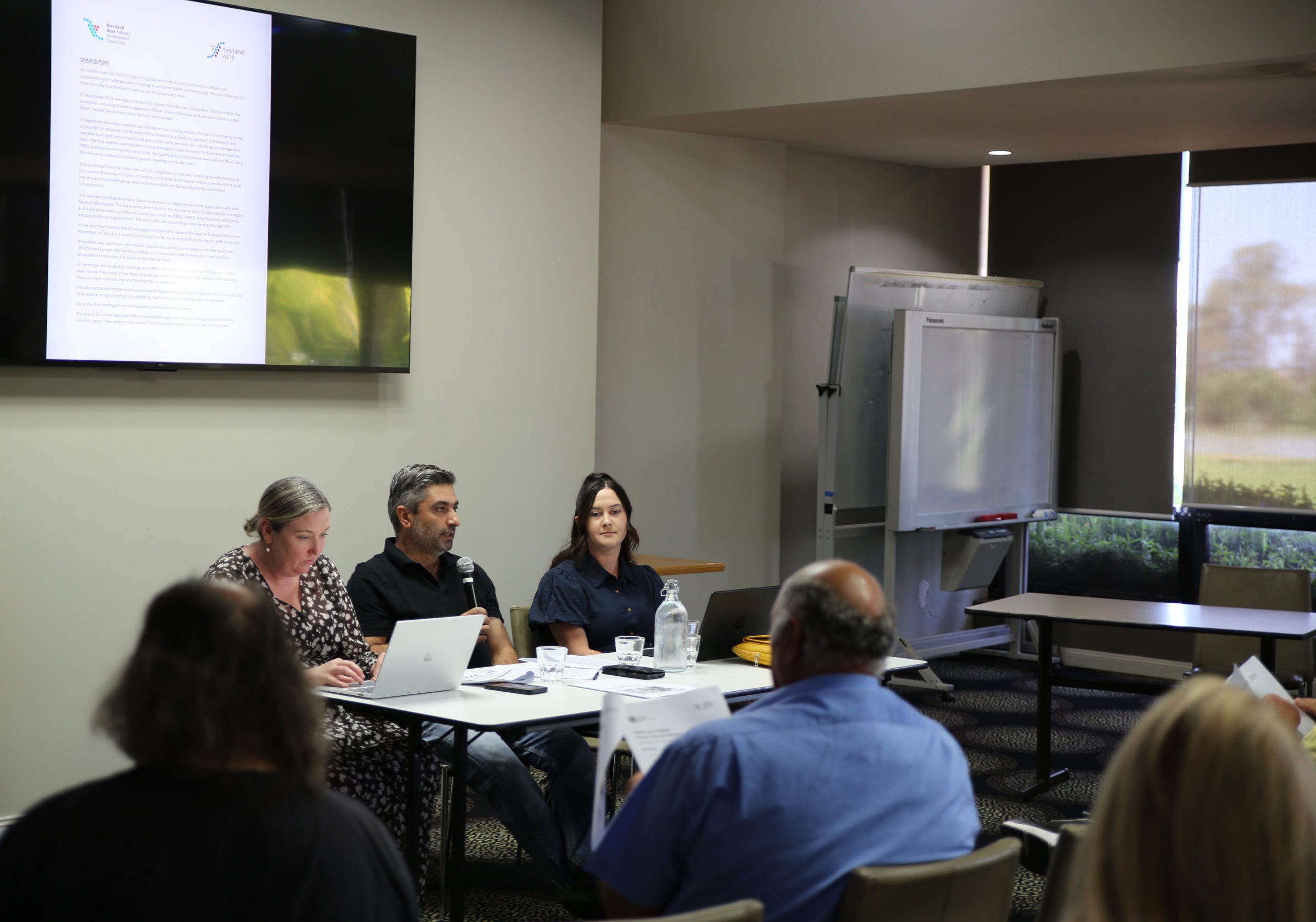
Photo: Alex Cannon-Leyson, Jim Markeas and Amanda Dimas at the Riverland Wine AGM in Berri yesterday
By Meg Riley in Berri
Concerns were voiced at Riverland Wine’s annual general meeting yesterday that certain wine industries overseas are receiving greater government support than the sector in Australia, and that therefore the international market for wine was “not a level playing field”.
“When you’ve got governments helping growers in countries like France, you’re actually not the same,” said one grower at the meeting in Berri. “That’s where we have to lobby governments more. We might have to take action so the governments can actually see that there is a big problem here, and some of that problem is because of their policies as well.
“We can’t sit back and say, ‘Oh, the government has no claim’ – they have a big role, because they’ve made a lot of money in this industry, and people can’t have worked for the last 50 years to see it all go down to dirt.”
The Riverland Winegrape Growers Association (RWGA) and Riverland Wine annual general meetings were held consecutively, reporting on the 2024/25 financial year operations and providing an opportunity for growers in the region to be heard. Beyond the procedural recapping of projects delivered in the past 12 months, the meetings also allowed for concerns to be brought to Riverland Wine and RWGA.
Jim Markeas, chair of Riverland Wine, explained the organisation’s approach to advocacy, and rationalised that parliament would already be aware of the struggles faced by growers.
“The tough thing is, you know, we’ve written letters,” said Markeas. “They [the State and Federal Governments] know the information. There’s enough industry boards out there asking for financial assistance for export, marketing, grants, and all kinds of things, for the last four years.
“We got hit with tariffs, COVID…there’s been a change in drinking culture […] people are drinking less, and it’s a worldwide issue. I think we all recognise that we’re probably not at the bottom of it yet. There’s still worse to come, but unfortunately, there’s only so much we can we do.
“[…] We’ve got no control in how they [the government] listen, or what they do during budgets and things like that. We’ve just got to keep telling our case, and that’s what we’re doing. Unfortunately, the reality is, we live in a free market.
“One thing that we’ve tried to really do with our insight meetings is give as much information, especially to our growers, because they’re a little bit further away from the market,” explained Markeas. “Because they deal directly with the wineries, they give them a great price, and that’s as far as they go. Whereas the wineries are dealing in international markets, domestic markets, dealing with importers, distributors, you name them; they deal with everything. So they have, I guess, a better understanding of the market.”
Markeas said that since its restructure earlier this year, the Riverland Wine board has listened to its members and increased its “hands-on” approach, with more growers’ meetings, survey activity, and communication to ensure growers are appropriately informed for the season ahead.
Amanda Dimas, chair of RWGA, also detailed the advocacy work underway in the region.
“The association has worked with the [Federal] Department of Agriculture, Forestry and Fisheries on the code of conduct, and have provided written a specific information where required,” she said. “We continue to advocate for support to diversify, exit and grow. We have advocated for this through communication with the state and federal governments, representation on Wine Grape Council SA board, representation on Inland Wine Regions Alliance board, communication with Australian Grape & Wine and communication with Australian Commercial Wine Producers.”
Dimas is no stranger to advocacy work herself – in fact, Daily Wine News first spoke with her in February 2024, when she launched the petition Save Riverland Wine. A Riverland local and vineyard owner, Dimas joined the RWGA in January this year, and has held the role of chair since July. It’s been nearly two years since she launched the petition, and yet conditions for growers in her region have only worsened.
“Being in the Inland Wine Regions Alliance, we’ve spoken to Murray Valley, Riverina – all our growers in all of our inland regions are struggling with the same issues,” said Dimas.
Photo: Riverland vineyards beside the Murray River. Winegrape growers across Australia’s inland regions are “are struggling with the same issues”
“It’s getting harder to put water on the vines because that’s a cost that’s just continually getting worse and worse.” This pressure, compounded with the difficulty to even find a market for the grapes, is completely crippling growers. “If it’s not $80/t for reds, there’s no way you can even pay for water,” she said.
“The early indicative pricing is anywhere from $80/t to $120/t – I heard a whisper of $150/t, but even so, if you have to lease in water for your property, that will cover just that. Don’t take into account fertilisers or preventative sprays or electricity, labour, or getting the grapes to the winery. It’s really tough. I keep telling all of our growers to keep looking out on each other. Growing grapes is what we do, but it’s not worth a life.”
“No one is better off than the next person. We’re all struggling. We’re all trying to keep relationships going, but so are the wineries. They’re trying to keep their relationships internationally, to hope that when this does settle, because it will, eventually – still many years away, that they’ll still have a home and a relationship there for wine.”
“If anything, more of your cooler climate regions are coming into a bulk market, where they are usually classed as premium.”
Although many growers in the region are aware of the need to reduce vineyard plantings in Australia, Dimas said that given the average age of growers in the Riverland, there is a physical barrier to vine removal, with removing the vines themselves often out of the question.
“My husband and I committed two years ago to removing our Shiraz, and we’re 32 [and] 35 – so very young, fit, but it was exhausting,” she said. “We also [removed] a patch on my father-in-law’s vineyard. And at 65, it was tough.
“And there are some growers out there that physically wouldn’t be able to remove their vineyards and would have to pay contractors to come in. And that’s at a cost of $7,000-$10,000 a hectare – who has that kind of money sitting in the bank after four years of below cost-of-production prices?”
Dimas said growers understand that plantings need to shrink, and would be open to planting other crops, but assistance is needed to make that adjustment.
“I would love to see some financial support for growers to diversify plantings, because we are in a region where you can plant almost anything,” she said.
“But in order to do that, there needs to be financial support, because the minute you tell a bank that you’re a grapegrower, you cannot get a loan.”
Beyond advocacy for the growers as a whole, Dimas also reiterated the importance of supporting growers individually.
“I urge you all to check in on a neighbour, friend, family member, to ensure not one grower in our community slips through the cracks during these difficult times,” she said.
Are you a Daily Wine News subscriber? If not, click here to join our mailing list. It’s free!
Dining and Cooking