
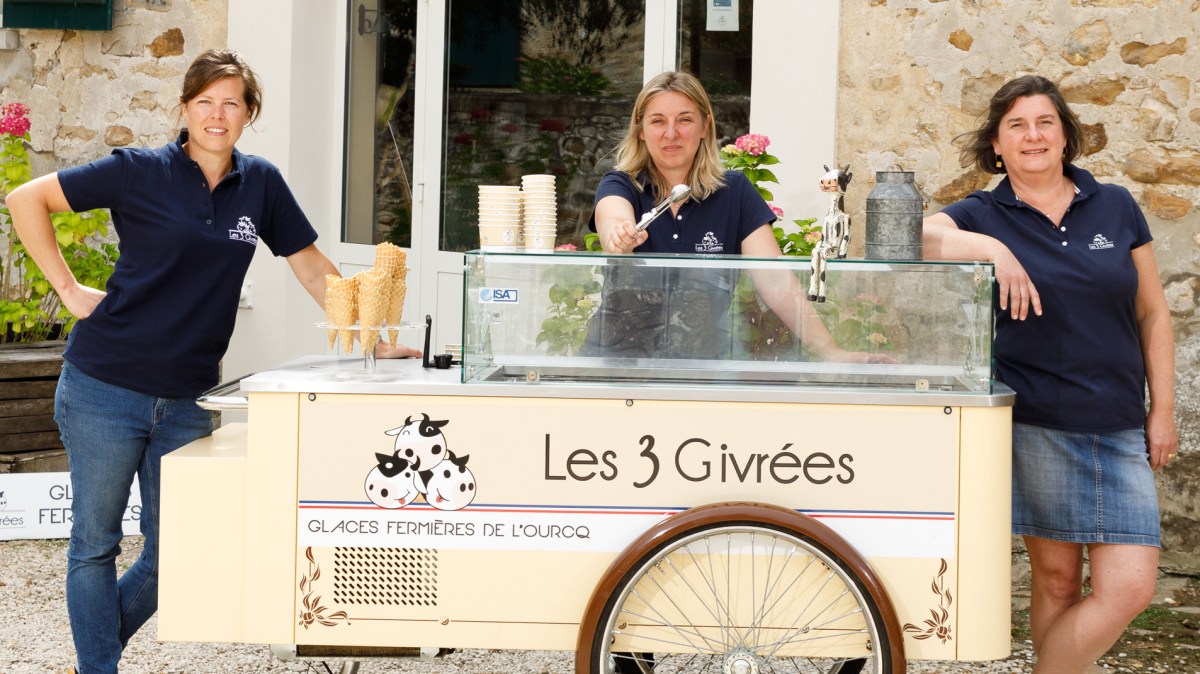
In the Seine-et-Marne département east of Paris, cattle used to have one overriding goal — to provide milk for the area’s most renowned product, Brie de Meaux cheese.
This is not the case today. In a move that dumbfounded traditionalists, three local women — Pauline Benoist, Emmanuelle Antoine and Alexandra Meheut — diverted a small proportion of the area’s milk into an ice cream making business.
With farming incomes falling, the band of farming entrepreneurs believe there is no point relying on crops and livestock alone to keep the wolf from the door. They decided to launch a range of ice creams that include brie cheese, mustard and beer flavours, along with more standard offerings like vanilla.

The innovative farmers have won local approval for their Brie, mustard and beer flavour ice creams
TEDDY HENIN
Benoist’s in-laws, who have farmed in the area for eight generations, were incredulous.
“They said ‘you’re mad’,” Benoist recalled, standing in a former cattle shed full of the freezers and mixers required for Les 3 Givrées, as the firm is called (the name being a play on words since givré has two meanings — frozen or crazy, depending on the context).
Today, however, Benoist, Antoine and Meheut have overcome resistance in order to sell their craft ice creams to people who visit the farm shop in the quaint village of May-en-Multien, as well as to restaurants and stores as far away as Paris.
They are not alone either. In the seven years since setting up, dozens of other farms have gone into ice cream making, notably in cattle breeding regions. With French dairy firm giants such as Lactalis buying milk for only about €425 per tonne, many farmers believe they can make a better living by transforming and selling it themselves.
On the whole, the dairy farm innovators have earned the grudging approval of professional bodies.
“At first we weren’t happy because they still had straw on their boots and what they made was disgusting,” Bruno Aïm, chair of the National Confederation of Ice Cream Makers of France, told Libération newspaper. “But today, they have the same standards as us, good laboratories and they make very good products.”
Despite receiving an annual €9.5 billion in subsidies from the EU, French agriculture is in crisis. Farmers blocked roads across the country to protest at declining incomes and proliferating red tape at the start of this year and the authorities in Paris are worried that the demonstrations could erupt again following the worst wheat harvest in about 40 years.

French paramilitary police with armoured vehicles face farmers and their tractors blocking a highway in January this year in Chilly-Mazarin, south of Paris
AP/CHRISTOPHE ENA
Gabriel Attal, the former prime minister, promised more than €400 million in February in the hope it would ease the brewing tensions. Michel Barnier, his successor, is already under pressure to spend some more of taxpayers’ money this autumn.
But not all French farms are on the breadline. In 2021 a study by the National Institute for Statistics and Economic Studies found that the average family of farmers had an annual disposable income of €52,400, although only €17,700 of this actually came from farming. The rest was generated by outside jobs or by developing on-site activities.
Benoist, for instance, decided to diversify after heavy rain in the spring of 2016 led to a disastrous harvest in the Seine-et-Marne. “People said it was a one-off year but with global warming, every year now seems to be a one-off,” she said.
With her husband, she opened three gîtes on the farm, which are often occupied by tourists looking for calm after visiting Disneyland Paris, a 40-minute drive away. They also teamed up with other farms to invest in a biogas plant, which take farm waste and turns it into green energy.
“The idea is not to put all your eggs in one basket,” said Benoist.
The cattle on Antoine’s farm contribute to the modernisation, 55 of them continue to provide milk for Brie de Meaux and five of them supply Les 3 Givrées.
The venture appears to be flourishing. During a visit from The Times last week, Mirabelle plums bubbled away in a pot in preparation for one sorbet, while a pile of pears were waiting to be peeled for another.
Along the walls were freezers full of pots of ice cream Benoist was hoping to sell during what was expected to be one of the last hot weeks of the year. There was stracciatella, vanilla, rum and raisin, pistachio and their bestseller, salted caramel.
Les 3 Givrées has also developed a range of ice cream to appeal to locals. There is a brie cheese ice cream which is popular in the Seine-et-Marne and a goat’s cheese one, inspired by a nearby farm which makes a reputed crottin de chèvre. Connoisseurs say they can be eaten with a meal – some people enjoy cheese ice cream with red meat – or straight up in front of the television.
On special occasions, the firm churns out two additional flavours enjoyed by locals: beer and mustard. Unsurprising perhaps as the region boasts a brewery along with the renowned Meaux mustard.
Dining and Cooking