
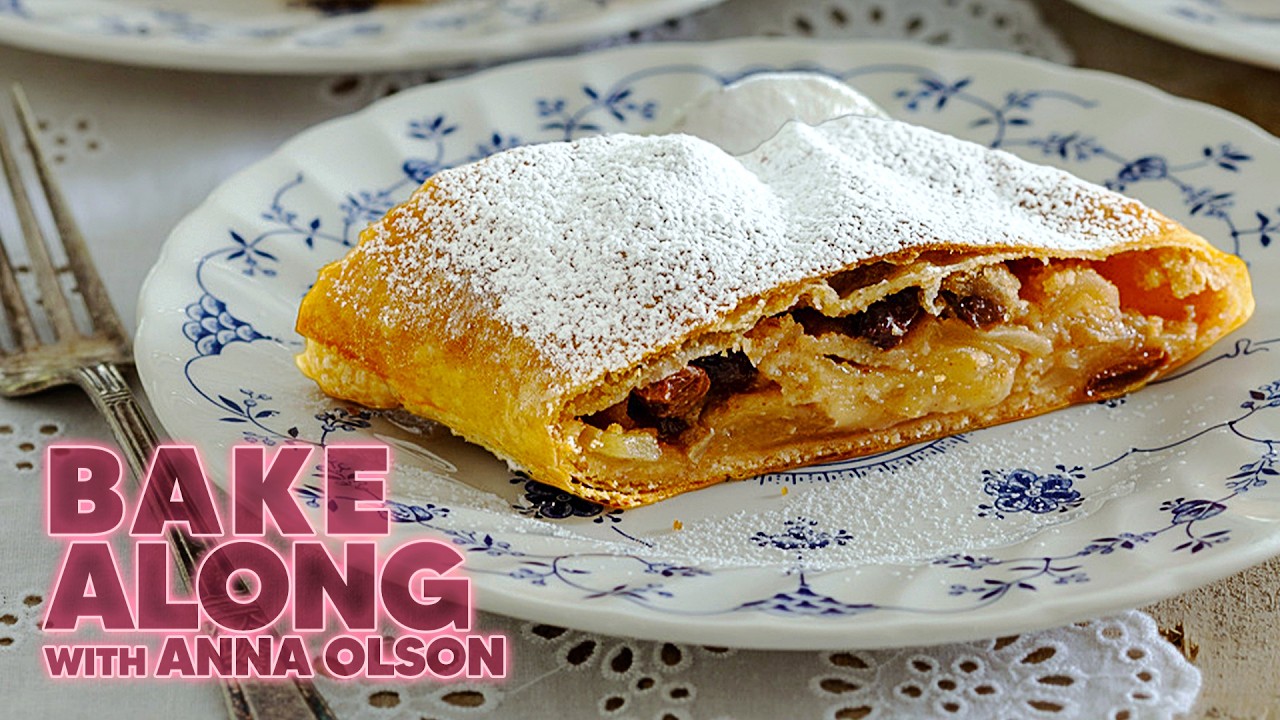
🍎 Faster to make than apple pie! Learn how to make authentic homemade apple strudel from scratch, no puff pastry and no store-bought phyllo dough required. This step-by-step apple strudel recipe uses the same amount of apples as a pie, and only half the sugar. If you’re looking to elevate your baking skills, this classic Austrian dessert is fun, impressive, and incredibly delicious.
——–
*• Recipe Info •*
Makes 1 strudel
Serves 8 to 10
This strudel is best served the day it’s baked, but can be stored, refrigerated for up to 3 days.
Notes
• You can make this dough ahead of time and chill it before stretching, but be sure to bring it fully up to room temperature before you start stretching.
• If the strudel dough starts springing back on you as you stretch, just walk away for 5 minutes. This will give the dough a chance to relax so that when you go back to it, it’ll stretch easily.
——–
*• Ingredients •*
Strudel Dough:
1 1/3 cups (200 g) bread flour
Pinch fine salt
½ cup (125 mL) warm water
3 Tbsp (45 mL) vegetable oil
1 tsp lemon juice
Apples:
½ cup (50 g) raisins
6 cups (900 g) tart baking apples (about 6 apples)
½ cup (100 g) granulated sugar
1 tsp ground cinnamon
Juice of ½ lemon
Assembly:
1/3 cup (75 g) unsalted butter, melted
2/3 cup (90 g) dry breadcrumbs
1 egg whisked with 2 Tbsp (30 mL) water, for brushing
icing sugar, for dusting
——–
*• Directions •*
1. For the strudel dough, blend the flour with the salt in a mixer fitted with the paddle attachment. Add the water, oil and lemon juice and mix on low speed until the dough comes together and then increase by one speed and knead for 2-3 minutes (the dough will seem sticky). Turn the dough out onto a lightly floured work surface and continue kneading until it has a smooth, elastic texture. Place the dough in a covered bowl and let it rest at room temperature for at least 1 hour.
2. For the apples, first soak the raisins in hot water while peeling and thinly slicing the apples. Drain the raisins and add them to the apples, along with the sugar, cinnamon and lemon juice, tossing well.
3. To assemble, preheat the oven to 375 °F (190 °C). Lay a clean tablecloth out over your work surface and dust it evenly with flour. Place the strudel dough in the middle of the tablecloth and with your hands or a dusted rolling pin; spread the dough out as far as you can. Now switch to only using your hands (and keep them dusted with flour) and pull and stretch the dough from underneath, using the back of your hands, until it is almost transparent (it’s alright if a hole pops up here or there).
4. Once stretched as far as it can, brush the entire surface of the dough gently with butter (or spread it with your hand). Sprinkle the dough with breadcrumbs halfway, then spoon the apple filling over the breadcrumbs. Trim away the end pieces of dough and, using the tablecloth for leverage, lift and roll up the strudel dough loosely and quickly. Use the tablecloth to lift it onto a parchment-lined baking tray (you can curve it, if it is bigger than the tray) and pinch the edges to ensure the strudel is sealed.
5. Brush the top with egg wash and bake for about 45 minutes, until it is a rich golden brown. Allow the strudel to cool for at least 20 minutes before slicing, and serve each slice generously dusted with icing sugar.
Hello bakers. Are you up for a challenge? I know you are because I’m going to walk you through the step by step to make delicious, truly authentic apple strudel. Yes, we’re not using pre-made filo dough or puff pastry. I am making the stretchable dough. And that’s where I’ll start with this recipe. Now, the ingredients are simple. I’m going to start in the mixer and then finish kneading this dough by hand. First, you want to use bread flour as opposed to allpurpose flour. It’s got a higher protein content, so it’s going to bond together when it’s time to stretch the dough. It’ll stretch easily and effortlessly. If you’re making sourdough at home, then I know you’ve got the bread flour. I will add a little bit of lemon juice. I’m just going to add it to my hot water, which is another key ingredient. You want to use hot, not boiling water, but just hot from the top, which is really going to help hydrate the flour quickly and allow those protein bonds to meet. The lemon juice also does the same thing. It loosens those strands so they become elastic, join together, and hang on to each other. I also add a couple tablespoons, three to be exact, of vegetable oil. I used to use melted butter when I made strudel dough, but I find because you want to work with this dough at room temperature and keep it really pliable that I have better luck using um a neutral oil. Just a pinch of salt. And now I’m using the paddle attachment as opposed to the dough hook and combining the dough until it just kind of sticks and grabs onto the paddle itself. I find doing this step, even though it only mixes for about 2 minutes, cuts back on your hand kneading by about 5 minutes. Okay. When you see that dough come together and start slapping along the sides of the bowl, then you know it’s ready to take out of the mixer. You really want to connect with your dough, which is why I like to finish kneading it by hand. You’ll find as you’re kneading the dough, you won’t have to add any flour or a minimal amount. And this is not like kneading bread dough. It’s got a just a loose stretchiness to it. And I’m just moving it back and forth. I’ll rotate it and give it a few minutes. And you will feel under your hands it grow more and more elastic and more and more smooth. So right now it’s coming along well, but you can see there’s an uneven texture to it there. It’s easier to see if I just set it down. That tells me it still needs a little more kneading. Does it sound crazy for me to say that making apple strudel is actually well in my mind easier than making apple pie? Now mind you, I have a great pie dough recipe and it is buttery and flaky and delicious. But if you’re nervous about making a pie pastry, a stretchy strudel dough, so long as you give it enough time to relax, is actually faster to make than an apple pie. And I hope this works out well or I’ll be eating my words. Now I can feel the dough smoothing out under my touch. Let’s take a look at it now. See, it has less of a pucker to it. And see how it’s starting to stand up. Even if I flatten it, it’s kind of got a springiness to it. So, that’s what we want initially. This the protein strands bonding together and hanging on, but they’ll need time to relax, too. They’ll stay bonded together, but if we try to stretch the strudel dough now, we would just end up with a mess. It would spring back, develop holes too quickly. That’s not our goal. This is a very relaxing task. Okay, it’s got a beautiful springiness to it now and it’s sitting upright. You can pop this in an ungreased bowl, cover it well, make sure it’s sealed. Um, or you can wrap the dough in plastic wrap if you wish, but you have to give it a minimum of an hour to rest. Ultimately, I like to give it two hours. And I leave it in a warm place. Don’t put it in the fridge. If you want to make this dough ahead of time, you can wrap it and put it in the fridge, but you have to pull it out a good 2 to 3 hours to let it come up to room temperature. Um, it’s you want to work with it when it’s warm and flexible and pliable. So, let me set this aside and work on my apples while the dough rests. Making your apple filling is really, really simple. I’ve peeled and sliced my apples and I’ve also soaked some raisins. I like raisins in my apple strudel. If you’re not a raisin fan, you can leave them out, but I poured boiling water over them to let them plump up, drain the water, and then you can add that to your apples. I’ll add my sugar. What I like about the filling for apple strudel is it has half the amount of sugar that an apple pie would have because you don’t want to create so many juices that ooze through that thin strudel pastry. Um, but you dust the top with icing sugar. So, you don’t need a lot of sugar inside. I balance the sweetness with a little bit of lemon juice. And of course, we have to add some cinnamon. Just give this a little stir. Okay, I’m just going to set that aside because I need clear open space to stretch the strudel dough. So, I made this a reasonable recipe. This is not a batch that will stretch to cover this entire table. It um is enough. It will stretch at least to this point, hopefully very easily, but it makes a more modest portion. Of course, if you want to do the full multiple trays of apple strudel, you can double up the recipe. Nothing changes in terms of timing or technique, just your end quantity. Find yourself a tablecloth that you’re not emotionally attached to. It might get a bit of butter on it. And you want to cover your table. All right. I’m going to move my tray out of the way, too. And I’ve got my relaxed strudel dough. You can see how completely different it looks from when I first made it and it was all tight in a ball. It’s just It truly has relaxed. I have a little bit of flour here. It’s up to you. You can use bread flour or allpurpose. And I like to sprinkle a layer over the tablecloth. This tablecloth will go right into the wash after I’m done with it. And I put a little extra bit at the corners because if I can, I’m going to hook the stretch dough onto the corners to keep it in place as I’m stretching it. But I will start in the middle. Flour your hands. Flour the dough. There we go. Oh, it this is such a soft, flexible dough. And it can be easy to want to start at the middle and stretch out, but that’s the easiest part of the dough to stretch. But you’ve got all the thickness at the ends here. So, I take the time and start stretching the that first. Because as your dough gets thinner and thinner, it gets harder to stretch this. The flour is there just so it doesn’t get too sticky. You may find you get a couple of little holes around the edges as you’re stretching. That’s okay. You want to try and avoid holes in the center. That’s why I wait to stretch the center part last. And it is pulling from the center. You can actually start seeing. I like to pick a pattern tablecloth so you can see. And you know your dough has been stretched enough when you can actually see the pattern through the dough itself. Now I’m going to with the back of my hands, not the front, coax this to the end. Will it reach? Will it reach? Oh, we’re getting there. Patience is key. If you find you’re stretching it and you’re starting to get holes, if you’re going too quick, just small, gentle motions are key, just take a break, walk away, come back to it. It will relax as it’s sitting here, and it won’t dry out in a short amount of time. Okay. Deep breaths. So, I’m taking advantage of the edges of my workt here. If you don’t have that, then having an extra person comes in handy to hold one side of the dough. In a pinch, if I don’t have the edges of the table to use, I can use my flour bowl to weight it down. But just be careful you put lots of flour. You don’t want it to stick. Okay, we’re getting there. Just this last corner. Okay. And I don’t have thick pieces of dough waiting for me at the end. I see I have one patch here that’s not as thin and one patch here. So, I’m just going to go in gently and stretch. And this may be a strange angle. I’m going to come around the other side of the table just so I can loosen that up. You can really see how light it is. Oh, developed one little tear. Patch it up. There we go. Why am I whispering? I don’t know. Okay. So, this is You can see the pattern of my tablecloth through the dough. It is thin enough. I’ve got my melted butter ready. This gets brushed or rubbed along the entire surface of the strudel dough. So, if you’re in a hurry, you can just take your palm, but I’m going to be gentle with a brush. No, I’ve changed my mind. I’m more comfortable using the palm of my hand. It’s actually smoother than using a brush. So in in its own way, this is laminating the dough because now there was only that bit of vegetable oil, but between this and the breadcrumb layer, this is what’s going to create the separation as you roll up the strudel dough. Okay, now let me unbutter my hand. I’ll be right back. The breadrumbs are the next layer. And they don’t get sprinkled on the entire surface of the dough, just the half. And you’re going to put the apples on half, too. I’m using panko, but really any dry breadrumb will work just fine. Even if you have leftover cake crumbs or you’d like to use graham crumbs. I like the neutral breadcrumb, though. This too creates separation and at the same time the breadcrumbs also absorb moisture from the apples. So that way your strudel layers stay nicely crisp and tender. I’m going to spread the apples out over the breadcrumbs. Don’t worry if you see a little patch here and there. You don’t have to arrange them. They’re all going to get rolled together. Even though I rolled the dough as thinly as I could, I like to trim the short ends of the dough because this will get rolled into the strudel itself and it’s just a little too thick. But it’s not a lot of dough as you can see, so you’re not wasting much. And it gives me one last chance to stretch. Push that strudel dough to its limits. I really hope you give this recipe a try. It takes the first time to do it and question every step of the way, but with these guiding tips and the experience, you’ll gain that confidence. And I know you’ll be making this before you know it. Okay? And this is why you do the tablecloth. It does all the work. Now, the key is not to roll it tightly, but to just let it tumble. That way you build in some air gaps that keep the strudel dough flaky. And there it is. You can see some little air pockets in there. And then I take advantage of the tablecloth to lift it onto my baking tray. Now, clearly this is not going to fit in a straight line. And I don’t want to cut it in half because then you’ll have filling leaking everywhere. So, I’ll just lift it over and then give it a curved shape. There we go. It’s less fragile now. It was very fragile when it was a single layer. The apple. You don’t want the apple slices to poke through. If you can avoid it now and again, it ain’t there. It does happen. But just get it so that it can fit on your baking tray like so. And then I’ll use scissors. This was the the end pieces that are thick with dough now that they’ve been rolled on top of themselves. But I’ll just seal that shut. There we go. And this is almost ready for the oven. The last touch, brushing it with egg wash. An egg mixed with a tablespoon of cold water gives it shine. promotes browning, helps it crisp up a little bit. Okay, so you saw that real time right in front of your eyes. And this is already set for the oven. I’ve preheated it to 375 and it takes about 45 minutes to bake. You look for a nice rich even golden brown on the surface. Some of the juices and syrup might leak out of the strudel a little bit. That’s just part of what it does. Now to do a load of laundry. Ah, and here is the strudel out of the oven. And you can see the beautiful little pockets, the blisters, and you know that flakiness is built into your homemade strudel dough. I just I find this such a fulfilling thing to make. You do want to give this like an apple pie. Uh not it doesn’t take as long as an apple pie to cool, but at least 20 minutes. So that way when you slice it, the apples stay in place. but traditional to a strudel. A generous dusting of icing sugar. I’ll leave it up to you if you want to serve it Mitchlag with a big dollop of whipped cream. Actually made this apple strudel to make for Thanksgiving dinner. And I had set up a buffet with a mix of desserts. And what I did was cut individual portions and put them on a platter. So I leave that up to you. This doesn’t present as nicely as in portions, but it slices so easily. And look at that shatter. You’re getting that flakiness immediately visible. Lovely little portions. Oh, got a little sticky apple syrup here. Come on, pull away. There we go. Oh, you can see the thin thin layers. And take such pride. You deserve to take pride in this accomplishment because making apple pie and apple strudel each are definitely accomplishments. You can see that flakiness, the nice soft apple filling, not juices running everywhere, but a nice moisture to the apple. With the icing sugar on top, you’ll get that perfectly balanced sweetness. You can hear the crunch. See the flakes. Really truly, you deserve to feel good when you make this apple strudel. Perhaps for a holiday meal or when it comes to January and you have a little weekend time and want a baking project, take on the challenge of homemade apple strudel. It’s been wonderful baking for you today and I wish you a happy holiday baking season. I’ll see you again for another delicious recipe m so good. Icing sugar everywhere. Bye everyone.
21 Comments
So interesting. I had no idea how to make strudel.
Thanks Anna!
My husband is German and I’m sure he’d love for me to give this a recipe a whirl!
I love your patience with this dessert!🙋🏾
8:25 here we go😱
Can't wait to try, thank you!!
Thanks How long and how wide do you pull the dough too
This looks absolutely wonderful! 🍎🥐 Your step-by-step guidance makes authentic apple strudel feel so achievable at home, truly inspiring baking. I’m definitely trying this, thank you for sharing! 💛✨
Very nice recipe chef 👍👌👏, and a fantastic d
Have you got a Yule log recipe
Thank you Chef, I've learned so much today and would try making this even if I'm so scared that I might tear the dough, I just loved to watch how you do it with ease. Thank you again for sharing to us your recipe. With love from the Philippines ❤
This was one of the most amazing things I have ever seen. Great job.
Do the apples have to be peeled? Some say that the peel adds a nice texture to the apples. Nice video.
Can't wait to try it 🍎🍏🥧
Do we have to use the cloth can we do this on the counter?
I just got back from Salzburg, Austria and took a class making this dessert and its exactly as Anna is explaining the process. The end result for me was just amazingand delicious.
Oma would approve! ❤
Thanks Anna! I will definitely try this ❤
Yummy Yummy Yummy. Thank you Anna!
Delicious! 😊
Is it me or is she kinda getting sensual with the dough lol
Hi Ms. Anna can you do a bake along to make cinnamon sugar POP TARTS?
Thanks Anna can’t wait to try! Looks just like my Hungarian grandma’s recipe!