
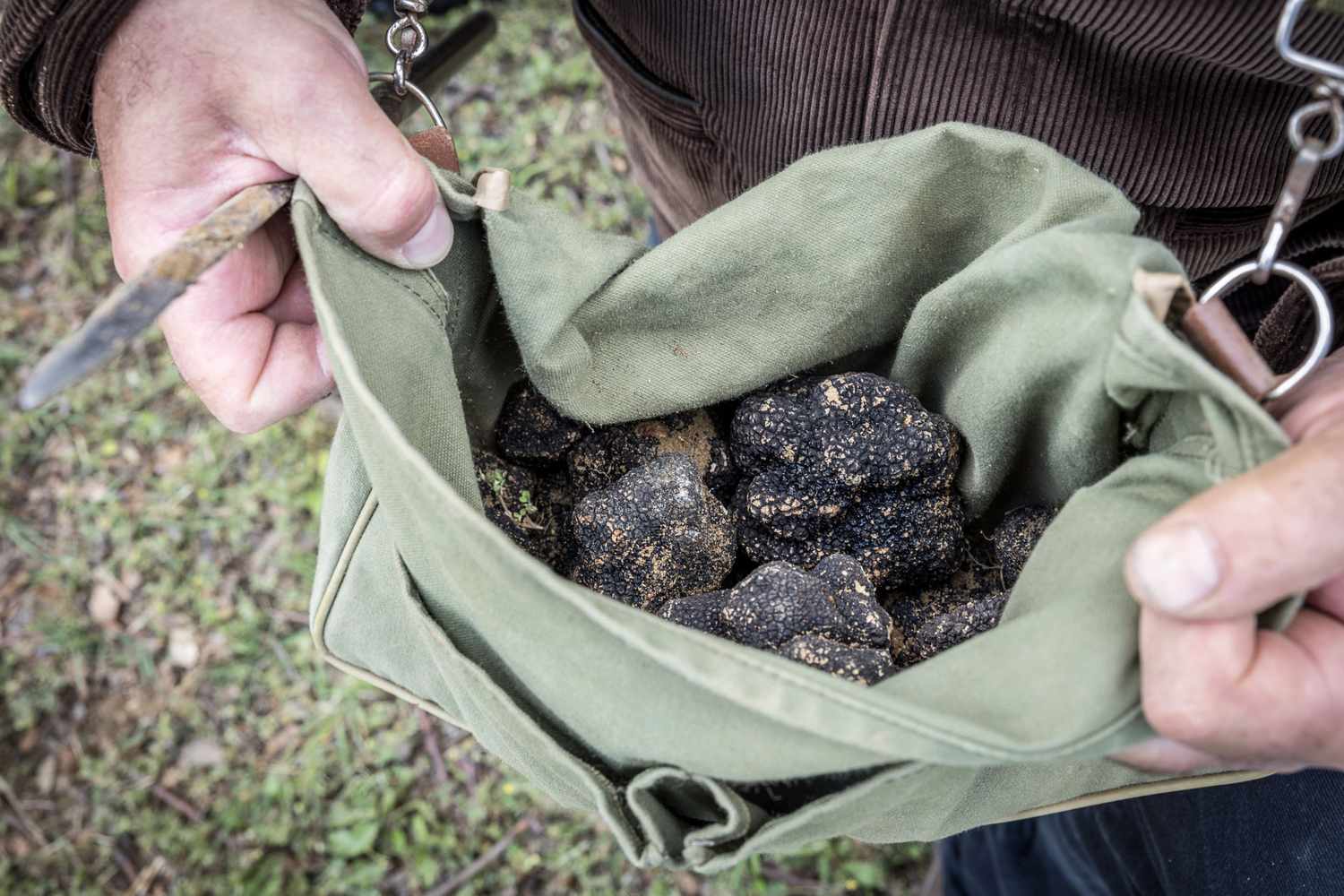
As a cook and an avid diner, I’ve become a little fixated on seeing where my food comes from. I’ve been fishing for halibut and salmon in Alaska, tasted my favorite bubbly in Champagne, walked the immense Parmigiano-Reggiano cheese caves in Parma, Italy, and visited a duck farm in New York’s Hudson Valley to see what the controversial foie gras process is really about. And as a food writer, I’ve donned more hairnets and disposable booties on factory tours than I can count.
Truffle foraging has long been on my culinary tourism bucket list, and the opportunity finally presented itself. On a fall morning in Ardeche Hermitage with no plans, sipping espresso at a sidewalk cafe while watching a woman play fetch with her large dog in the park across the street, I browsed a delightfully retro paper map and spotted Truffière La Baume Saint Antoine.
Once I knew truffling was an option, there was no going back. Dressed for an afternoon winery visit, I found myself on a spontaneous quest to a truffle farm in the idyllic Southeastern French countryside. I was nothing short of ecstatic.
Fifth-generation truffle farmers Karine and Franck Boissieux own Mason Boissieux. Their children, Emma and Lucas, have joined the family business and are primed to lead the truffle estate at Truffière La Baume Saint Antoine into the sixth generation.
I drove through seemingly endless green fields lined with bushy chestnut trees, up a pebble path to an old stone house with a rust-colored shingled roof, and an adjacent, more modern building that served as a visitor’s center full of antique truffling paraphernalia, with a dining room for guests.
Franck welcomed me, pushing open the heavy white wooden door that revealed the centuries-old truffle cave. He discussed the family history of Maison Boissieux, which dates back to 1870, while two very cute dogs, Lulu and Cecilia, vied for his attention and my eager pets.
Before we could gallivant into the fields, he pointed out a 1970s-era truffle washing device in the cave, where truffles are stored at low humidity and cool temperatures. This specific dark, rocky space has a deep history.
During World War II, the cave was used to store food for resistance fighters and served as a bomb shelter. Workers living in Romans-sur-Isère would sleep in the cave to avoid bombings, and then bike to work the next morning. Karine’s great-grandfather hid a Jewish Austrian refugee, 7-year-old Gitta Ryle, for two years to protect her from the Germans. Now 93 years old, the Holocaust survivor lives in California and is still close with the Boissieux family.
To be in a place with such a lauded and important history, a living testament to standing up for what is right and showing immense bravery in horrific times, felt surreal. I thought I was just hunting for the world’s priciest fungus with some cute dogs. This space was so much more than that.
Enlivened and a little bit emotional by the history, I am ready to hit the truffle fields. Unlike truffle hunting forests, seen in France, Italy, and even the Northwestern United States, this truffle farm has strategically planted trees under which the truffles grow. It’s not unlike an apple orchard in appearance. Colder months are better for truffle harvesting, but the dogs can sniff them out at any time.
After being unleashed in the open field, the dogs padded up the rows of trees, snouts to the ground, eagerly sniffing out gourmet ingredients. When they find one, they gently tap their paws, and perhaps more excitedly if it’s taking too long for a human to come dig up the truffle. Once a human comes with a shovel, the dog is rewarded with either a stick to fetch or a treat, and the instant gratification keeps the dogs wagging and sniffing until they’re whistled back to their handlers.
After observing the process a few times, Franck asked if I was okay getting my nails dirty (obviously), and let me dig up a truffle that Lulu tapped at under a shady branch. I used my hands to locate the small truffle and dug it up with just my fingers (novices can damage the truffles with a metal tool). The pros were not impressed with the walnut-sized treasure, though it smelled incredibly earthy and decadent, and I could envision how it would taste shaved on some buttered tagliatelle, so they let me keep my prize.
Guests at Truffière La Baume Saint Antoine can purchase fresh truffles priced by the kilogram at market price, about half or less what truffles cost stateside. Most of Mason Boissieux’s truffle harvest is exported to the United States, via the New York-based wholesale grocer Céline-Gourmet Attitude.
After the hunt (I could have stayed out there all day, but Franck had other guests coming in) and a good wash of my hands, I tried the fresh truffle shavings, as well as Franck’s homemade truffle ice cream, reminiscent of cookies and cream with shaved French black truffles instead of cookies.
Two hours prior, I was merely giddy to be experiencing a dog-centric travel wish I’d long dreamed about, but leaving the truffière, I’d found a whole new appreciation for how animals and humans can work together, and even more so how the world is so small and interconnected and unexpectedly joyful and delicious in so many more ways than we can ever imagine.
There is, in fact, a very good reason truffles are so expensive, and the truffle in my pocket was far more valuable than any I’d enjoy back home in New York.
How to truffle hunt at Truffière La Baume Saint Antoine
Maison Boissieux independently offers truffle discovery tours, including a visit to the truffle orchards with a truffle-centric meal afterward in the Rhône Valley about an hour’s drive south of Lyon, France. Groups of up to 20 people can also book private experiences. During peak truffle season, it’s recommended to book at least two months in advance. Visits start at 59€ (about $69) and can be booked online. Wear shoes that can get muddy. Free parking is available on site.
Dining and Cooking