
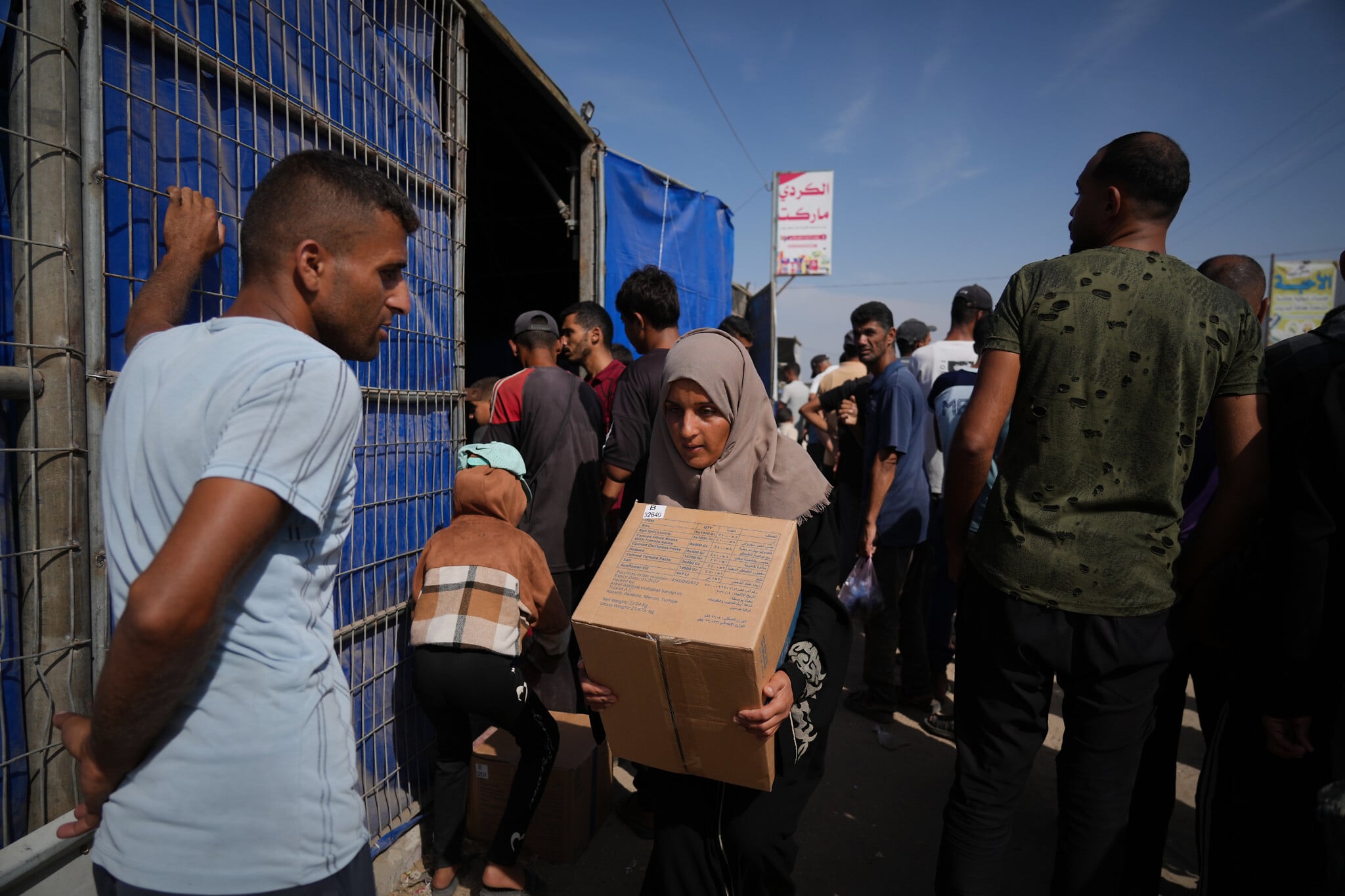
DOHA, Qatar — The deputy director of the United Nations’ World Food Programme says food security in Gaza has improved since a ceasefire came into place two months ago, even as the broader humanitarian situation remains dire due to a variety of unaddressed challenges.
“It’s clear that there are improvements, and the food security situation has stabilized… but other sectors are not making as much progress,” Carl Skau said in an interview with The Times of Israel on the sidelines of the Doha Forum earlier this month.
He pointed to continued IDF restrictions on dual-use items that Israel believes could be repurposed by Hamas, which have led to a lack of shelter materials in the Strip as the peak of winter approaches.
Hundreds of thousands of displaced Gazans face their tents and shelters being flooded by heavy rains, and materials for shelters and sandbags are not being allowed to enter the enclave, the UN International Organization for Migration said on Friday.
COGAT, the Defense Ministry agency that oversees humanitarian matters in Gaza, did not immediately comment on the claim, but on Tuesday said it was working “continuously to support a winter humanitarian response for the civilian population,” with 270,000 tents and tarpaulins shipped into the Strip and repairs made to critical infrastructure.
Get The Times of Israel’s Daily Edition
by email and never miss our top stories
By signing up, you agree to the terms
The US established a Civil-Military Coordination Center (CMCC) in Kiryat Gat, southern Israel, to monitor the ceasefire and serve as a hub to boost coordination on humanitarian aid distribution, but Skau said it hasn’t led to the resolution of problems regarding dual-use restrictions.
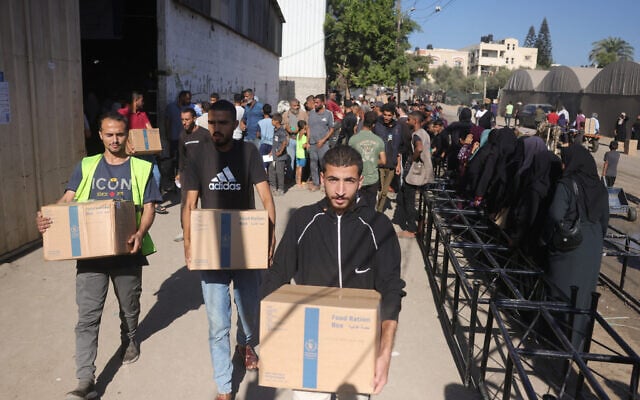
Food boxes provided by the World Food Programme (WFP) are collected by Palestinians at a distribution centre in the village of Al-Zawayda, in the centre of the Gaza Strip on October 27, 2025. (Photo by BASHAR TALEB / AFP)
“At the start, there was a lot of good energy in that and a lot of investment. WFP is represented there, but so far, it’s struggling to resolve problems,” he said.
While the amount of aid has improved significantly since the ceasefire came into effect on October 10, Israeli figures put the average of aid trucks entering the Strip each day at roughly 460 — well under the 600 benchmark stipulated in the truce deal signed by Israel and Hamas.
Roughly half of the trucks deliver humanitarian aid while the other half ferry in commercial products, with WFP responsible for as many as half of those each day. As Israel has boxed the UNRWA agency for Palestinian refugees out of the aid distribution process, WFP has become the primary organization responsible for food assistance delivery.
WFP aid recipients are required to register in advance and are able to collect aid from hundreds of distribution centers, soup kitchens, and bakeries by presenting special ID cards, allowing for a more orderly process that served 1.5 million people last month alone.
This system broke down throughout the war, as levels of aid trucks Israel allowed into Gaza plateaued. There were weeks-long stretches during which the vast majority of aid from WFP and other international organizations was looted. However, this phenomenon has subsided since the ceasefire, thanks to upticks in trucks entering and additional routes being opened for trucks to reach distribution points.
Skau said this shift demonstrated that the issues causing the looting were insufficient aid quantities and distribution routes, as opposed to widespread Hamas theft, which Israel faulted for the sustained humanitarian crisis.
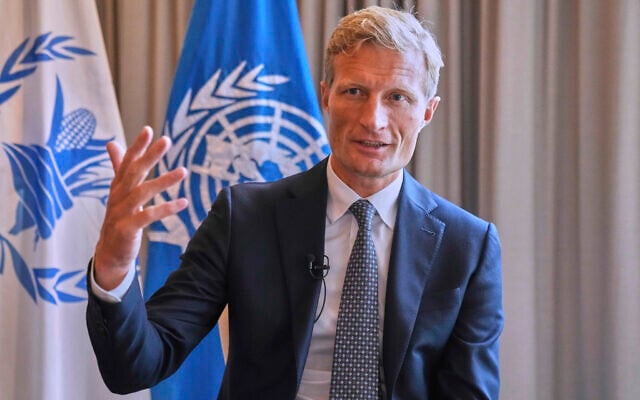
Carl Skau, deputy executive director and chief operating officer of the World Food Program, talks to The Associated Press during an interview in Bangkok, Thailand, Tuesday, Sept. 16, 2025. (AP Photo/Sakchai Lalit)
The WFP’s ID card system differed from the model adopted by the Gaza Humanitarian Foundation, which was established during the war but was forced to shut down after the October ceasefire came into place due to a lack of funds or broader support from the international community.
GHF operated three distribution centers, which required Gazans to walk long distances in order to pick up boxes of food. During the first couple of months of operation, recipients came under daily fire from IDF troops as they tried to reach the militarized sites.
While GHF’s director said in a farewell statement last month that his organization’s model was being adopted by the CMCC, Skau said he was unaware of such a development.
“They had a different approach in terms of also how they looked at security in that they used private security firm contractors, who ended up having to shoot at people.”
“We get our security from our engagement with communities, and it was important that we not mix those two approaches because that would put us at risk,” he said, explaining why WFP chafed at US pressure to collaborate with GHF.
“For us, it was troubling that it became a period there where humanitarian aid was seen as something you need to fight and run for,” Skau said, referring to the scenes at GHF distribution sites, which became a free-for-all where younger men benefited. The American organization did adapt, though, operating female-only distribution days.
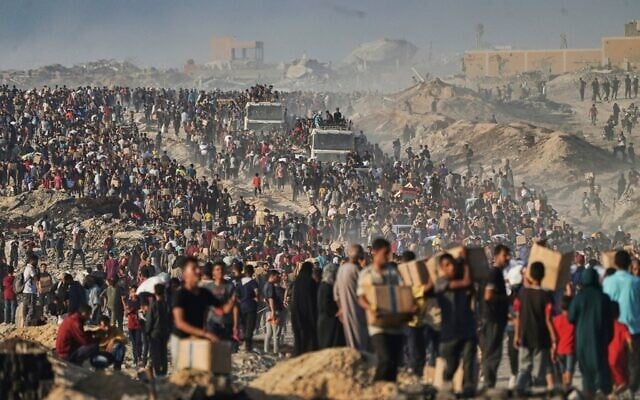
Palestinians carry away food and humanitarian aid from a World Food Program convoy that had been headed to Gaza City in the northern Gaza Strip, June 16, 2025. (AP Photo/Jehad Alshrafi, File)
Since the ceasefire, aid groups in Gaza have begun operating “temporary learning centers” for children to enjoy some degree of respite and routine. WFP provides meals to feed around 250,000 at these makeshift schools, which are also used to entice parents to send their kids there, knowing that they’ll be able to receive a meal.
While food has increased, Skau said the variety has still been limited due to Israeli restrictions. “What we’re seeing at markets is that there is food, but it’s not always the right kinds of foods. There are often lots of chocolate and Pringles, but fewer fresh fruits and vegetables,” which are essential for stabilizing the diet of a highly vulnerable population after two years of war, during which nutritional food was highly limited.
The WFP deputy director said his organization is urging Israel to allow for an increase in commercial goods, in an effort to revive Gaza’s private sector, which was largely devastated by the war as farmers and fishermen lost their assets. “This won’t cover their entire needs, but it’s an important way of also re-establishing a sense of normalcy.”
Skau also encouraged Israel to allow for the expansion of e-wallet use, so Gazans don’t rely on cash for food payments. Israel periodically limited the use of electronic payments due to fear that the system was being used by Hamas, but the WFP deputy chief argued that it is easier to monitor than cash.
You appreciate our journalism

You clearly find our careful reporting valuable, in a time when facts are often distorted and news coverage often lacks context.
Your support is essential to continue our work. We want to continue delivering the professional journalism you value, even as the demands on our newsroom have grown dramatically since October 7.
So today, please consider joining our reader support group, The Times of Israel Community. For as little as $6 a month you’ll become our partners while enjoying The Times of Israel AD-FREE, as well as accessing exclusive content available only to Times of Israel Community members.
Thank you,
David Horovitz, Founding Editor of The Times of Israel
Join Our Community
Join Our Community
Already a member? Sign in to stop seeing this
Dining and Cooking