
Winegrowers practice a profession that is very dangerous—and has already cost many their lives. Matthias Stelzig reports on the risks they face while working outdoors. A second article about the dangers in the cellar will follow.

Matthias Stelzig
Freelance journalist, author, and insider on all aspects of wine
If things go badly, it catches winemakers on their way to work. Especially during the harvest season, many drivers are annoyed by the slow tractor teams, in which the driver has hardly any all-round visibility. Risky overtaking maneuvers often end badly: A winemaker from Rheinhessen was returning from the bottling plant when the driver behind him became impatient. However, his car rammed the trailer during the overtaking maneuver, spilling 1,750 bottles of wine onto the road. In the Palatinate, the driver of a van tried to quickly pass a tractor and brushed against it while turning left. The vehicles tipped over—total loss.
The police in the growing regions have long recognized winemaker accidents as a category of intervention. However, the accident causes also include the farmers themselves: Overloaded trailers that become detached often have to be righted with a crane. Lost cargo falls under “winemaker black ice.” There are still fatalities and injuries.
In 2020, harvest helpers in a steep slope near Longen (Mosel) used a tractor with a winch to pull and load the grapes. Due to operator error, it rolled backward and fell 30 meters.
Police Directorate Trier
Fall in the steep slope
The greatest risk comes from accidents caused by winemakers themselves. The out-of-control fire, in which a winemaker from Baden set himself on fire in the vineyard and had to be flown to the hospital, is more of an isolated case. However, tipping machines are perhaps the greatest danger: Anyone who gets under a ton-heavy harvester has a survival chance of zero.
Viticulture is a very labor-intensive form of agriculture: In Germany alone, there are an average of around 200 reported serious accidents and fatalities almost every year – while accident numbers in the entire agricultural sector, according to the Social Insurance for Agriculture, Forestry, and Horticulture (SVLFG), decrease every year. From a statistical perspective, hunters live more safely than winemakers.
It also affects big names: The famous Brunello winemaker Gianfranco Soldera died in a car accident in the vineyard, as did Johann Artner, one of the most prominent winemakers in Carnuntum, and in 2024, the Piwi pioneer Erhard Tutzer from South Tyrol. The winemaker and vine breeder, who supplied top wineries like Gaja and Antinori, fell four meters over a wall with his tractor and was crushed by it. The Mosel winemaker Ulrich Franzen from Bremm had a fatal accident in a similar manner in 2010 at Calmont, Europe’s steepest vineyard.
Post drivers also crush bones
Many machines used in viticulture also have a high potential for injury: Post drivers can, in the worst case, not only crush the wooden posts but also bones. Pneumatic and electric shears can unintentionally detach and cause serious injuries, harrows and choppers can fling vine parts and stones through the air. Soil cultivators and disc harrows with rotating blades and rollers continue to run even when hands and arms approach. Defoliation and harvesting machines may spare the grapes, but not the body parts of the winemakers.
Agricultural machines are also used for many years after depreciation, especially in financially weak operations. Often, the senior still works, who should take better care of himself. Thus, many factors come together that favor an accident.
Monorail cog railways are often the only way for winemakers in steep slopes to transport people, equipment, posts, and grapes.
Robert Thomson – Wikipedia
In steep slopes like those at the Mosel, winemakers often use vineyard crawlers. The tracked vehicle drives into the vine row from above and is additionally secured with a steel cable to the tractor that stands above the vine row. A brilliant invention for sloped areas with inclines of over 60 degrees, if it weren’t for the risks: The safety cable is subjected to extreme stress during work, its fibers or wires become brittle, especially the first meters behind the tractor. Many winemakers overlook this because the rest still looks inconspicuous. But when it breaks, it becomes life-threatening for those riding along. Accidents also happen with monorail systems: The single-rail cog railways transport people, equipment, and grapes over the steepest slopes. However, they are prone to technical damage due to carelessness as well as manipulation. For example, the police at the Mosel have documented several monorail crashes, where experts clearly determined: The cause was sabotage.
Narrow gauge with great risk
The most common cause of death, however, is the narrow gauge tractors. For the agile machines, there are numerous attachments in front, beside, and behind. This is why they are the all-purpose weapon in small-scale viticulture. However, when turning on slopes, they quickly reach their limits due to their narrow track width, and weight shifts from attachments worsen track stability.
“The greatest concerns are regions with difficult topographical conditions,” explains Dr. Erich Koch, spokesperson for the SVLFG. Because sloped areas are risk zones: In Europe, most are in Switzerland, Germany, Austria, France, and Northern Italy (South Tyrol), which is why experts from these countries have already organized entire conferences on machine safety to discuss the risks. One of the results: a driving safety training specifically developed for narrow gauge tractors in the field, which is “in high demand,” reports Koch. Because almost every winemaker who works outdoors has already survived life-threatening situations. However, they only talk about it, at most, among colleagues—these near-catastrophes do not appear in accident statistics.
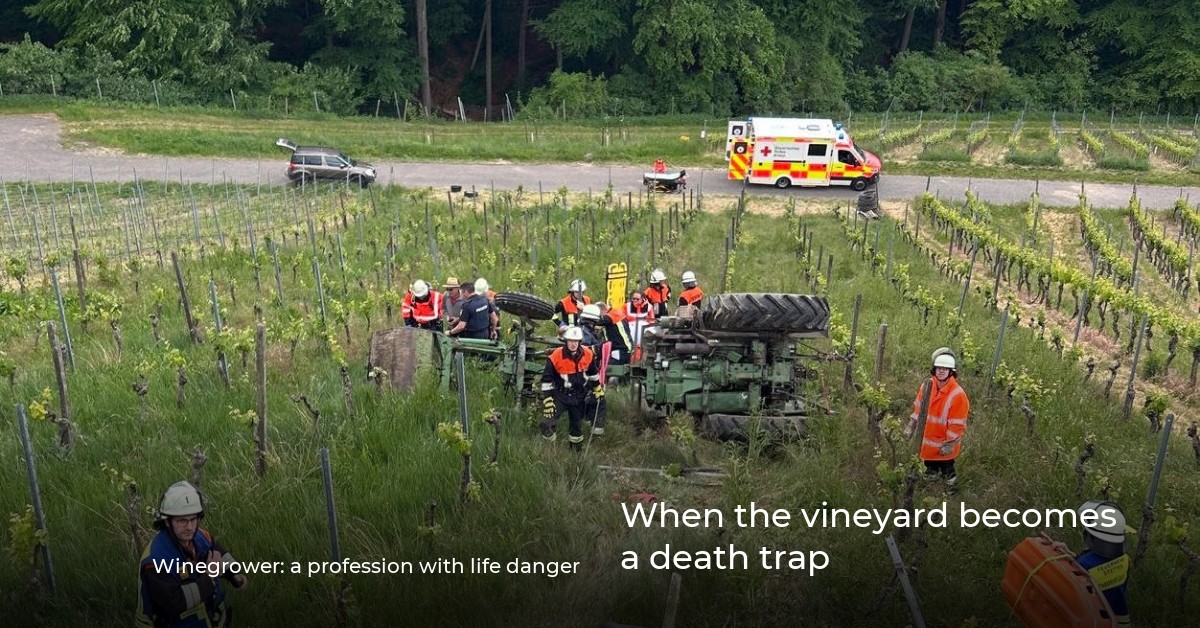
Once the balance is lost, especially at the upper end of a vine row, nothing can be done. With their weight, the tractors can tumble down into the valley onto the road. This happened in the Hohenlohe district (Württemberg) when a 74-year-old winemaker apparently forgot to engage the handbrake before getting off. The man tried to stop the tractor and was seriously injured in the process. The tractor rolled down through three parcels, tearing down vine wires and dragging them across the road. A 16-year-old motorcyclist fell and was also seriously injured. In Efringen (Baden), a vineyard tractor fell onto the tracks of the ICE. Fortunately, the approaching train was able to brake in time, and over 100 passengers narrowly escaped disaster. In May 2025, a winemaker fell with his tractor in the vineyard near Karlstadt (Franconia) (image above) and was seriously injured.
Also, sloping driving tracks, getting caught on metal posts, slippery ground, embankment edges, and wall collapses repeatedly become death traps for winemakers. Weather influences such as moisture, drought, or frost, as well as the greenery in the vine row, increase the danger. The circumstances of the accidents are often gruesome. Tractors can run over or crush their drivers. Newer tractors have become safer and are equipped with sophisticated improvements such as tipping cabins and emergency stop systems. However, even in less severe accidents, it can take time for help to arrive: Firefighters and rescue services must first locate the winemaker in the middle of the vineyard after the emergency call and then find a way to free, secure, and recover the injured—often a logistical and technical masterpiece in steep, difficult terrain. But too often, help arrives too late.
In the second part, Matthias Stelzig reports on the dangers that winemakers face while working in the cellar. The text will be published shortly.
Read more:
Dining and Cooking