
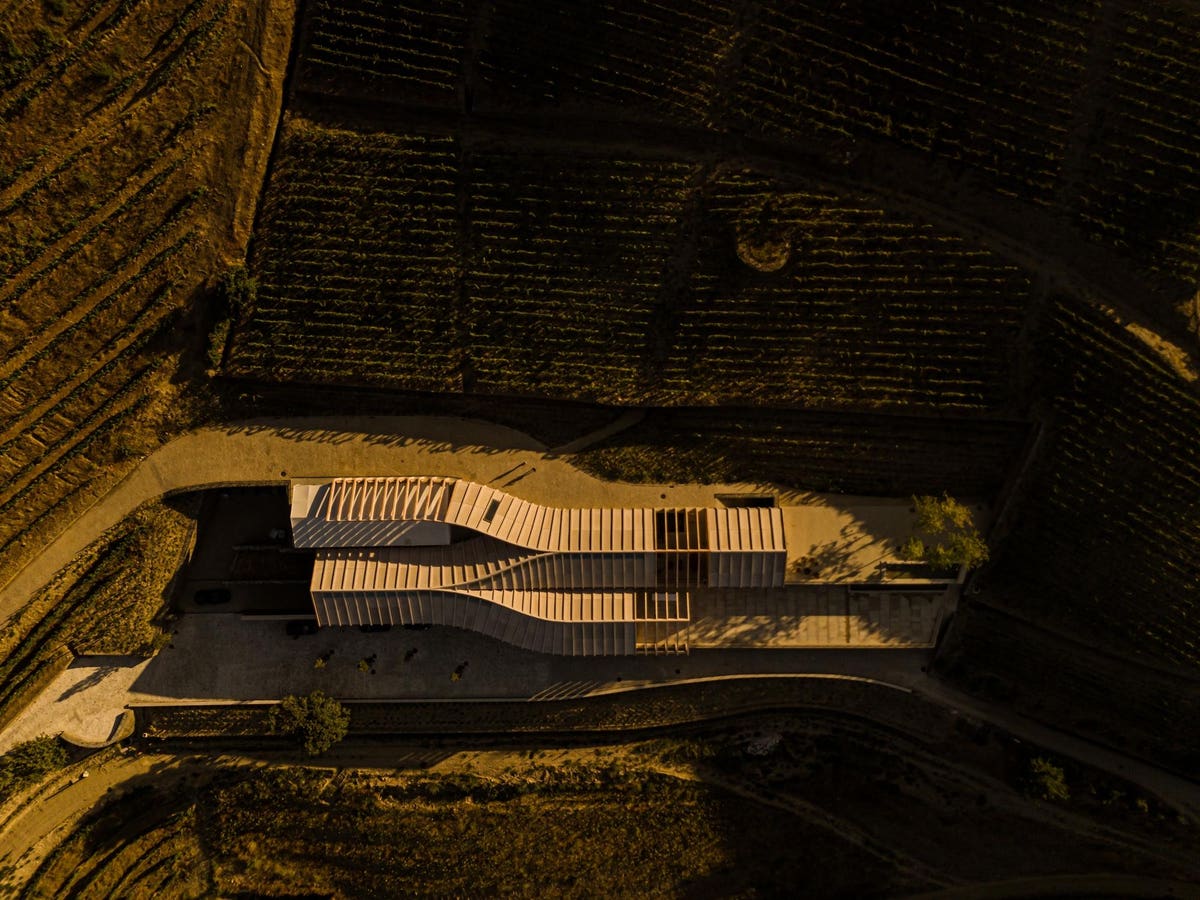
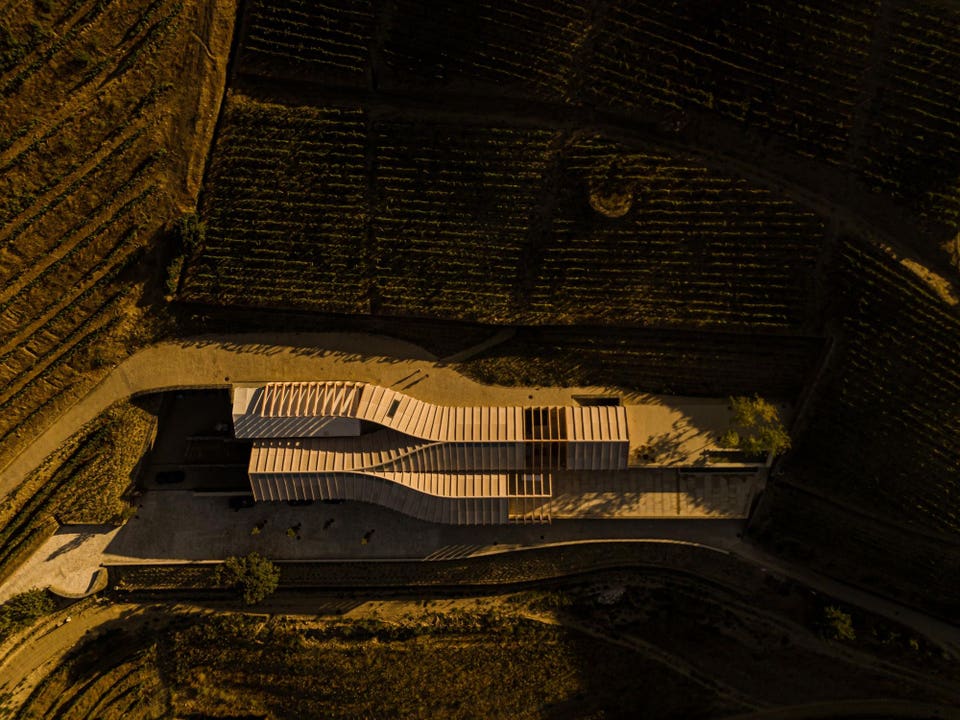
Conceived by Porto-based architectural practice Atelier Sergio Rebelo, the winery at Quinta de Adorigo has been designed to minimise environmental impact while blending in with its surroundings.
FERNANDO GUERRA
One of the oldest demarcated wine regions in the world and a listed UNESCO World Heritage site, the Douro Valley is a place of natural wonder and exquisite charm. However, preserving its inherent beauty is no mean feat, especially when balancing the maintenance of the existing architecture of its many Quintas and developing each to cope with the region’s growing popularity amongst an international visitor base. Added to this, thanks to the UNESCO restrictions in place, ensuring each development remains at one with its natural surroundings is of utmost importance.
With its architectural history deeply intertwined with the wine economy from the 18th Century onwards, the development of manor houses, wineries and warehouses, and the terraced formations of the vineyards themselves, have shaped the landscape as we know it today. Elongated facades follow the contour lines of the undulating hillsides while large sloping roofs and vast stone surfaces cast illusions that blur the boundaries between estates, hamlets and farmhouses.
Ventozelo Hotel & Quinta has been remodelled by architect Carlos Santelmo and recently received the Sustainable Wine Tourism Practices Award at the Best of Wine Tourism 2026 Awards.
Courtesy of the Municipality of Porto
For Carlos Santelmo, the architect behind the redesign of Ventozelo Hotel & Quinta, he says contemporary additions should never dominate or overshadow the original architecture. “It should contribute to a coherent overall reading,” he states, “and this can be established on several levels from form and scale to structure, texture and colour.” The recipient of the Sustainable Wine Tourism Practices Award at the Best of Wine Tourism 2026 presentation held earlier this year in Porto, Ventozelo is a great example of how heritage is being preserved through a contemporary lens. Boasting a 500 year history, the estate covers 400 hectares with 29 rooms spread across its seven buildings. Alongside the conversion of its original barns, the estate’s concrete spherical wine vats, known as baloes or balloons, have been transformed into standalone luxury suites.
“Ventozelo has a unique landscape,” explains Santelmo, “and nothing can truly compete with its grandeur so it is essential to establish this dialogue and to understand artificiality is something discreet and naturally embedded in the place.” Centred on respect for the environment, Santelmo’s approach is grounded on minimal intervention: preserving the terrain, reusing existing structures and working with local materials. “My aim is for architecture to become a natural extension of the landscape, achieved through scale, materiality, orientation and restraint,” he says.
Preserving the heritage of original buildings while blending in contemporary alterations is a key focus for Portugal’s architects, as seen here at Quinta do Vesúvio.
Courtesy of the Municipality of Porto
Over at Caso do Santo, the winner of the Architecture and Landscape category at the same awards, architect Luis Lima faced a similar challenge in preserving the existing structure of the farm caretaker’s house. “We preserved the stonework, proportions and patina as much as possible while adapting it to modern hospitality standards,” he reveals. “The key was subtlety. We introduced new interventions as “light touches,” using local materials and craftsmanship so that additions felt natural and almost inevitable.” Lima also explains how the main challenge was the integration of modern services such as lighting, climate control and accessibility. “Without disturbing the historical fabric of the building, it required close collaboration between conservation experts and contemporary designers, ensuring every decision was both respectful and forward-thinking.”
The original caretaker’s house at Caso do Santo was reimagined by architect Luis Lima.
Courtesy of the Municipality of Porto
Echoing Santelmo’s words, Lima says balancing heritage and innovation begins with respect. “It is about understanding the historical, cultural and emotional value of the building before any design intervention,” he comments, “and by identifying what must be preserved and where contemporary innovations can bring new life and functionality. Innovation is not about contrast for its own sake; it’s about creating a dialogue between past and present, where new elements enhance rather than overshadow the heritage fabric. Using contemporary techniques and materials in a sensitive way allows us to future-proof the space while honouring its original spirit.”
Sustainable design strategies are also core integrations into the development of these estates, with natural ventilation, green roofs and passive shading allowing the architecture to ‘disappear’ into the landscape, resulting in buildings that feel organic and not imposing. “In the Douro Valley, the landscape is not a backdrop, it is the essence of the project,” Lima says. “We design with the terrain, not against it, embedding structures into natural contours and using materials that blend with the vineyard textures and tones. Increasing capacity means working horizontally rather than vertically, distributing functions across the land in a way that maintains openness and visual harmony.”
For Porto-based architectural practice Atelier Sergio Rebelo, the creative masterminds behind the remodelling of the winery at Quinta de Adorigo in 2024, working in this way was of paramount importance. By creating a curvilinear structure to mirror the formation of the vineyards, the recently completed development seamlessly blends within its surrounding environment. While opting for locally-sourced concrete on some of its internal walls, the primarily wooden external structure, alongside schist and granite, has helped to reduce the building’s C02 emissions while replicating the natural palette of the valley’s ecosystems. And, with the exterior exposed to the elements, the materials will continue to evolve and age, much like the wine produced inside.
Alongside its efficient energy consumption, water conservation and considered use of resources, the development’s landscape design is also reviving native flora, helping to increase biodiversity while giving back to ecosystems that benefit vineyard health and promote economic activities that run parallel to the wine production. It’s this regenerative mindset, both environmentally and economically, that is contributing to the success of the region.
Thanks to the ingenuity of Atelier Sergio Rebelo, the winery at Quinta de Adorigo combines tradition with innovation and sustainability.
FERNANDO GUERRA
With the Douro Valley and Vinho Verde region both easily accessible from Porto, this sensitive approach to the built environment is one that is also mirrored across the city. “In Porto, the past and future meet in perfect harmony,” says Catarina Santos Cunha, the City Councillor for Tourism and Internationalisation at the Municipality of Porto. “The Municipality’s mission is to preserve the city’s remarkable heritage while embracing innovation and creativity. Through strict guidelines and careful planning, the historic character of buildings is protected, even as new technologies and contemporary uses breathe fresh life into the urban landscape. The city’s UNESCO World Heritage status stands as both an honour and a responsibility, ensuring that modernity enhances, rather than diminishes, the beauty of tradition.”
With this delicate balance perfectly portrayed within some of the city’s iconic landmarks, such as the recently restored Mercado do Bolhão, it displays how integral restoration and conservation is to preserving the heritage of a city while allowing it to meet the demands of its residents and visitors today. With the former Matadouro also under renovation and set to reopen in 2026 as a dynamic centre for innovation and culture, is the region’s architectural approach one we should all be paying more attention to?
The renowned Porto School of Architecture stands as a global reference for its distinctive approach, while it also remains the only city in the world that is home to two living and active Pritzker Prize winners, Álvaro Siza Vieira and Eduardo Souto Moura, reiterating its reputation of architectural excellence on a global stage. With such international recognition drawing design and architecture lovers from all over the world, Santos Cunha says the success is down to the deep, intuitive understanding of the city’s identity from local architects. “Collaborating with local architects ensures that Porto’s architectural transformation remains deeply connected to its sense of place and community,” she says, “while affirming the city’s position as an international model for sustainable, creative, and forward-looking urban developments.”
It is this local knowledge that is simultaneously helping to preserve the magic and authenticity of the wine regions too. “It involves understanding its history, its signs and meanings, making judgments and establishing hierarchies of importance,” says Santelmo. “A local architect carries an unconscious cultural assimilation of the territory and that can be a real advantage.” With local architects holding invaluable knowledge of the region’s climate, building traditions, regulations and cultural sensibilities, the result are projects that remain not only technically sound but also culturally resonant. “Collaboration with local teams creates architecture that feels rooted and not imported,” concludes Lima. “It also supports local economies and strengthens community ownership of the project. Ultimately, design that reflects the hands, minds, and materials of its place has an authenticity that no external perspective can replicate.” And, in witnessing the architectural sensitivity and organic charm of both the wine regions and Porto alike, I’m certainly inclined to agree.
Dining and Cooking